Flavius Josephus
37CE-100CE
- Born in 37CE, Josephus was not contemporary.
- The Jewish War was published around 75-79CE. Antiquities of the Jews was published around 93-94CE. Against Apion was published around 94-100CE.
- Josephus doesn't mention any Popes or apostolic succession. Even after residing in Rome after 71CE.
- Gospel similarities:
- His father's name was Matthias. In Aramaic his name would have been Joseph bar Matthias or Joseph ben Matthias in Hebrew. Which is similar to Joseph of Arimathea, a location with no external evidence for its existence.
- In The Life of Flavius Josephus, during the siege of Jerusalem he recognized three friends who were crucified. He went to Titus and asked for them to be taken down. Titus grants his request and provides them the best medical care. Two died while the third recovered.
- Josephus talks about the anointing process.
- While he does talk about how the anointing ointment is created and what it is used on, Josephus doesn't mention what the title of "Christ" means or how anyone gets the title of "Christ."
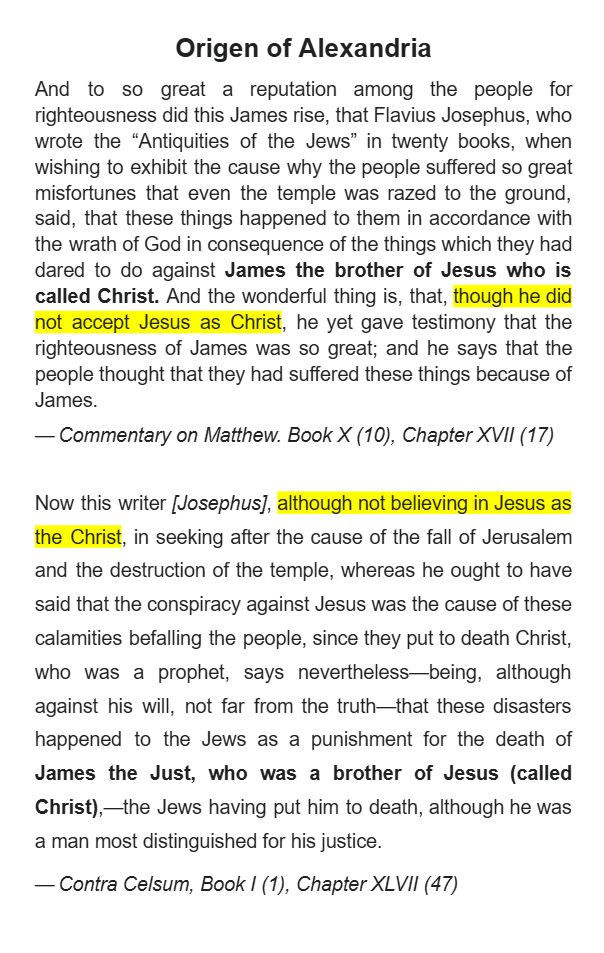
- Book 20.9.1 could have a rational reason for using the term Christ; in the Old Testament High Priests were anointed, and Josephus mentions it in his passage discussing how to make the ointment. This would have made the High Priest, Jesus son of Damneus a "Christ." but Origen's remarks (first image below) make the inclusion of the title unlikely.
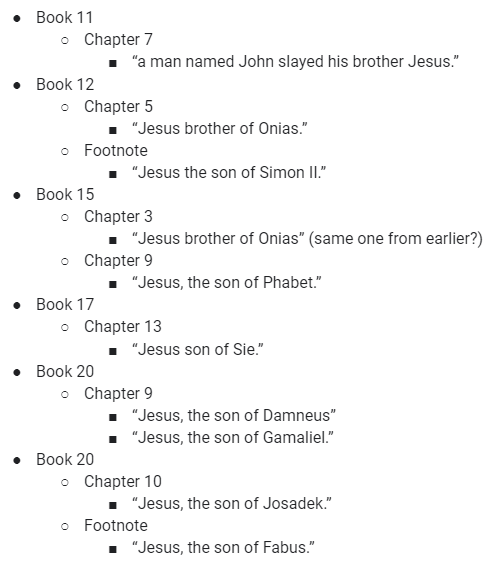
- Book 20.9.1 the phrase "brought before them the brother of Jesus who was called Christ, whose name was James." Josephus often references people through familial relationships, but if this was a reference to Jesus, Josephus would be talking about James through the relationship to Jesus who would have been dead for nearly 30 years. We are left with no explanation of the importance of Jesus in the passage, unless it's about Jesus who is also the son of Damneus. We have no examples of Josephus introducing someone by a long-dead relative that hasn't been introduced previously, isn't famous, or part of a dynasty or royalty.
- James the son of Damneus in book 20.9.1 doesn't face the same death as James the Just.
- According to Hegesippus (110CE-180CE), James the Just was thrown off a building, stoned when he survived the fall, and then a fuller's club was thrown at his head, ending his life.
- Hegesippus also notes that shortly after the execution of James the Just, Vespasian (9CE-79CE) besieged Judaea 67CE-69CE.
- Josephus' account of the son of Damneus in Book 20.9.1 happened around 61CE.
- Origen and Eusebius believe Josephus is writing about James the Just. However, there is a long standing debate over the identity of James the Just who is also known as James the Lesser and James Son of Alphaeus.
- On the Apostles and Disciples [Pseudonymous Hippolytus (165CE-235CE)] there are three different men named James.
- James, his brother, was beheaded by Herod. This would be the James referenced in Acts.
- James the son of Alphaeus was stoned to death and buried by the temple.
- James the Lord's brother, bishop of Jerusalem. As one of the 70 disciples, his manner of death isn't stated.
- It also says: Simon the Zealot, the son of Clopas, who is also called Jude, became bishop of Jerusalem after James the Just.
- This also lists Matthias as someone who took the 12TH place as an apostle, and as one of the seventy disciples.
- It doesn't mention Judas.
- There is debate over the identity of which James is which. Some tradition holds that James the Just is the son of Alphaeus and the Lesser.
- The book of John (written after Josephus' account of 61CE) explicitly says Jesus' brothers didn't believe in him.
- Book 18.3.3 is known as the Testimonium Flavianum. It is an interpolation by Eusebius. This isn't a new theory as phrasing unique to Eusebius is only present in the Testimonium Flavianum and the works of Eusebius. Stylometry provides additional evidence of its interpolation.
- Book 18.3.3 doesn't directly mention apostles or disciples. To paraphrase. it says he appeared again, alive, to the ones that loved him. Josephus never describes anything about them, name them in any way, or discuss any martyrdom they might have faced.
- In Josephus' other works he only uses the term "poietes" to mean poet. In the Testimonium Flavianum it is used to mean "doer" in the phrase "doer of great works." That use is consistent with Eusebius writings.
- Eusebius is the first person who quotes the Testimonium Flavianum. He includes the entire passage within Demonstratio Evangelica Book 3 instead of summarizing or paraphrasing it. He also makes the questionable statement: "And here it will not be inappropriate for me to make use of the evidence of the Hebrew Josephus".
- According to Louis H. Feldman, a surviving 5TH-6TH century table of contents for Antiquities doesn't include the Testimonium Flavianum.
- While the Arabic translation of Antiquities contains the Testimonium Flavianum, it differs in terminology. For example, instead of saying "For he appeared to them alive again, the third day" it says "They reported that he had appeared to them three days after his crucifixion and that he was alive; accordingly he was perhaps the Messiah" providing speculative hearsay.
- Christian authors before 324CE refer to Josephus' works, but none of them mention the Testimonium Flavianum.
- Origen of Alexandria
- * Hippolytus of Rome, his descriptions of the Essenes parallels Josephus' description in Jewish Wars. It's believed Hippolytus adapted Josephus directly.
- ** Sextus Julius Africanus a surviving fragment quotes books 12, 14, and 15 of Antiquities of the Jews (disclosure: I haven't found that specific fragment yet). That fragment is not to be confused with his reference to Herod's beother who is also named Josephus.
- *** Arnobius of Sicca mentions Josephus by name, but doesn't quote his works.
- Saint Photios the Great in the 9TH century wrote a review of Josephus' works. Still, he doesn't reference the Testimonium Flavianum. He does claim that Josephus wrote about the Massacre of the Innocents and the virgin birth of Jesus, but the scholarly consensus is that Josephus never wrote about those events.
- Richard Carrier mentions the works of Louis Feldman, G.J. Goldberg, Paul Hopper, Ken Olson, and Alice Whealey who support the claim that Eusebius created the interpolation.
- Additional scholars are listed here. The post points out additional evidence and sources supporting the claim.
Origen of Alexandria
A popular name
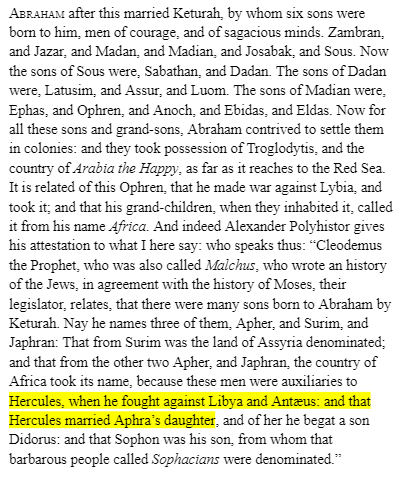
Hercules
Josephus Antiquities Book 18 Chapter 3 Section 3
3. Now there was about this time Jesus, a wise man; if it be lawful to call him a man. For he was a doer of wonderful works; a teacher of such men as receive the truth with pleasure. He drew over to him both many of the Jews, and many of the Gentiles. He was [the] Christ. And when Pilate, at the suggestion of the principal men among us, had condemned him to the cross; those that loved him at the first did not forsake him. For he appeared to them alive again, the third day as the divine prophets had foretold these and ten thousand other wonderful things concerning him. And the tribe of Christians, so named from him, are not extinct at this day.
Josephus Antiquities Book 20 Chapter 9 Section 1
1. [A.D. 61.] And now Cesar, upon hearing the death of Festus, sent Albinus into Judea, as procurator. But the King deprived Joseph of the High Priesthood; and bestowed the succession to that dignity on the son of Ananus, who was also himself called Ananus. Now the report goes, that this eldest Ananus proved a most fortunate man. For he had five sons, who had all performed the office of an High Priest to God; and who had himself injoyed that dignity a long time formerly: which had never happened to any other of our High Priests. But this younger Ananus, who, as we have told you already, took the High Priesthood, was a bold man in his temper, and very insolent. He was also of the sect of the Sadducees: who are very rigid in judging offenders above all the rest of the Jews: as we have already observed. When therefore Ananus was of this disposition, he thought he had now a proper opportunity [to exercise his authority]. Festus was now dead; and Albinus was but upon the road. So he assembled the sanhedrim of judges, and brought before them the brother of Jesus who was called Christ, whose name was James: and some others; [or, some of his companions.] And when he had formed an accusation against them as breakers of the law, he delivered them to be stoned. But as for those who seemed the most equitable of the citizens, and such as were the most uneasy at the breach of the laws, they disliked what was done. They also sent to the King [Agrippa,] desiring him to send to Ananus that he should act so no more: for that what he had already done was not to be justified. Nay some of them went also to meet Albinus, as he was upon his journey from Alexandria; and informed him, that it was not lawful for Ananus to assemble a sanhedrim without his consent. Whereupon Albinus complyed with what they said; and wrote in anger to Ananus; and threatened that he would bring him to punishment for what he had done. On which account King Agrippa took the High Priesthood from him, when he had ruled but three months; and made Jesus, the son of Damneus High Priest.