The Gospels
Mid 2ND century
Issues
- The Gospels are anonymous. The authors don't identify themselves.
- Mark supposedly was the interpreter of Peter, but never met Jesus.
- Luke supposedly was a companion of Paul.
- Paul never knew or met Jesus.
- According to Acts 4:13, both Peter and John were illiterate.
- The Gospels were named by Irenaeus of Lyon ~180CE. If his naming was correct we run into an interesting problem. Matthew borrows from Mark, which is akin to writing about a personal friend but borrowing details from someone who never knew your friend.
- Jesus didn't fulfill any prophecies. The 300+ prophecies often cited, weren't fulfilled.
- Matthew 2:6 references Jesus coming from Bethlehem in Micah 5:2 (5:1 in some editions) but the verse is to Bethlehem Ephrathah, an individual in the small clan of Bethlehem. It also neglects the rest of the passage where the subject is supposed to rule Assyria with the sword, which Jesus didn't fulfill.
- Matthew 2:15 references Hosea 11:1 but neglects Hosea 11:2 where offerings are made to Baal.
- There's no evidence for a custom of governors releasing a prisoner on Passover. This detail is only in the Gospels and nowhere else.
- Psalms 22 does not talk about Jesus. The most accurate translation is from the NRSVUE and it doesn't mention piercing. It's also not a prophecy because it is not written in future tense.
- Pontius Pilate was not known to succumb to crowd pressure. In Josephus' works The Jewish Wars Book 2 Chapter 9 Section 3, Pilate hides soldiers in the crowd and has them attack and kill people on his command. It's also mentioned in Antiquities of the Jews Book 18 Chapter 3 Section 2. Additionally, in Antiquities of the Jews Book 18 Chapter 4 Sections 1-2 Pilate orders more violence upon the people and was eventually removed from his position for his actions in 36CE.
- Origen of Alexandria argues for the spiritual, allegorical interpretation of Scripture in De Principiis Book IV: Since, therefore, as will be clear to those who read, the connection taken literally is impossible, while the sense preferred is not impossible, but even the true one, it must be our object to grasp the whole meaning, which connects the account of what is literally impossible in an intelligible manner with what is not only not impossible, but also historically true, and which is allegorically understood, in respect of its not having literally occurred. For, with respect to holy Scripture, our opinion is that the whole of it has a spiritual, but not the whole a bodily meaning, because the bodily meaning is in many places proved to be impossible.
Contradictions
- Jesus birth:
- Mary is pregnant in Luke 1 and Matthew 2:1 during Herod the Great (72BCE-4BCE)
- Luke 2 says Mary is still pregnant when Cyrenius/Quirinius (51BCE-21AD) was governor of Syria. Quirinius was appointed in 6CE.
- 4BCE to 1BCE = 4 and 1CE to 6CE = 6. That's a difference of around 10 years.
- Matthew 2 mentions Joseph's vision and flight to Egypt. Luke 2 has them go to Jerusalem for purification, where Herod was allegedly killing the firstborn (according to Matthew; this event isn't recorded anywhere else) and then back to Nazareth.
- If Jesus was born during the census in 6CE and Luke says he was about thirty years old, he would have started his ministry around 36CE and died in 39CE. This is a problem because Pontius Pilate returned to Rome in 36CE and died in 39CE.
- Nazareth
- Matthew 2:23: States Joseph fled to Nazareth, fulfilling what the prophets foretold "He will be called a Nazarene."
- John 1:46: Quotes Nathanael "Can anything good come out of Nazareth?" Indicating the author of John was unaware of the prophecy.
- Nazareth and Nazarene are not found anywhere in the Old Testament. There is no known prophecy that Matthew is speaking of.
- Jesus genealogy:
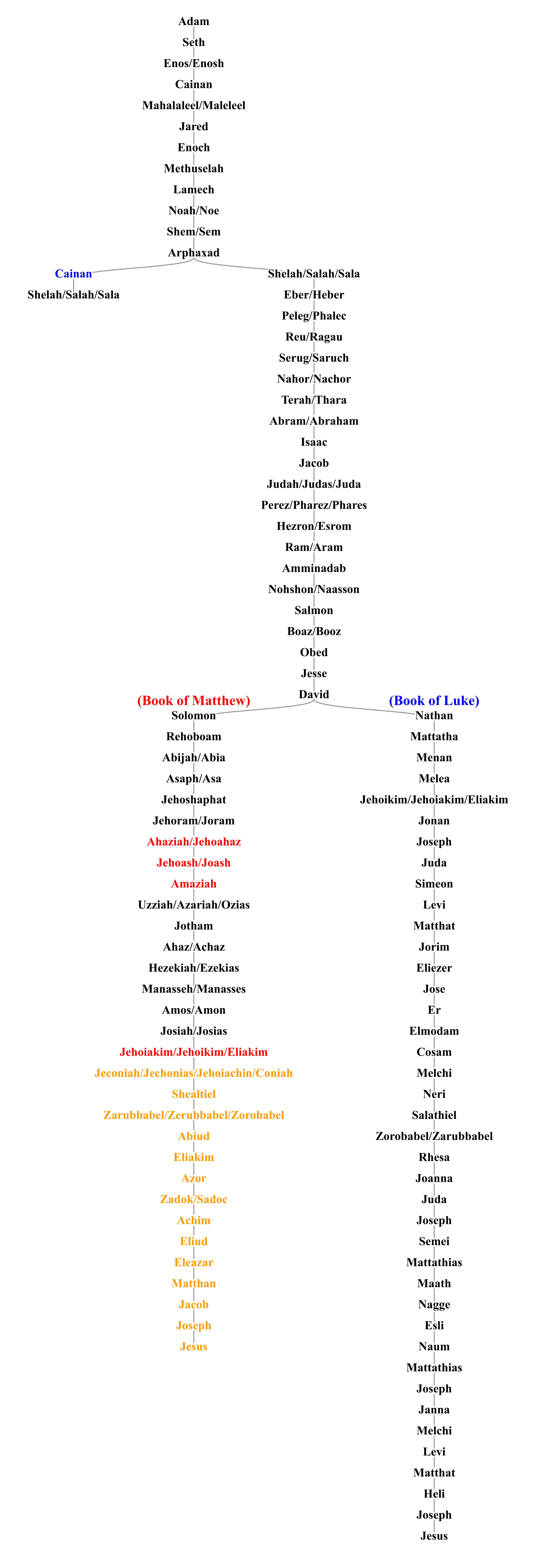 Color coding: Orange: Jeconiah cursed lineage, Blue: Person missing from Luke's account, Red: Person missing from Matthew.The claim that one of the genealogies is for Mary is mistaken. Mary's parents Joachim and Anne are listed in the Protoevangelium of James.Numbers 1:2-4 and throughout the rest of the book and Bible utilize patriarchal lineage.Joseph wasn't biologically related to Jesus. It would only be a paper relationship and not a bloodline relationship.Since Joseph wasn't the father, Jesus satisfies the misbegotten/illegitimate birth conditions of Deuteronomy 23:2.Inheritance laws didn't not apply equally to adopted children, and was only recently legally recognized.It wasn't until the Mishnaic/Talmudic period near the second century that a person was considered Jewish through the matrilineal line. This is still observed in conservative and Orthodox communities.
 - Jesus death & burial.
- The day Jesus was crucified:
- Matthew: The day after preparation.
- Mark, Luke & John: The day of preparation.
- The hour Jesus was crucified:
- Who carried Jesus' cross:
- Matthew, Mark & Luke: Simon of Cyrene.
- John: Jesus carried his own cross.
- Mocking criminals:
- Matthew & Mark: The thieves mocked Jesus.
- Luke: One of the thieves mocked Jesus, but the other repented.
- Last words:
- Matthew & Mark: Jesus cried out before dying.
- Luke: "Father, into thy hands I commend my spirit." before dying.
- John: "It is finished." before dying.
- The Darkness:
- Passover happens during a full moon. Only a lunar eclipse is possible during a full moon because the shadow of the Earth is cast onto it, making them visible at night. For darkness to happen during the day a solar eclipse during the "new moon" phase is required and that isn't possible during Passover.
- Jesus allegedly started his ministry during the 15TH year of Tiberius Caesar's (42BCE-37CE) reign which started in 14CE. Meaning Jesus started his ministry in 29CE. A solar eclipse was visible in Jerusalem in November of that year but it only lasted 1m59s.
- A total solar eclipse did take place on Sunday March 19TH 33CE but it wasn't visible in Jerusalem and it wasn't during passover.
- A lunar eclipse occurred on April 3RD 33CE which people point to as the darkness during the crucifixion. However, it wasn't during the day and it was not a total lunar eclipse. It was only a partial lunar eclipse, but it lasted nearly 3 hours.
- Who was at the Tomb:
- Matthew: An earthquake happened, an angel came down and rolled the stone away, then sat on it, while Mary Magdalene and the other Mary were there.
- Mark: Mary Magdalene, Mary the mother of James, and Salome saw that the stone was already rolled away.
- Luke: The stone was already rolled away but it was Mary Magdalene, Joanna, Mary the mother of James, and other women that were there.
- John: The stone was already rolled away and it was only Mary Magdalene who was there.
- Contents of the Tomb:
- Matthew: The angel tells both women to look and see that Jesus was not in the tomb, it doesn't say if they looked, just that the women departed.
- Mark: A young man was in the tomb.
- Luke: Two men in shining garments were in the tomb.
- John: Mary ran to tell Peter and an anonymous disciple that Jesus was taken. The anonymous disciple looked first, but both he and Peter only saw linens in the tomb, and then they went home. When Mary looks into the tomb, she sees two angels, and then she sees Jesus but doesn't recognize him.
- The day Jesus was crucified:
- Death of Judas:
- Matthew 27:3-5 says Judas hung himself after throwing the money down in the temple.
- Acts 1:16-19 says he bought a field with the money and his guts exploded.
- The number of Apostles after the crucifiction; Judas betrayed Jesus and was no longer one of the twelve:
Joseph of Arimathea
- Arimathea doesn't exist. There is no external evidence for the existence of Arimathea.
- Apologists claim it was Ramathaim from 1 Samuel 1:1. But they would be using the Greek Septuagint, instead of Hebrew. However, it's still not a proper reference because the Septuagint says "Armathaim Sipha", if that was the reference they didn't copy it correctly, even though we know the they referenced the Septuagint.
- Ramla was identified as Arimathea, but it was founded in the 8TH century.
- This character is not mentioned anywhere else. He's a wealthy man who makes a sudden appearance to serve a distinct purpose.
- Joseph bar Matthias is a far more likely candidate. Yosef bar Matthias has a phonetic similarity to Yosef Arimathea. This is also the patronymic name for Flavius Josephus who was also a wealthy man who helped some acquaintances after their crucifixion.
Solitary claims
- Only John claims that Jesus was pierced by a spear and the others being crucified had their bones broken.
- Only Mark claims Jesus says "Eloi, Eloi, lema sabachthani?" which is Aramaic. The problem is, the Aramaic speaking crowd of Jewish people incorrectly think he's talking about Elijha. This might make sense to a Greek storyteller but if the audience was Aramaic they wouldn't have misunderstood what was said.
- Only Matthew claims the tomb was guarded, and it was guarded a day later.
Later additions
- Mark 16:9-20 isn't present until the 4TH century. Most apologists will say the idea was present even though it's not in the text. Eusebius of Caesarea (an admitted liar) even noted that accurate copies of Mark ended earlier.
- John 7:53-8:11 wasn't added to John until around the 5TH century. The Didascalia Apostolorum a.k.a. the Teachings of the Apostles it contains the Pericope Adulterae (Jesus and the woman taken in adultery) but the Didascalia Apostolorum was written between the 3RD and 4TH century.
- 1 John 5:7-8 the Johannine comma is not found in any Greek manuscript until the 14TH century.
- Matthew 17:21 was added around the 4TH-5TH century.
- Matthew 18:11 isn't seen until after the 5TH century.
Third person omniscient
External records
- There are no arrest or execution records for Jesus.
- Josephus would not have suggested that Jesus was more than a man. It's a known interpolation by Eusebius.
- Tacitus never mentioned the name Jesus, at best the title of Christ is mentioned, without a real name. It also gets Pilate's position wrong, a title he uses 77 times in the works we have of his.
- Suetonius has a similar issue; he mentions a group who caused violence at the instigation of a person who was alive at the time, which would have been after the supposed lifetime of Jesus.
- The Pilate cycles contain known fakes written much later than the lifetime of Jesus. Several of the stories contain unrealistic claims.
Apocrypha
- A significant number of gospels, epistles, apocalypses, and acts were produced.
- Many of these works were cited by early church fathers and circulated within early Christianity until the 5TH century.
- Some of the works contain fantastic feats and events. Such as the Infancy Gospel of Thomas where Jesus brings clay sparrows to life, and kills children who cross him. In one instance he blinds the parents of the child that he killed with a curse. Jesus also cures his stepbrother James (son of Joseph) from a snake bite, this instance would present problem; the book of John states that his brothers didn't believe in him.