Before Jesus
Chrest the Magician
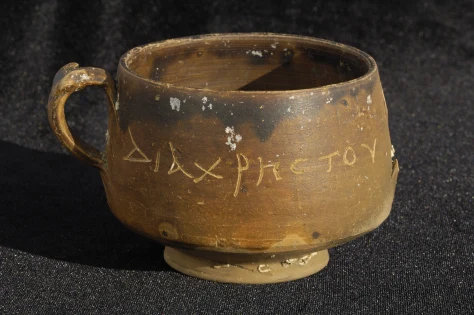
Jucundus, the Chrestian

Chrestians are Christians
- Justin Martyr 100CE-165CE
- Clement of Alexandria 150CE-211CE
- Tertullian 160CE-224CE
- Lactantius 240CE-320CE
Justin Martyr Apology 1, ch. 4
"By the mere application of a name, nothing is decided, either good or evil, apart from the actions implied in the name; and indeed, so far at least as one may judge from the name we are accused of, we are Chrestians. But as we do not think it just to beg to be acquitted on account of the name, if we be convicted as evil-doers, so, on the other hand, if we be found to have committed no offense, either in the matter of thus naming ourselves, or of our conduct as citizens, it is your part very earnestly to guard against incurring just punishment, by unjustly punishing those who are not convicted."
Clement of Alexandria Stromata Book II Chapter IV
"Now those who have believed in Christ both are and are called Chrestians, as those who are cared for by the true king are kingly. For as the wise are wise by their wisdom, and those observant of law are so by the law; so also those who belong to Christ the King are kings, and those that are Christ's Christians."
Tertullian Apology Ch.III
"Now then, if this hatred is directed against the name, what is the guilt attaching to names? What accusation can be brought against words, except that a certain pronunciation of a name sounds barbarous, or is unlucky or abusive or obscene? But 'Christian,' as far as its etymology goes, is derived from 'anointing.' And even when it is incorrectly pronounced by you 'Chrestian' (for not even is your acquaintance with the name accurate), it is formed from 'sweetness' or 'kindness.' In innocent men, therefore, even an innocent name is hated."
Lactantius Divine Institutes, Book IV Ch. VII
"...for Christ is not a proper name, but a title of power and dominion; for by this the Jews were accustomed to call their kings. But the meaning of this name must be set forth, on account of the error of the ignorant, who by the change of a letter are accustomed to call Him Chrestus. The Jews had before been directed to compose a sacred oil, with which those who were called to the priesthood or to the kingdom might be anointed. And as now the robe of purple is a sign of the assumption of royal dignity among the Romans, so with them the anointing with the holy oil conferred the title and power of king. But since the ancient Greeks used the word χρίεσθαι to express the art of anointing, which they now express by ἀλείφεσθαι, as the verse of Homer shows, "But the attendants washed, and anointed them with oil;" on this account we call Him Christ, that is, the Anointed, who in Hebrew is called the Messias. Hence in some Greek writings, which are badly translated from the Hebrew, the word eleimmenos is found written, from the word aleiphesthai, anointing. But, however, by either name a king is signified:"
Therapeutai, Jessaeans, Nazoraeans
- Eusebius identified Therapeutai/Jessaeans as the first Christian monks referencing descriptions from Philo of Alexandria.
- Philo of Alexandria (20BCE-50CE) describes Therapeutai in his work: On the Contemplative Life around 10CE.
- Therapeutes is term for worshippers and Therapeutai is a term for healers/physicians.
- Therapeutae can refer to followers of Asclepius and the temples dedicated to healing known as Asclepieions (over 300 found).
- Therapeutes are also associated with Serapis, a syncretic Graeco-Egyptian god created by Ptolemy I Soter in the 4TH century BCE.
- Epiphanius (310/320-403CE) provides the various names Christians were previously identified by in Panarion 29.
- Epiphanius, like Eusebius, claims that Philo was describing Christians in his work: On the Contemplative Life.
- Epiphanius makes the distinction that Christians were not "nazirites" or "Nasaraean."
- Epiphanius commits a "No true Scotsman" by refusing to accept that Gnostics, Marcionites, and others are not Christians.
Messiah before Jesus
Dead Sea Scrolls
3rd century BCE-1st century CE
- They consist of ~9000 fragments in four languages (Hebrew, Aramaic, Greek, and Nabataean) discovered in caves near Qumran between 1946CE and 1956CE.
- Approximately 40% of the scrolls consist of the Hebrew Bible.
- Approximately 30% of the scrolls are texts from the Second Temple period such as Enoch, Tobit, and Jubilees.
- The remaining 30% of the scrolls consist of rules and beliefs of sects within Judaism.
- They contain the Book of Sirach, which is also known as The Wisdom of Jesus the Son of Sirach.
- In the 1960's Jose O'Callaghan argued fragment 7Q5 belonged to the book of Mark. It contains 18 legible or partially legible Greek letters and there are multiple counterarguments to his proposal.
- They do not contain the New Testament.
- They do not contain anything about Jesus.
Old Testament connections
- Claim: The first 10 names of the Bible contain a hidden prophecy of Jesus.Adam: Man.Seth: Appointed.Enosh: Mortal.Kenan: "sorrow" has other meanings associated with smithing.Mahalalel: "the Blessed God" primarily means "praise of God."Jared: Descent.Enoch: Fixed/Sorrow.Methuselah: "his death shall bring" but means "man of the spear/dart" or "man of god."Lamech: Powerful.Noah: Rest/Comfort.
- Issues:
- The "prophecy" depends on a specific non-standard combination of etymological roots. For example, breaking Mahalalel into Mahalal and El to create the desired outcome.
- Forces the New Testament concept of atonement into he Old Testament. Utilizing eisegesis instead of interpreting the text in its original context.
- It depends on a genealogy that is meant to lead to Jesus, even though Jesus had no patriarchal relation to the bloodline.
- Various sources provide different and sometimes conflicting interpretations of what the names mean in their original Hebrew. Leaving no consensus on prophecy.
- If there was an intentional connection, the New Testament authors skipped it while they simultaneously invented prophecy from partial verses.
- Stopping at 10 is arbitrary. Going further to 14 would have aligned better with the importance of the number of mentioned in Matthew. 12 would have aligned with the significance associated with that number.
Borrowed Miracles
- Water into wine
- Dionysus (Bacchus) 13TH-12TH century BCE.
- Walk on water
- Orion son of Poseidon (Neptune) who also rode a chariot on water. Iliad 8TH century BCE.
- Healing
- Isis 27TH-22ND century BCE.
- Asclepius Iliad 8TH century BCE.
- Serapis Ptolemy I Soter 3RD century BCE.
- Raising the dead
- Multiplying food
- Amaltheia 6TH-4TH century BCE.
- Resurrection
Making a religion older for legitimacy
Cicero, De Legibus (On the Laws), 2.18, c. 52BCE
let no one have private gods -- neither new gods nor strange gods, unless publicly acknowledged, are to be worshiped privately -- let the temples which the fathers have constructed in the cities, be upheld
Livy, Ab Urbe Condita (History of Rome), 39.16.7-8, c. 25BCE-17CE
How often in the times of your fathers and grandfathers has the task been assigned to the magistrates of forbidding all foreign rites and ceremonies, prohibiting hedge-priests and diviners from entering either the Forum, the Circus, or the City, seeking out and burning all books of pretended prophecies, and abolishing every sacrificial ritual except what was accordant with Roman usage! Those men were masters of all human and divine love, and they believed that nothing tended so much to destroy religion as the performance of sacrificial rites, not after the manner of our fathers, but in fashions imported from abroad.
Josephus, Against Apion, 2 152, c. 94-100CE
Indeed, their endeavor was to have every thing they ordained believed to be very ancient, that they might not be thought to imitate others, but might appear to have delivered a regular way of living to others after them.