Before Jesus
Chrest the Magician
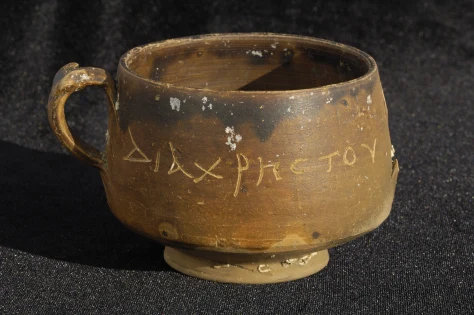
Jucundus, the Chrestian

Chrestians are Christians
- Justin Martyr 100CE-165CE
- Clement of Alexandria 150CE-211CE
- Tertullian 160CE-224CE
- Lactantius 240CE-320CE
Justin Martyr Apology 1, ch. 4
"By the mere application of a name, nothing is decided, either good or evil, apart from the actions implied in the name; and indeed, so far at least as one may judge from the name we are accused of, we are Chrestians. But as we do not think it just to beg to be acquitted on account of the name, if we be convicted as evil-doers, so, on the other hand, if we be found to have committed no offense, either in the matter of thus naming ourselves, or of our conduct as citizens, it is your part very earnestly to guard against incurring just punishment, by unjustly punishing those who are not convicted."
Clement of Alexandria Stromata Book II Chapter IV
"Now those who have believed in Christ both are and are called Chrestians, as those who are cared for by the true king are kingly. For as the wise are wise by their wisdom, and those observant of law are so by the law; so also those who belong to Christ the King are kings, and those that are Christ's Christians."
Tertullian Apology Ch.III
"Now then, if this hatred is directed against the name, what is the guilt attaching to names? What accusation can be brought against words, except that a certain pronunciation of a name sounds barbarous, or is unlucky or abusive or obscene? But 'Christian,' as far as its etymology goes, is derived from 'anointing.' And even when it is incorrectly pronounced by you 'Chrestian' (for not even is your acquaintance with the name accurate), it is formed from 'sweetness' or 'kindness.' In innocent men, therefore, even an innocent name is hated."
Lactantius Divine Institutes, Book IV Ch. VII
"...for Christ is not a proper name, but a title of power and dominion; for by this the Jews were accustomed to call their kings. But the meaning of this name must be set forth, on account of the error of the ignorant, who by the change of a letter are accustomed to call Him Chrestus. The Jews had before been directed to compose a sacred oil, with which those who were called to the priesthood or to the kingdom might be anointed. And as now the robe of purple is a sign of the assumption of royal dignity among the Romans, so with them the anointing with the holy oil conferred the title and power of king. But since the ancient Greeks used the word χρίεσθαι to express the art of anointing, which they now express by ἀλείφεσθαι, as the verse of Homer shows, "But the attendants washed, and anointed them with oil;" on this account we call Him Christ, that is, the Anointed, who in Hebrew is called the Messias. Hence in some Greek writings, which are badly translated from the Hebrew, the word eleimmenos is found written, from the word aleiphesthai, anointing. But, however, by either name a king is signified:"
Therapeutai, Jessaeans, Nazoraeans
- Eusebius identified Therapeutai/Jessaeans as the first Christian monks referencing descriptions from Philo of Alexandria.
- Philo of Alexandria (20BCE-50CE) describes Therapeutai in his work: On the Contemplative Life around 10CE.
- Therapeutes is term for worshippers and Therapeutai is a term for healers/physicians.
- Therapeutae can refer to followers of Asclepius and the temples dedicated to healing known as Asclepieions (over 300 found).
- Therapeutes are also associated with Serapis, a syncretic Graeco-Egyptian god created by Ptolemy I Soter in the 4TH century BCE.
- Epiphanius (310/320-403CE) provides the various names Christians were previously identified by in Panarion 29.
- Epiphanius, like Eusebius, claims that Philo was describing Christians in his work: On the Contemplative Life.
- Epiphanius makes the distinction that Christians were not "nazirites" or "Nasaraean."
- Epiphanius commits a "No true Scotsman" by refusing to accept that Gnostics, Marcionites, and others are not Christians.
Messiah before Jesus
Dead Sea Scrolls
3rd century BCE-1st century CE
- They consist of ~9000 fragments in four languages (Hebrew, Aramaic, Greek, and Nabataean) discovered in caves near Qumran between 1946CE and 1956CE.
- Approximately 40% of the scrolls consist of the Hebrew Bible.
- Approximately 30% of the scrolls are texts from the Second Temple period such as Enoch, Tobit, and Jubilees.
- The remaining 30% of the scrolls consist of rules and beliefs of sects within Judaism.
- They contain the Book of Sirach, which is also known as The Wisdom of Jesus the Son of Sirach.
- In the 1960's Jose O'Callaghan argued fragment 7Q5 belonged to the book of Mark. It contains 18 legible or partially legible Greek letters and there are multiple counterarguments to his proposal.
- They do not contain the New Testament.
- They do not contain anything about Jesus.
Old Testament connections
- Claim: The first 10 names of the Bible contain a hidden prophecy of Jesus.Adam: Man.Seth: Appointed.Enosh: Mortal.Kenan: "sorrow" has other meanings associated with smithing.Mahalalel: "the Blessed God" primarily means "praise of God."Jared: Descent.Enoch: Fixed/Sorrow.Methuselah: "his death shall bring" but means "man of the spear/dart" or "man of god."Lamech: Powerful.Noah: Rest/Comfort.
- Issues:
- The "prophecy" depends on a specific non-standard combination of etymological roots. For example, breaking Mahalalel into Mahalal and El to create the desired outcome.
- Forces the New Testament concept of atonement into he Old Testament. Utilizing eisegesis instead of interpreting the text in its original context.
- It depends on a genealogy that is meant to lead to Jesus, even though Jesus had no patriarchal relation to the bloodline.
- Various sources provide different and sometimes conflicting interpretations of what the names mean in their original Hebrew. Leaving no consensus on prophecy.
- If there was an intentional connection, the New Testament authors skipped it while they simultaneously invented prophecy from partial verses.
- Stopping at 10 is arbitrary. Going further to 14 would have aligned better with the importance of the number of mentioned in Matthew. 12 would have aligned with the significance associated with that number.
Borrowed Miracles
- Water into wine
- Dionysus (Bacchus) 13TH-12TH century BCE.
- Walk on water
- Orion son of Poseidon (Neptune) who also rode a chariot on water. Iliad 8TH century BCE.
- Healing
- Isis 27TH-22ND century BCE.
- Asclepius Iliad 8TH century BCE.
- Serapis Ptolemy I Soter 3RD century BCE.
- Raising the dead
- Multiplying food
- Amaltheia 6TH-4TH century BCE.
- Resurrection
Making a religion older for legitimacy
Cicero, De Legibus (On the Laws), 2.18, c. 52BCE
let no one have private gods -- neither new gods nor strange gods, unless publicly acknowledged, are to be worshiped privately -- let the temples which the fathers have constructed in the cities, be upheld
Livy, Ab Urbe Condita (History of Rome), 39.16.7-8, c. 25BCE-17CE
How often in the times of your fathers and grandfathers has the task been assigned to the magistrates of forbidding all foreign rites and ceremonies, prohibiting hedge-priests and diviners from entering either the Forum, the Circus, or the City, seeking out and burning all books of pretended prophecies, and abolishing every sacrificial ritual except what was accordant with Roman usage! Those men were masters of all human and divine love, and they believed that nothing tended so much to destroy religion as the performance of sacrificial rites, not after the manner of our fathers, but in fashions imported from abroad.
Josephus, Against Apion, 2 152, c. 94-100CE
Indeed, their endeavor was to have every thing they ordained believed to be very ancient, that they might not be thought to imitate others, but might appear to have delivered a regular way of living to others after them.
Pontius Pilate
??BCE-39CE
Pontius Pilate was not known to succumb to crowd pressure. The Jewish Wars Book 2 Chapter 9 Section 3 by Josephus tells us Pilate hides soldiers in the crowd and has them attack and kill people on his command. Josephus also mentions it in Antiquities of the Jews Book 18 Chapter 3 Section 2. In Antiquities of the Jews Book 18 Chapter 4 Sections 1-2, Pilate ordered more violence upon the people and was eventually removed from his position for his actions in 36CE.
There are a collection of letters known among scholars as the Pilate cycle, purportedly written by or to Pontious Pilate. None of them are genuine.
The stories aren't entirely consistent, contain far-fetched details, and none of them are conclusively dated to the correct period in history.
- Acts of Pilate: There are two versions. Version A claims to be written by a guard of Pilate, translating a Hebrew letter written by Nicodemus. It borrows from the gospels, thus, it wasn't written at the time of Jesus. Version B tells a story of Jesus descending into Hades (location) and seeing John the Baptist, Adam, Seth, various patriarchs, and prophets. It says Satan is misled into believing Jesus is a mere human, and wants Hades (the deity) to trap Jesus. Jesus breaks the gates of hell and releases the dead.
- Anaphora Pilati: Purportedly written by Pilate to Emperor Tiberius. It most likely isn't genuine and originated in the 4TH-5TH century and the oldest copies are from the 6TH century. It's largely anti-Jewish and says the dead poured out from Hades (location) and Jews that spoke against Jesus were consumed by an earthquake, not leaving bodies. It also claims that all of the synagogues were destroyed except for one.
- Letter of Herod to Pilate: It isn't considered genuine since it was likely written in the 4TH century. A Syriac document from the 5TH-6TH century is the oldest version available. Herod is awaiting judgment as various punishments are befalling his family. His daughter's head comes off as her mother grabs it while trying to save her from an unexpected flood of a river. His son is wasting away, his wife is blind, and he has worms. Herod reveals that Longinus (the Roman who stabbed Jesus) is being eternally shredded and eaten by a lion, only to reanimate every morning.
- Letter of Pilate to Emperor Claudius: Written between the 2ND and 5TH centuries. What makes it especially questionable is that Claudius started ruling in 41CE. This after the death of Jesus and Pilate's term as prefect and death in 39CE. It takes some influence from the Gospel of Matthew. However, it says the guards witnessed the resurrection. It also claims that all of the Jews called Jesus the son of god.
- Letter of Pilate to Herod: Written between the 3RD and 4TH centuries. A Syriac document from the 5TH-6TH is the oldest version available. It says Pilate, his wife, and Longinus all converted to Christianity.
- Letter of Pilate to Tiberius: Probably written around the Renaissance. Nothing very special in it. Claims Pilate folded to social pressure, which aligns with the gospels, but is contrary to history.
- Letter of Tiberius to Pilate: Unknown date of authorship, likely medieval, 11TH century at the earliest. Tiberius considers Pilate's acts as criminal and calls for the executions of several key individuals. Tiberius ends up accidentally ending Pilate with an arrow that flies through Pilate's prison cell window while he is hunting deer.
Thallus
1ST? century
Paul
5CE-57/68CE
- Paul is a diminutive of the name "Paulus", meaning "small", "little", or "humble" (in Latin).
- There is no evidence for Paul's existence anywhere, including church tradition, before the mid 2ND century.
- The Erastus inscription does not mention Paul.
- Multiple Erastus inscriptions/references exist.
- Andrew D. Clarke writes about other inscriptions. One discovered in 1960 that dates to the 2ND century.
- A marble stele was found in the Athenian Agora inscribed with two decrees which were passed during the archonship of Erastus.
- An inscription from Athens, dated to 164BCE-163BCE.
- Additional examples: SEG 11, 622 (Laconia, Hadrian's reign), and 994 (Messenia, 2ND or 1ST century BCE); SEG 25, 194 (Attica, 3RD or 2ND century BCE); SEC 28, 1010 (Erastus of Memmius, Bithynia, 2ND or 3RD century CE); CIC 269; 1241 (Sparta); 1249 (Sparta); 6378.
- The Galio (proconsul of Achaia) inscription does not mention Paul.
- Excavations of Ephesus, Philippi, and Thessalonica only confirm locations, not the existence of Paul.
This is only evidence for those people and locations, not Paul. Just like how New York isn't evidence for the existence of fictional characters that live in New York. Likewise, historical figures in the works of Shakespeare aren't evidence that the events in Shakespeare's plays actually happened.
- The Erastus inscription does not mention Paul.
- Paul is cited as being a murderer, but he was never recorded as having killed anyone in the New Testament. He approved and stood near while Stephen was stoned and "breathed murderous threats" against followers of Jesus but never claimed or recorded committing murder himself.
- In the epistles attributed to Paul, there are inconsistencies in tone and content that suggest multiple authors or later interpolations.
- Only the book of Acts makes the claim that Paul's name used to be "Saul".
- Paul never met Jesus, and there is no record of any interaction between Paul and Jesus in historical sources. The accounts in the New Testament describe a vision or hallucinations.
- The book of John (written after Galatians) explictly says Jesus' brothers didn't believe in him. Saying he "saw none of the other apostles—only James, the lord's brother." Is a peculiarity. Additionally, the earliest form of Galatians didn't include Paul meeting James or the next verse in chapter 1:20 (swearing to god that he isn't lying), the earliest form is shown in The New First Testament Marcion's Scriptural Canon by J.D. BeDuhn on page 230.
- Only the book of Acts tells about Paul's conversion experience (hallucinations). It's not in the epistles attributed to Paul. It's told three times and each account offers different versions about what he and his companions experienced, what was said by "Jesus", and his blindness. Depending on the translation, "Jesus" quotes The Bacchae (405CE) by using the phrase "kick against the pricks/goads."
- Paul appoints himself as an apostle. Claiming to have gotten it through Jesus, who he never met.
- The character of Paul harms his own reputation by claiming he isn't lying before being challenged about a claim, which is the equivalent to "Trust me bro." Paul admits to playing different roles to different groups of people, utilizing deception as a strategy in order to persuade them. He also admits to robbing Macedonia so he doesn't burden the Corinthians.
- The first references to Paul are within the New Testament canon presented by the Marcionites.
- Marcion means "little Mark." Paul could be a reference to Marcion.
- Only 6-7 of the epistles attributed to Paul are considered authentic by modern scholars. The remaining letters are considered pseudepigraphical (false authorship). While the 6-7 "authentic" letters could have been written by a single person or a collection of people, that doesn't mean they aren't pseudepigraphical.
- This view is supported by the scholar Dr. Nina Livesey whose recent book "The Letters of Paul in their Roman Literary Context: Reassessing Apostolic Authorship" argues that all of the letters are pseudonymous and none of them were written by Paul.
- Bart Ehrman states that Jesus must have existed because Paul meets Jesus' brother, but he's operating on the assumption that Paul existed because some of the epistles bearing his name are authentic. Epistolary fiction was a popular genre in ancient times with examples from authors such as Homer and Philostratus. Another great example is Ovid's Heroides.
- The earliest codex/manuscript of Paul's letters (Papyrus 46) is dated to between 150CE-399CE using Palaeography, which is limited to the amount of texts that appear similar from a known time period. They're still dated well after Paul's supposed death.
- In Acts 28 Paul survives a shipwreck and ends up on the island of Malta. While placing wood on a fire, he is bitten by a viper. There are no vipers on Malta and only one of native species is mildly venomous.
Problems with Paul
- Says the Jews demanded signs/miracles and the Crucifixion is a stumbling block for them. Even though they were a large part of the audience to the miracles in the Gospels.
- He mistakenly talks about Jesus appearing to the "twelve" disciples after the resurrection. Judas had betrayed Jesus and was no longer one of the twelve. Matthew, Mark, Luke, and Acts correctly state eleven disciples. However, John also gets it wrong.
- Never mentions Judas.
- Never mentions miracles.
- Never mentions parables.
- Never mentions Jesus' life.
- Never quotes or records any accounts of those who claimed to know Jesus.
- No verifiable evidence that he met the disciples.
- There is no evidence of letters written or addressed to Paul.
The books that mention Paul
- Are supposedly written by Paul.
- Are pseudepigrapha claiming to be him.
- 2nd Peter which is pseudepigrapha that claims to be Peter.
- Acts which was written years after the alleged death of Paul and contains many embellishments such as: Philips teleportation, Ananias and Sapphira dying for not giving all of the money from the sale of their own property, Peter's hunger dream, and Paul's marathon preaching, where Eutychus falls three stories and was thought to be dead. (It doesn't say Paul resurrected him. Paul just says he's alive.)
Paul's Timeline
Galatians
- Legend has it that Paul converted 4-7 years after the alleged death of Jesus (29CE-33CE). Meaning Paul's conversion would have happened between 33CE-40CE.
- Paul traveled to Arabia and returned to Damascus. 2 Corinthians mentions King Aretas having control of Damascus. King Aretas IV (d. 40CE) was the only King Aretas alive during this time but he did not have control of Damascus. King Aretas III had control of Damascus but he reigned from 87BCE-62BCE.
- After 3 years Paul traveled to Jerusalem ~36CE-43CE.
- Then Paul traveled to Syria and Cilicia.
- After 14 years returned to Jerusalem, this is thought to be when the Jerusalem council takes place. He travels with Barnabas and Titus. This is the first time Barnabas is mentioned, while Acts has him accompanying Paul for a majority of the time. ~49/50CE-57CE.
- Paul confronts Peter in Antioch.
- Galatians places Paul in Antioch around 49CE-58CE.
Acts
- Barnabas travels to Tarsus looking for Paul. Then they preach for a year in Antioch. The verse says the disciples were first called Christians in Antioch, but it doesn't say it happened during this visit by Paul/Saul.
- Barnabas and Paul travel to Judea.
- King Herod Agrippa I (d. 44CE) executes James the brother of John.
- Barnabas and Paul return from/to Jerusalem, it only specifies that it was after the death of King Herod Agrippa I (d. 44CE).
- They return to Antioch.
- Barnabas and Paul travel to Seleucia, Cyprus, Salamis, Paphos, Perga, Iconium, Lystra, Derbe, back to Lystra, Iconium, Antioch, Prisidia, Pamphylia, Perga, Attalia, and finally Antioch where they "abode long time."
- Barnabas and Paul return to Jerusalem. Scholars place the Jerusalem council around: ~49/50CE-58CE.
- Barnabas and Paul return to Antioch but parted ways, Paul leaving with Silas to Syria and Cilicia.
- Paul and Silas travel to Derbe, Lystra, Iconium, Phrygia, Mysia, Troas, Samotheacia, Neapolis, and Philippi.
- Paul and Silas travel to Amphipolis, Apollonia, Thessalonica, Berea, and Athens.
- Paul spends 1½ years in Corinth ~50.5/51.5CE-59.5CE.
- Paul traveled alone to Syria, Ephesus, Caesarea, Antioch, Galatia, Phrygia, and Achaia.
- Paul continues to Ephesus and stays for 2 years and 3 months. ~52.75/53.75CE-61.75CE
- Paul decides to go to Macedonia, Achaia, then Rome. After staying in Asia (Ephesus) season/little longer. ~53/54CE-62CE
- Paul travels to Macedonia and through "that area", then Greece where he stayed for 3 months. ~53.25/54.25CE-62.25CE
- Paul sails from Philipi after 5 days to Troas where he stayed 7 days.
- Paul walked to Assos, sailed to Mitylene, Chios, Samos, Miletus, past Ephesus.
- Paul sailed to Kos. Went to Rhodes then Patara. Sailed to Phoenicia, Syria and landed at Tyre.
- Paul sailed to Ptolemais then left for Caesarea for several days.
- Paul arrives in Jerusalem.
- Paul was arrested after 7 days.
- Paul was sent to Caesarea and was in prison for 2 years. ~55.25/56.25CE-64.25CE
- Festus travels to Jerusalem and after 8-10 days returns to Paul.
- Fustus consults King Agrippa several days later.
- The next day Paul is brought in front of Agrippa.
- Paul, still a prisoner, place on a boat headed for Rome. They traveled to Sidon, Cyprus, Cilicia, Pamphylia, Myra, Cnidus, Crete, then Fair Havens.
- The ship encountered a storm and were at sea for two weeks.
- They were shipwrecked on Malta.
- A man named Publius took the prisoners in for three days.
- After three months, they traveled to Syracuse for three days, Rhegium, Puteoli for seven, then Rome. ~55.5/56.5CE-64.5CE
- Paul lived in Rome for two years. ~57.5/58.5CE-66.5CE
The belief that the term "Christian" was coined in the 40-50's is based on the account in Acts 11:26. However, the verse only states the term originated in Antioch, it doesn't specify when. The proximity of the claim that it originated in Antioch and the account of Paul and Barnabas visiting Antioch could explain why people conflate the two. Ultimately, the timelines of Acts and Galatians do not align chronologically or geographically. Either Paul omitted multiple trips and durations in his own accounts or Acts fabricated them.
Antonius Felix places Paul in prison and after two years Antonius Felix is replaced by Porcius Festus. History says this happened in 60CE but the leading annotation in Antiquities of the Jews by Josephus it says it was 58CE. One would presume he started as procurator around 58-60CE, but the historical estimates are broad. According to Josephus, Porcius Festus' was dead in 61CE. Paul's timeline is wide enough to bring doubt because it could be 3 years too early or too late. There are no historical records of Porcius Festus interacting with Paul or being involved in any events related to Christianity outside of the New Testament.
Accounts of Paul's death aren't exact. Estimates are anywhere between 57-68CE. The Vatican places it exactly on June 29th, 67CE.. It should be noted that none of the cited sources for his death are from an offical record or secular account. The ealiest account listed is 1 Clement, but the date given is not valid. A detailed explaination is offered by Dr. M. David Litwa.
Between 2001CE-2011CE the Acts Seminar met twice a year. They state "Today we are convinced that Acts is a work of imaginative religious literature".
Nobody would die for a lie.
60CE-Present
People will often remark that the disciples wouldn't die for a lie. They are missing an important distinction; people can and will die for a lie if they believe it to be true. Their belief doesn't make the lie true.
- Only two of the disciples deaths are listed in the Bible: James, and Judas (which contains two conflicting stories)
- There are many instances of people dying for a lie: Peoples Temple, Heavens Gate, Movement for the Restoration of the Ten Commandments of God, Good News International Church, Order of the Solar Temple, and Branch Davidians.
- A good example of someone who died for a lie and knew it was a lie, because it originated with him, is: Joseph Smith.
The Disciples (and Paul)
- Peter
- Acts of Peter tells us about Peter's death. It also contains a talking dog, people witnessing Peter flying but he says it was an illusion, Peter brings a dead herring back to life, a miracle battle between Peter and Simon (Magus) who brings man back to life, and sees Jesus going back into Rome to be crucified a second time.
- 1 Clement mentions the martyrdom of Peter in 1 Clement but the details are lacking.
- A letter once attributed to Pope Linus about the martyrdom of Peter and Paul is now dated to the 6TH century.
- Andrew
- The Acts of Andrew (~260CE) tells us how Andrew was crucified, on an X shaped cross at the city of Patras in 60CE, and died after three days.
- Philip
- The Acts of Philip (~4TH century) is incomplete, Some versions of the text say Philip was beheaded, some noting it was after being crucified upside-down.
- It also says Philip and his group were accompanied by a talking goat and leopard.
- Bartholomew
- The Acts of Philip also foretells of Bartholomew being crucified.
- The Martyrdom of Bartholomew (~4TH-5TH century) says he was beaten and beheaded. Then 13 days later the king and priests involved were strangled by demons.
- St. Theodore the Studite (11TH century) mentions multiple tales of how Bartholomew was martyred.
- Thomas
- The Acts of Thomas (225CE-240CE) says Thomas was pierced with spears.
- Matthew
- The accounts of Matthew's martyrdom are varied.
- In Acts and Martyrdom of St. Matthew (4TH-5TH century) he is nailed to the ground and his executioners try to be set on fire, but it turns into dew. Matthew survives the attempts on his life, and lives on to have a son. Acts and Martyrdom of St. Matthew does not appear to conclude with his death.
- Simon
- No single, verified contemporary historical record details the martyrdom of the disciple Simon the Zealot. Several stories are listed on the wikipedia page. The Golden Legend from the late middle ages says Simon and Jude were martyred together. However, On the Apostles and Disciples says Simon fell asleep at the age of 120.
- James the Great (son of Zebedee)
- His martyrdom is listed in Acts 12:1-2
- John brother of James (son of Zebedee)
- Wasn't martyred.
- James son of Alphaeus
- According to Pseudo Hippolytus he was stoned.
- Later works such as Encomium on James by Nicetas the Paphlagonian (9TH century), Historia Ecclesiastica by Nikephoros Kallistos (14TH century), and The Prologue of Ohrid by Saint Nikolai Velimirovic (19TH century) claim he was crucified.
- Judas Iscariot
- Wasn't martyred. The bible contradicts itself on how he died.
- Thaddeus (Jude)
- Multiple accounts on the location of his death exist. Places in the traditions list: Armenia, Beirut, and Rome.
- Matthias
- Tradition varies on the manner of death, some say he was stoned and then beheaded, others say he was crucified.
- Paul
- Acts of Paul offers details of Paul's death. It states Paul was beheaded and milk spurted on the cloak of the executioner.
- 1 Clement also mentions the martyrdom of Paul in 1 Clement stating Paul was stoned.
Flavius Josephus
37CE-100CE
- Born in 37CE, Josephus was not contemporary.
- The Jewish War was published around 75-79CE. Antiquities of the Jews was published around 93-94CE. Against Apion was published around 94-100CE.
- Josephus doesn't mention any Popes or apostolic succession. Even after residing in Rome after 71CE.
- Gospel similarities:
- His father's name was Matthias. In Aramaic his name would have been Joseph bar Matthias or Joseph ben Matthias in Hebrew. Which is similar to Joseph of Arimathea, a location with no external evidence for its existence.
- In The Life of Flavius Josephus, during the siege of Jerusalem he recognized three friends who were crucified. He went to Titus and asked for them to be taken down. Titus grants his request and provides them the best medical care. Two died while the third recovered.
- Josephus talks about the anointing process.
- While he does talk about how the anointing ointment is created and what it is used on, Josephus doesn't mention what the title of "Christ" means or how anyone gets the title of "Christ."
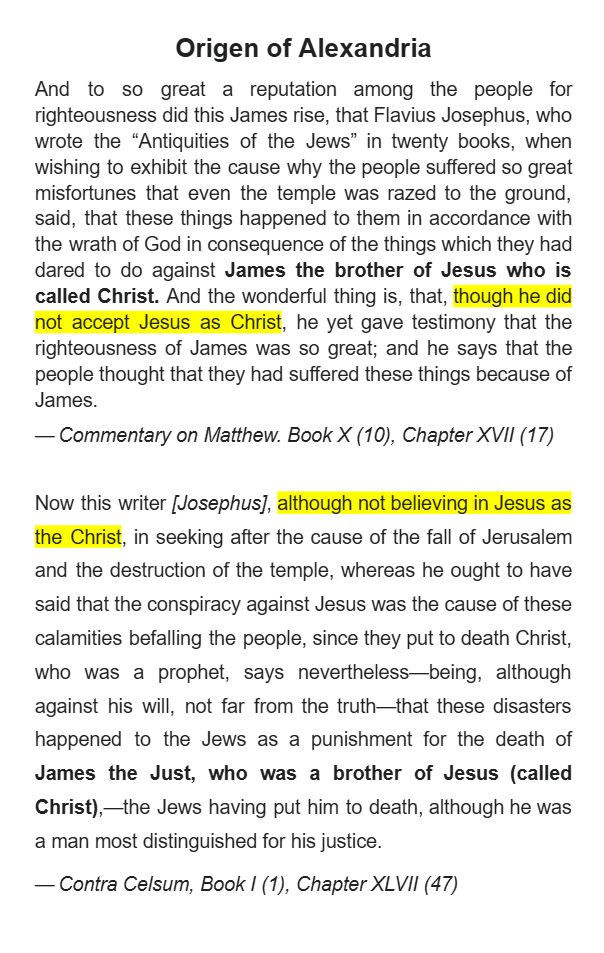
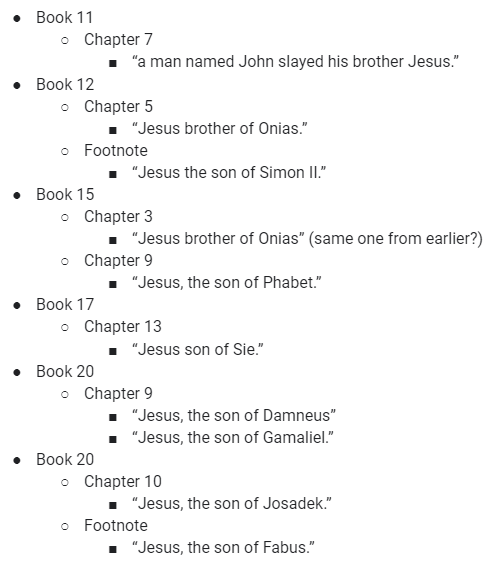
- Book 20.9.1 could have a rational reason for using the term Christ; in the Old Testament High Priests were anointed, and Josephus mentions it in his passage discussing how to make the ointment. This would have made the High Priest, Jesus son of Damneus a "Christ." but Origen's remarks (first image below) make the inclusion of the title unlikely.
- Book 20.9.1 the phrase "brought before them the brother of Jesus who was called Christ, whose name was James." Josephus often references people through familial relationships, but if this was a reference to Jesus, Josephus would be talking about James through the relationship to Jesus who would have been dead for nearly 30 years. We are left with no explanation of the importance of Jesus in the passage, unless it's about Jesus who is also the son of Damneus. We have no examples of Josephus introducing someone by a long-dead relative that hasn't been introduced previously, isn't famous, or part of a dynasty or royalty.
- James the son of Damneus in book 20.9.1 doesn't face the same death as James the Just.
- According to Hegesippus (110CE-180CE), James the Just was thrown off a building, stoned when he survived the fall, and then a fuller's club was thrown at his head, ending his life.
- Hegesippus also notes that shortly after the execution of James the Just, Vespasian (9CE-79CE) besieged Judaea 67CE-69CE.
- Josephus' account of the son of Damneus in Book 20.9.1 happened around 61CE.
- Origen and Eusebius believe Josephus is writing about James the Just. However, there is a long standing debate over the identity of James the Just who is also known as James the Lesser and James Son of Alphaeus.
- On the Apostles and Disciples [Pseudonymous Hippolytus (165CE-235CE)] there are three different men named James.
- James, his brother, was beheaded by Herod. This would be the James referenced in Acts.
- James the son of Alphaeus was stoned to death and buried by the temple.
- James the Lord's brother, bishop of Jerusalem. As one of the 70 disciples, his manner of death isn't stated.
- It also says: Simon the Zealot, the son of Clopas, who is also called Jude, became bishop of Jerusalem after James the Just.
- This also lists Matthias as someone who took the 12TH place as an apostle, and as one of the seventy disciples.
- It doesn't mention Judas.
- There is debate over the identity of which James is which. Some tradition holds that James the Just is the son of Alphaeus and the Lesser.
- The book of John (written after Josephus' account of 61CE) explicitly says Jesus' brothers didn't believe in him.
- Book 18.3.3 is known as the Testimonium Flavianum. It is an interpolation by Eusebius. This isn't a new theory as phrasing unique to Eusebius is only present in the Testimonium Flavianum and the works of Eusebius. Stylometry provides additional evidence of its interpolation.
- Book 18.3.3 doesn't directly mention apostles or disciples. To paraphrase. it says he appeared again, alive, to the ones that loved him. Josephus never describes anything about them, name them in any way, or discuss any martyrdom they might have faced.
- In Josephus' other works he only uses the term "poietes" to mean poet. In the Testimonium Flavianum it is used to mean "doer" in the phrase "doer of great works." That use is consistent with Eusebius writings.
- Eusebius is the first person who quotes the Testimonium Flavianum. He includes the entire passage within Demonstratio Evangelica Book 3 instead of summarizing or paraphrasing it. He also makes the questionable statement: "And here it will not be inappropriate for me to make use of the evidence of the Hebrew Josephus".
- According to Louis H. Feldman, a surviving 5TH-6TH century table of contents for Antiquities doesn't include the Testimonium Flavianum.
- While the Arabic translation of Antiquities contains the Testimonium Flavianum, it differs in terminology. For example, instead of saying "For he appeared to them alive again, the third day" it says "They reported that he had appeared to them three days after his crucifixion and that he was alive; accordingly he was perhaps the Messiah" providing speculative hearsay.
- Christian authors before 324CE refer to Josephus' works, but none of them mention the Testimonium Flavianum.
- Origen of Alexandria
- * Hippolytus of Rome, his descriptions of the Essenes parallels Josephus' description in Jewish Wars. It's believed Hippolytus adapted Josephus directly.
- ** Sextus Julius Africanus a surviving fragment quotes books 12, 14, and 15 of Antiquities of the Jews (disclosure: I haven't found that specific fragment yet). That fragment is not to be confused with his reference to Herod's beother who is also named Josephus.
- *** Arnobius of Sicca mentions Josephus by name, but doesn't quote his works.
- Saint Photios the Great in the 9TH century wrote a review of Josephus' works. Still, he doesn't reference the Testimonium Flavianum. He does claim that Josephus wrote about the Massacre of the Innocents and the virgin birth of Jesus, but the scholarly consensus is that Josephus never wrote about those events.
- Richard Carrier mentions the works of Louis Feldman, G.J. Goldberg, Paul Hopper, Ken Olson, and Alice Whealey who support the claim that Eusebius created the interpolation.
- Additional scholars are listed here. The post points out additional evidence and sources supporting the claim.
Origen of Alexandria
A popular name
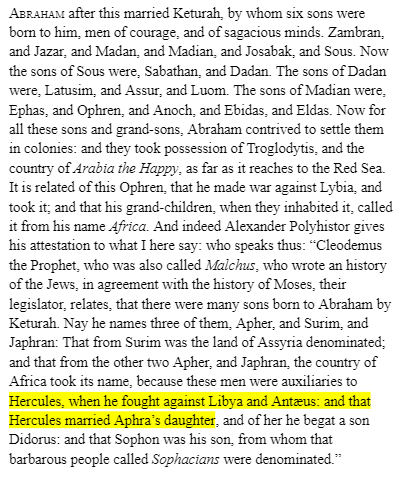
Hercules
Josephus Antiquities Book 18 Chapter 3 Section 3
3. Now there was about this time Jesus, a wise man; if it be lawful to call him a man. For he was a doer of wonderful works; a teacher of such men as receive the truth with pleasure. He drew over to him both many of the Jews, and many of the Gentiles. He was [the] Christ. And when Pilate, at the suggestion of the principal men among us, had condemned him to the cross; those that loved him at the first did not forsake him. For he appeared to them alive again, the third day as the divine prophets had foretold these and ten thousand other wonderful things concerning him. And the tribe of Christians, so named from him, are not extinct at this day.
Josephus Antiquities Book 20 Chapter 9 Section 1
1. [A.D. 61.] And now Cesar, upon hearing the death of Festus, sent Albinus into Judea, as procurator. But the King deprived Joseph of the High Priesthood; and bestowed the succession to that dignity on the son of Ananus, who was also himself called Ananus. Now the report goes, that this eldest Ananus proved a most fortunate man. For he had five sons, who had all performed the office of an High Priest to God; and who had himself injoyed that dignity a long time formerly: which had never happened to any other of our High Priests. But this younger Ananus, who, as we have told you already, took the High Priesthood, was a bold man in his temper, and very insolent. He was also of the sect of the Sadducees: who are very rigid in judging offenders above all the rest of the Jews: as we have already observed. When therefore Ananus was of this disposition, he thought he had now a proper opportunity [to exercise his authority]. Festus was now dead; and Albinus was but upon the road. So he assembled the sanhedrim of judges, and brought before them the brother of Jesus who was called Christ, whose name was James: and some others; [or, some of his companions.] And when he had formed an accusation against them as breakers of the law, he delivered them to be stoned. But as for those who seemed the most equitable of the citizens, and such as were the most uneasy at the breach of the laws, they disliked what was done. They also sent to the King [Agrippa,] desiring him to send to Ananus that he should act so no more: for that what he had already done was not to be justified. Nay some of them went also to meet Albinus, as he was upon his journey from Alexandria; and informed him, that it was not lawful for Ananus to assemble a sanhedrim without his consent. Whereupon Albinus complyed with what they said; and wrote in anger to Ananus; and threatened that he would bring him to punishment for what he had done. On which account King Agrippa took the High Priesthood from him, when he had ruled but three months; and made Jesus, the son of Damneus High Priest.
Papias of Hierapolis
60CE-130/164CE
- There is debate around his death. Some sources say 130-135CE but the Paschel Chronicle says he died around 163-164CE. Though modern scholars think this is an error due to the confusion between Papias and Papylas.
- He wrote the now lost Exposition of the Sayings of the Lord (~100CE-140CE). Portions of it were cited by Irenaeus and Eusebius.
- Papias did not declare knowing, hearing, or being an eyewitness to the apostles in Exposition of Dominical Oracles. He took the word of people who claimed to know them.
- He preferred hearsay told orally that conformed to stories he learned from elders over written accounts.
- Irenaeus is the first to claim that he was a "hearer" of John despite Papias' own denial. Irenaeus also claimed he was a companion of Polycarp. We have nothing from Polycarp or Papias confirming this.
- Eusebius disputes that it was John the Apostle (as claimed by Irenaeus) and instead a different John the Elder. Though Papias doesn't make that claim either. Eusebius also says he employed testimonies from the first epistle of John and from Peter (though Acts 4:13 says they were illiterate), his exact meaning is ambiguous.
- Eusebius says Papias heard a story from Philip's daughters. Though from the fragments of Papias' work it's not clear if he met them in person or if it was a story that claimed to have originated from them.
- Papias claimed Matthew was in Hebrew (or heard in Aramaic or in a Semitic work) but the book of Matthew that we have today wasn't written in Hebrew (It quotes the Septuagint directly, making the same errors.) and wasn't named until Irenaeus in the 180s CE.
Pliny the Younger
61CE-113CE
Timeline of Pliny the Younger and Catholic tradition.
- According to Tacitus the Great Fire in Rome was blamed on Chrestians in 64CE (Also alleged start of Christian persecution.) Though many confessed and ratted out their companions, making early Christians, terrorists.
- St. Peter dies on Vatican Hill in Rome 64CE.
- Pope Linus (10CE-80CE). Papacy given in 67CE. Catholics say he was martyred in 76CE, other sources say he died in 80CE. In Rome.
- Pliny was sent to Rome ~75CE by his preceptor in charge of his education at a young age (~14) and became a student of Quintilian (35CE-100CE).
- Pliny became close to his famous Uncle Pliny the Elder (23CE-79CE). Pliny the Elder left his estate to Pliny the Younger, when Pliny the Younger was around 17. Pliny went on to Publish the Elder’s Natural History.
- Pope Anacletus (16CE-92CE) begins Papacy 80CE. Born and Died in Rome.
- Pliny is one of the Judges of the centumviral court (civil court) ~81CE.
- Pliny is a Staff Officer in Syria ~81CE.
- Pliny is an Officer of the noble order of knights ~mid 80CE's
- Pliny is the Quaestor attached to the Emperor's staff (Public official). 88CE-89CE.
- Pliny is elected Tribune of the People, the most important check on the power of the Roman Senate and magistrates. 91CE.
- Pope Clement (??-100CE) begins Papacy 92CE. Died in Crimea (Roman Empire)
- Pliny became Prefect of the Military Treasury 94CE-96CE.
- Pliny became Prefect of the Treasury of Saturn 98CE-100CE.
- Pope Evaristus (??-108CE) begins Papacy 100CE. Died in Rome.
- Pliny became one of the two members of the Suffect consul (the two highest elected public officials of the Roman Republic) 100CE.
- Pliny is the publicly elected Augur (Priest and official) 103CE-104CE.
- Pliny is overseer of the banks of the Tiber 104CE-106CE.
- Pliny is a three-time member of the judicial council of Trajan 104CE-107CE.
- Pope Alexander I (??-119CE) begins Papacy 108CE. Died in Rome.
- Pliny was the imperial governor of Bithynia 110CE-112CE.
- Pliny wrote in 111CE to Emperor Trajan. The information he provides shows that not only he was unfamiliar, but he believes the Emperor doesn't have this information.
Points of interest
- By the time Pliny the Younger was 18, legend says Peter was martyred on Vatican Hill, and a new Pope was in charge.
- When Pliny the Younger reports that he's never participated in the trials of Christians, the church claims there have been 6 Popes.
- Rome was in a city that Pliny the Younger had an intense familiarity with, evidenced by his service in the Military, as a Lawyer, Judge, elected official, a representative of the people, and a Priest.
- Pliny appears to know their name: "I have never participated in trials of Christians." but not much else.
- Pliny's legal and political career happened during the alleged "Christian persecution" of Domitian's reign (81CE-96CE).
- Rome was the central hub for Christianity according to Papal tradition, but Pliny appears to be encountering them for the first time in what is now modern day Turkey.
- Pliny thinks that even though they're spreading, they're small enough in size that they can "check it and cure it."
- Pliny says that before dawn they sing a hymn to Christ as to (a) god, share food, sing hymns, and vow to not commit crime. And true Christians refused to worship other gods.
- After torturing two deaconesses he says "I discovered nothing else but depraved, excessive superstition."
- If Pliny had known that of the Christ/Messiah to Judaism then superstition is a bizarre term given Judaism's longevity and participation in wars.
- What we could have expected but isn't mentioned:
- JesusJudeaJudaismDisciplesResurrectionExecution or methodMessiahPontius PilateMeaning of ChristGospels (supposedly in circulation)
- Pliny's friend Tacitus gets information that Pliny doesn't, without resorting to Torture.
- Spoiler alert:Tacitus didn't have the information either; the passage about Christus is interpolated.
Pliny, Letters 10.96-97
Pliny the Younger's letter to Trajan
It is my practice, my lord, to refer to you all matters concerning which I am in doubt. For who can better give guidance to my hesitation or inform my ignorance? I have never participated in trials of Christians. I therefore do not know what offenses it is the practice to punish or investigate, and to what extent. And I have been not a little hesitant as to whether there should be any distinction on account of age or no difference between the very young and the more mature; whether pardon is to be granted for repentance, or, if a man has once been a Christian, it does him no good to have ceased to be one; whether the name itself, even without offenses, or only the offenses associated with the name are to be punished.
Meanwhile, in the case of those who were denounced to me as Christians, I have observed the following procedure: I interrogated these as to whether they were Christians; those who confessed I interrogated a second and a third time, threatening them with punishment; those who persisted I ordered executed. For I had no doubt that, whatever the nature of their creed, stubbornness and inflexible obstinacy surely deserve to be punished. There were others possessed of the same folly; but because they were Roman citizens, I signed an order for them to be transferred to Rome.
Soon accusations spread, as usually happens, because of the proceedings going on, and several incidents occurred. An anonymous document was published containing the names of many persons. Those who denied that they were or had been Christians, when they invoked the gods in words dictated by me, offered prayer with incense and wine to your image, which I had ordered to be brought for this purpose together with statues of the gods, and moreover cursed Christ--none of which those who are really Christians, it is said, can be forced to do--these I thought should be discharged. Others named by the informer declared that they were Christians, but then denied it, asserting that they had been but had ceased to be, some three years before, others many years, some as much as twenty-five years. They all worshipped your image and the statues of the gods, and cursed Christ.
They asserted, however, that the sum and substance of their fault or error had been that they were accustomed to meet on a fixed day before dawn and sing responsively a hymn to Christ as to a god, and to bind themselves by oath, not to some crime, but not to commit fraud, theft, or adultery, not falsify their trust, nor to refuse to return a trust when called upon to do so. When this was over, it was their custom to depart and to assemble again to partake of food--but ordinary and innocent food. Even this, they affirmed, they had ceased to do after my edict by which, in accordance with your instructions, I had forbidden political associations. Accordingly, I judged it all the more necessary to find out what the truth was by torturing two female slaves who were called deaconesses. But I discovered nothing else but depraved, excessive superstition.
I therefore postponed the investigation and hastened to consult you. For the matter seemed to me to warrant consulting you, especially because of the number involved. For many persons of every age, every rank, and also of both sexes are and will be endangered. For the contagion of this superstition has spread not only to the cities but also to the villages and farms. But it seems possible to check and cure it. It is certainly quite clear that the temples, which had been almost deserted, have begun to be frequented, that the established religious rites, long neglected, are being resumed, and that from everywhere sacrificial animals are coming, for which until now very few purchasers could be found. Hence it is easy to imagine what a multitude of people can be reformed if an opportunity for repentance is afforded.
Publius Cornelius Tacitus
56CE-120CE
- Born in 56CE, Tacitus was not contemporary.
- Annales was published in 116CE.
- Tacitus doesn't mention any Pope or apostolic succession. The list of Popes says they were on their 7th Pope by 116CE.
- There are no surviving Annales originals and there are no extant manuscripts written before the 11TH century.
- The oldest manuscript we have contains a visible edit and a note on the side margin specifying "Christians."

A scan done under UV light shows discoloration where the ink was scratched out. Revealing an "E".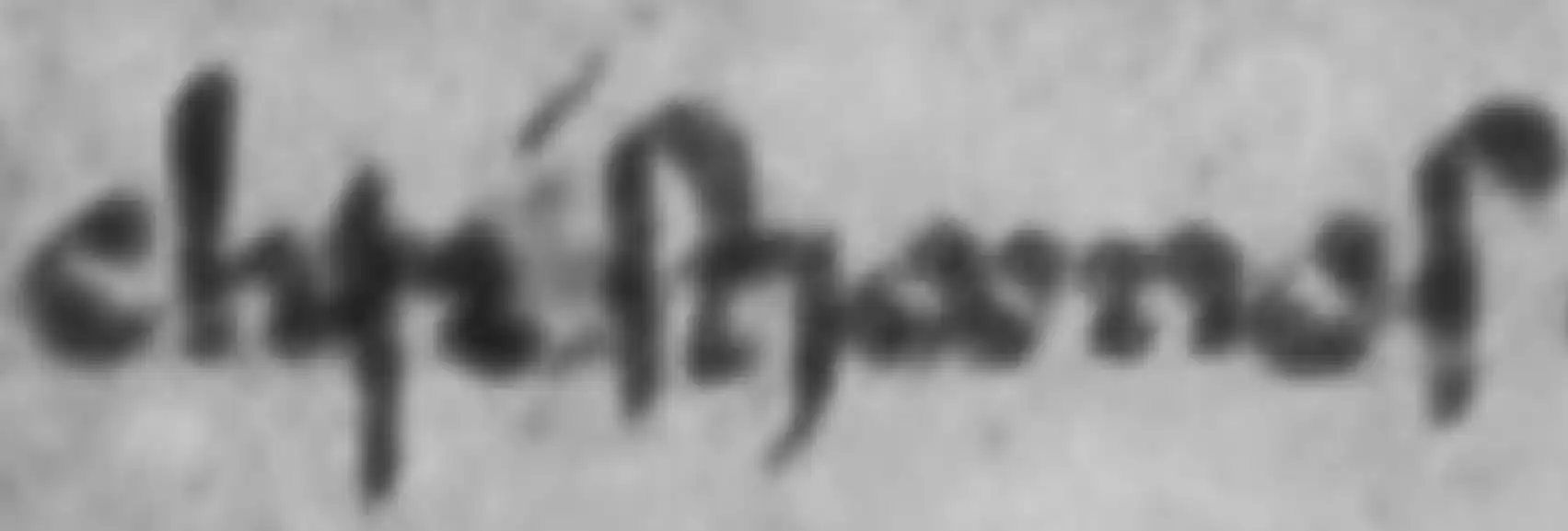
A scribe note shows the correction "Christiani" in the right margin of the page.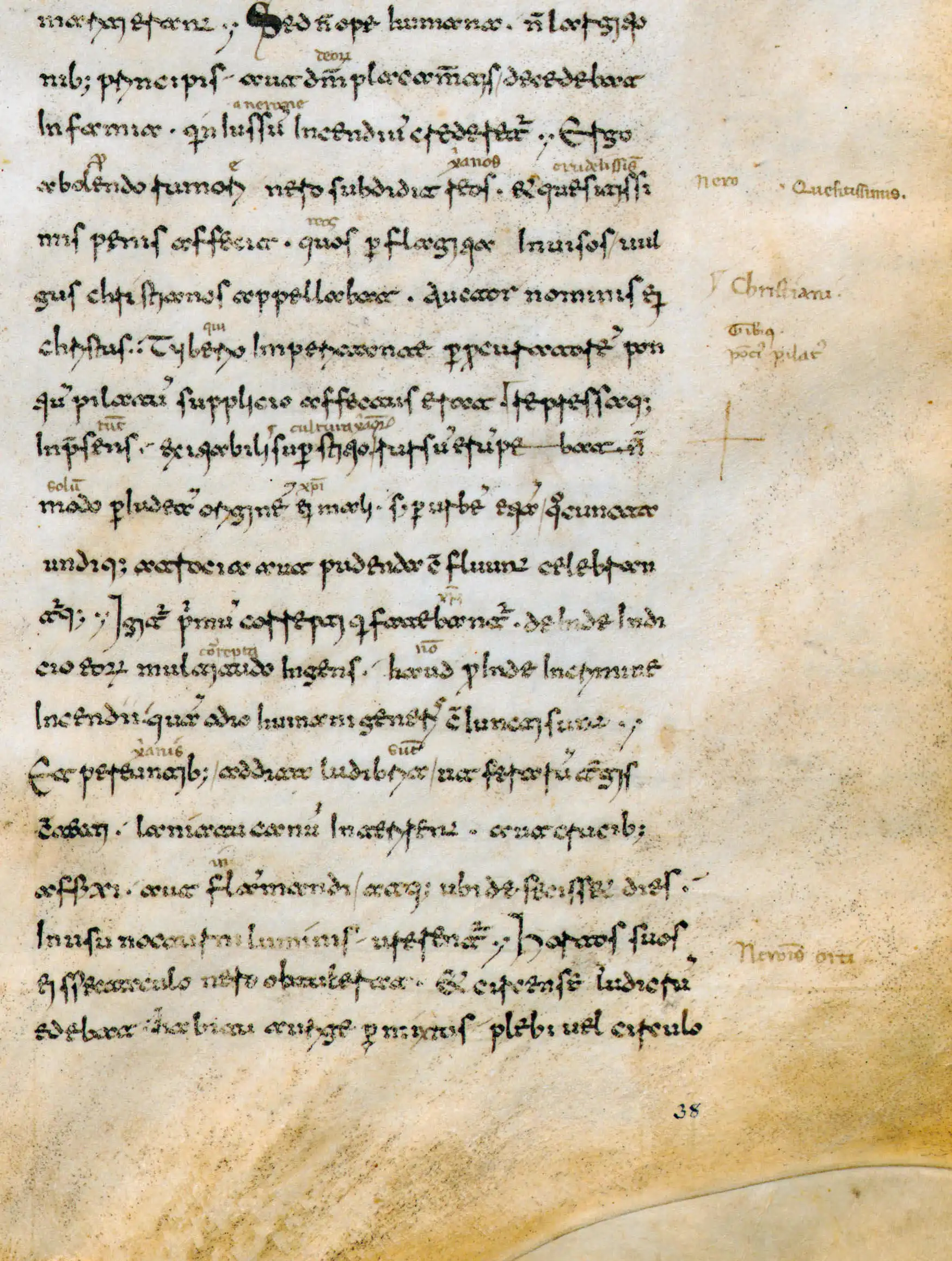
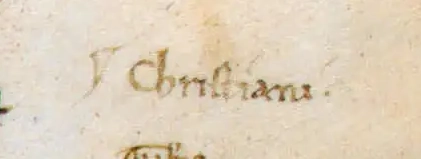
- Noting that "Chrestians" are named after "Christus" doesn't add up.
- Early Christians were terrorists that pleaded guilty, leading to an immense multitude of them being convicted.
- No other contemporary historian or figure mentions the Christians being persecuted by Nero for the fire in Rome. Suetonius writes about the fire, but doesn't associate it with the Christians.
- There is speculation that Tertullian (155CE-220CE) references Tacitus because Tertullian writes that Nero was the first to attack Christians but he doesn't offer a source, he says to "consult your histories".
- A non-contemporary, Sulpicius Severus (363CE-425CE) mentions Nero blaming the Christians for starting the fire in Rome Chronicle book 2 chapter 30. His account doesn't mention a source but there is a hypothesis that either he had an interpolated source that he was referencing, or someone took this account (which he obtained from somewhere else) and then interpolated it into the works of Tacitus. It's inconclusive.
- Tacitus had access to the Roman archives but makes several unusual mistakes:
- He doesn't provide sources for anything in the passage.
- A reference to a title (Christus/Chrestus) without a name (Jesus). This is about as useful as a gravestone that says: "Oiled."
- Instead of a date, he only provides the range of during Tiberius' reign. A window of 22 years, 5 months, 27 days. With access to the Roman archives he could have specified the date, instead this looks like someone trying to vaguely make the connection to what's stated in Luke and Evangelion.
- He doesn't mention Crucifixion, only that an unnamed person suffered the extreme penalty, but he doesn't explain why the extreme penalty was given. Crosses are mentioned as once of the punishments performed on the group, but it doesn't say that's what happened to Christ.
- Incorrectly calls Pilate a procurator, instead of a prefect in Annals 15.44. While it is true that procurator was expanded in the 40s, the first being Cuspius Fadus.
- Tacitus makes a clear distinction between the titles 19 chapters earlier in Annals book 15 chapter 25.
- The best evidence that he knew the difference are the 77 times he mentions prefects:
* Differentiates Procurators and Prefects a few chapters before making the mistake.
- The reference to and the details about Christians after specifying the Chrestians in Annales 15.44 is an interpolation. Stylometry provides additional evidence of its interpolation.
Tacitus Annales 15.44
Sed non ope humana, non largitionibus principis aut deum placamentis decedebat infamia, quin iussum incendium crederetur. ergo abolendo rumori Nero subdidit reos et quaesitissimis poenis adfecit, quos per flagitia invisos vulgus Chrestianos appellabat. auctor nominis eius Christus Tibero imperitante per procuratorem Pontium Pilatum supplicio adfectus erat; repressaque in praesens exitiabilis superstitio rursum erumpebat, non modo per Iudaeam, originem eius mali, sed per urbem etiam, quo cuncta undique atrocia aut pudenda confluunt celebranturque. igitur primum correpti qui fatebantur, deinde indicio eorum multitudo ingens haud proinde in crimine incendii quam odio humani generis convicti sunt.
But all human efforts, all the lavish gifts of the emperor, and the propitiations of the gods, did not banish the sinister belief that the conflagration was the result of an order. Consequently, to get rid of the report, Nero fastened the guilt and inflicted the most exquisite tortures on a class hated for their abominations, called Chrestians by the populace. Christus, from whom the name had its origin, suffered the extreme penalty during the reign of Tiberius at the hands of one of our procurators, Pontius Pilatus, and a most mischievous superstition, thus checked for the moment, again broke out not only in Judæa, the first source of the evil, but even in Rome, where all things hideous and shameful from every part of the world find their centre and become popular. Accordingly, an arrest was first made of all who pleaded guilty; then, upon their information, an immense multitude was convicted, not so much of the crime of firing the city, as of hatred against mankind.
Gaius Suetonius Tranquillus
69CE-122CE
- Suetonius worked for Pliny the Younger. Pliny helped Suetonius buy property and helped him gain favor with Trajan and Hadrian.
- Emperor Claudius' reign was around 41CE-54CE. It should be obvious that the reference isn't about Jesus since he wouldn't have been alive during Claudius' reign. It also describes a specific person who was instigating crime.
- It also mentions Rome, which we have no evidence that Jesus ever visited. So Jesus wouldn't have been instigating trouble there. The closest reference we have is the apocryphal Gospel of Peter mentioning Peter seeing Jesus on the road to Rome as Peter is leaving.
- The use of "them." While it has been argued that it can mean a single individual, the start of the quote provides the context of plural usage with "the Jews."
- Suetonius also wrote about Christians and their persecution by Nero, however, he does not connect them to the Great Fire of Rome as Tacitus does. He mentions the laws passed by Nero to maintain public order, in that passage the word translated to mischievous: "maleficus" could also mean magical or magician, possibly associated with black magic. The passage is also nothing more than a reference to an existing group of believers, not to the existence of Jesus. It also demonstrates that Suetonius made a distinction between the Christians in this passage and the Jewish Crestians in the Biography of the Emperor Claudius.
- He never mentions Jesus.
Lives of the Twelve Caesars: Nero 16
Biography of the Emperor Claudius Divus Claudius 25
Polycarp
69CE-155/167CE
- Irenaeus claimed he was a companion of Papias and a "hearer" of John.
- Irenaeus also claims Polycarp was converted to Christianity by apostles.
- There are claims that he and Ignatius had correspondence but the surviving letter we have of Polycarp contains interpolations and the letters of Ignatius are also considered spurious.
- St. Alphonsus reports that Irenaeus had the good fortune, when young, to know Polycarp who was advanced in age.
- In the Martyrdom of Polycarp it states he had served for 86 years, it is unclear if he is referring to his age or if he had lived 86 years after his conversion.
- Irenaeus states that on Polycarp's visit to Rome that he converted many disciples of Marcion and Valentinus. Which would be likely post 140CE because Marcion published his canon around 140CE-144CE and Valentinus formed his own group after not becoming Bishop of Rome (Pope) between 136CE-143CE.
Phlegon of Tralles
2ND century
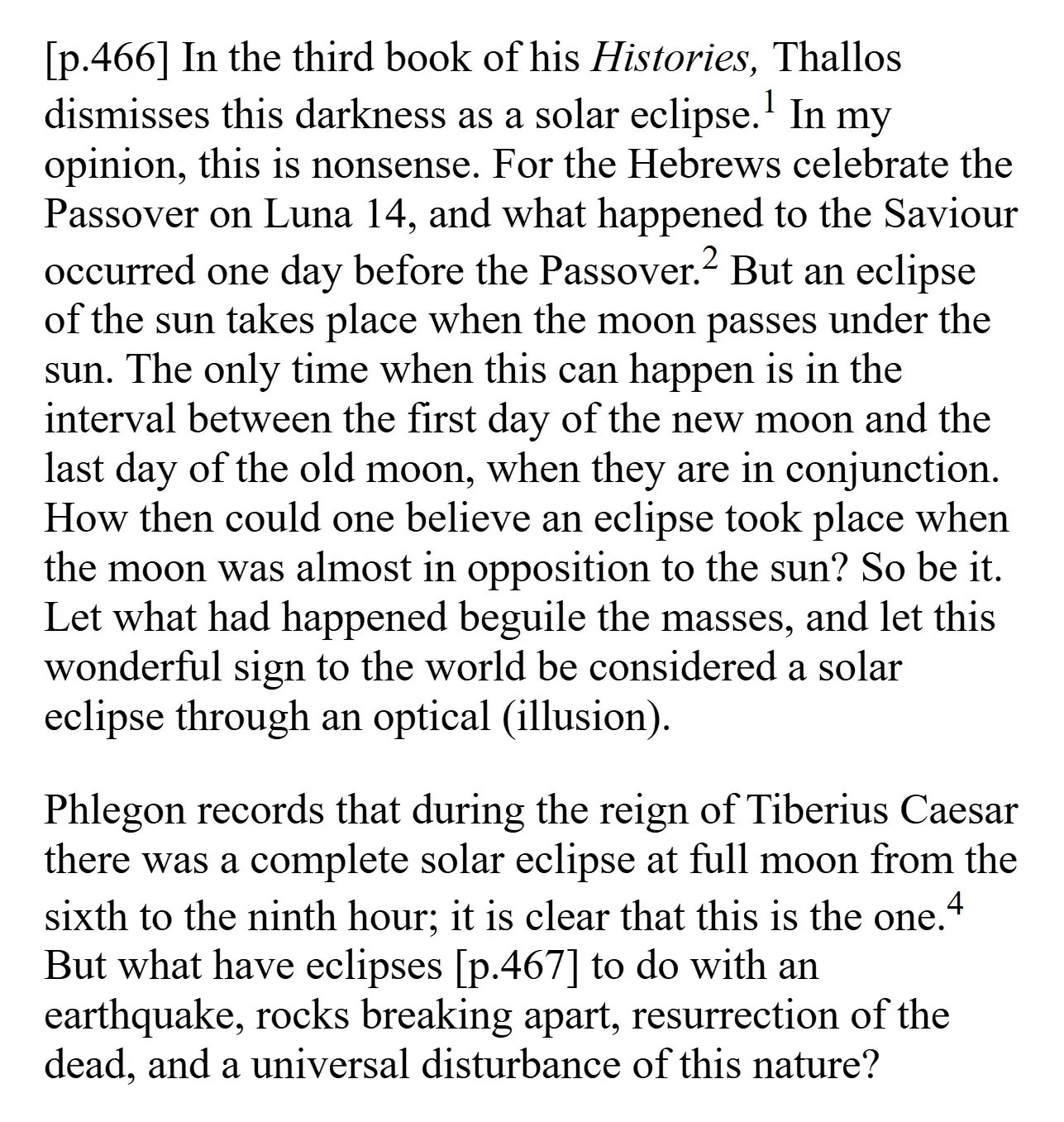
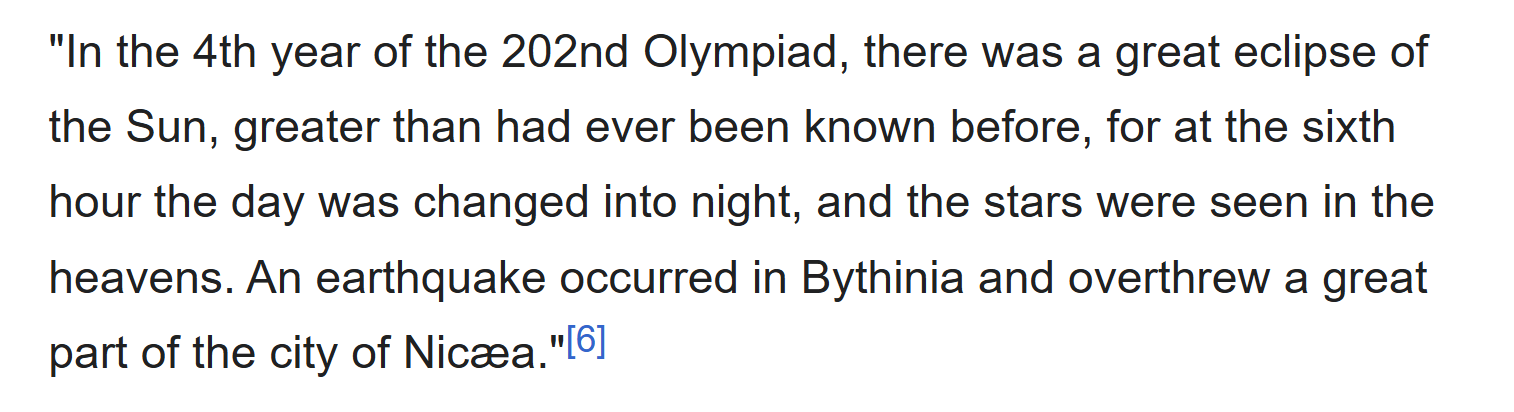
- Origen of Alexandria quotes Phlegon saying Jesus knew about future events but also notes that Phlegon mistakenly attributes things Peter did to Jesus. There aren't any surviving texts to support what Origen says and Origen didn't include quotes of the text he's referring to. Origen also mentions in his commentary on Matthew "Phlegon, who mentioned an eclipse during the reign of Tiberius Caesar, did not say that it happened during the full moon."
- Eusebius and Origen's quote tells us that the earliest version of the passage from Julius Africanus didn't make wild claims like the later manuscripts. Since Julius was a contemporary of Origen, Origen would have either cited Africanus or pointed out that his writings didn't quote Phlegon properly. We also know that Origen knew Africanus because he published their correspondence.
- We also see that he says nothing about the eclipse lasting three hours or happening during a full moon.
Marcion of Sinope
85CE-160CE
- The first to publish a complete New Testament canon around 144CE.
- It included:
- Evangelion (Gospel of Marcion)
- Apostolikon: Galatians, 1 & 2 Corinthians, Romans, 1 & 2 Thessalonians, Laodiceans, Colossians, Philippians, and Philemon.
- Evangelion and the Apostolikon are thought to have been composed between the 130s-140s CE and according to Tertullian, published in 144 CE.
- Marcion believed the Old Testament god was an evil and vengeful deity that he referred to as the Demiurge.
- Marcion presented Jesus as a deity that was sent down from heaven by the Unknown God to save humanity.
- There are claims that he was excommunicated by the early Christian church for his teachings around 144CE. There are no surviving records of this event. There isn't a clear consensus as to who was the Pope at the time: Pope Pius either started between 142-146CE to 157-161CE. His predecessor Pope Anicetus may have started between 153-157CE.
- All or nearly all of Evangelion is found in other works and gospels. For example, the Codex Bezae contains phrasing that aligns with the reconstructions of Evangelion rather than the standardized Alexandrian text.
- Irenaeus claimed Marcion mutilated Luke.
- Tertullian claimed in Against Marcion that Marcion erased portions of the text.
- It was more common to add text than to remove it:
- Johann Jakob Griesbach (1745-1812): Griesbach established a critical canon stating that "scribes were much more prone to add than to omit. They hardly ever leave out anything on purpose, but they added much".
- Bart Ehrman (The Scribes Who Changed Their Texts on Purpose): Ehrman highlights that intentional alterations (as opposed to accidental, which are more common) were often made to add clarifications, fill in "gaps" in the narrative, or harmonize parallel passages (like making Mark conform to Matthew).
- Prof.David M. Carr uses the term "Revision by Extension" to describe the act of using empty space on a scroll.
- Daniel B. Wallace wrote about scribal additions in "The Significance of the Scribal Corruptions to the New Testament Text."
- Using Stylometry we can see that the reconstructions of Evangelion are present in the majority of Luke (chapters 4-22). While Luke (chapters 1-4, 23-24) aligns with Acts. This result would not be possible if Evangelion was written after Luke; if Evangelion was written after Luke, it would be an offshoot of Luke and Acts, instead of being the majority of Luke. This means the claims about Marcion taking Luke and truncating to fit his needs are false. Instead published works were taken and expanded upon.
- Evangelion could be the quelle source "Q" document.
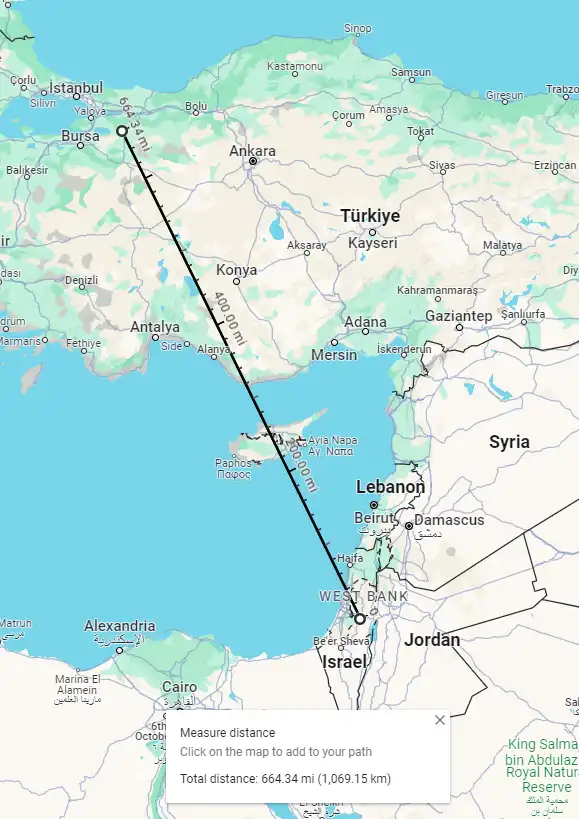
- Marcion is from Sinope. Sinope is located on the northern coast of Bithynia. Pliny the Younger wrote about his first encounter with Christians while governor of Bithynia, this is the first, first-hand documented encounter of Christians (~111CE), he described them as superstition that could be put in check. This area is also the one that Paul was unable to enter according to Acts.
- Additionally 1 Timothy 6:20 warns against "opposing arguments falsely called knowledge." The Greek words are antithesis and gnosis. Marcion was a gnostic and published a work called Antithesis.
- Marcion portrayed Jesus as a celestial being that came down from heaven. As such, Evangelion and Apostolikon did not contain elements that tied Jesus to birth narrative or familial relationships. While some argue that because verses like Galatians 1:19-20 were not quoted by adversaries does not mean they weren't there. However, there's no satisfactory reason why they would be included in the original Evangelion if he was not born and did not have an earthly family.
- The First New Testament: Marcion's Scriptural Canon (Jason BeDuhn)
- Jesus never affirms the Christ title. In the verse where Peter makes that identification, Jesus rebukes him. Jesus also calls himself "the human being" and advises against following people who will call him Christ.
- Evangelion places importance on listening to the teachings of Jesus, whereas Luke adds references to Jewish scriptures and listening to god.
- Evangelion doesn't refer to Jesus as a punisher or have him using threatening language as found in Luke.
- Evangelion never uses the term "devil" but Luke inserts it seven times. Evangelion uses the name Satan twice, while Luke uses it five times.
- Marcionites as a group were ascetic (avoid physical/material pleasures and live without luxury) which aligns with the followers of John and the Pharisees, which is referenced and contrasted in Luke.
- Marcionites rejected physical resurrection and believed the death of the body was "insignificant."
- Marcionites did not believe in any kind of judgement from god or Jesus. Unlike the messages in Luke.
- To quote BeDuhn on page 77: The “missing” material relative to Luke does not contain any concept contrary to Marcionism not found also in other passages retained in the Evangelion.
- The absence of a birth narrative is not an indication of a redaction from Luke. This is evidenced by the fact that Mark and John also do not present birth stories.
- Current canon compared to Evangelion and Apostolikon
- Canonical SectionPresent in Canonical NTStatus in Marcion's ReconstructionLuke 1:1-2:52Infancy narratives (Birth of John the Baptist, Annunciation, Virgin Birth, Boy Jesus in Temple).Absent entirely (Gospel opens at Luke 3:1 / 4:31).Luke 3:1-4:30 (portions)Baptism by John, physical Genealogy through Adam (Luke 3:23-38), Nazareth rejection.Absent (No baptism or genealogy).Luke 4:22"Is not this Joseph's son?"Absent.Luke 8:19Explicit narrator statement: "Now Jesus' mother and brothers came to see him..."Absent (Luke 8:20-21 retained as dialogue: "My mother and my brothers are those who hear the word of God and do it.")Luke 9:27"Indeed, truly I tell you, there are some standing here who will not taste death before they see the kingdom of God."Absent.Romans 1:3-4"Born of the seed of David according to the flesh"Absent (Attested by Tertullian as missing).Romans 9-11Extensive discourse on Israel's covenant history.Substantially reduced / absent.Galatians 1:19Mention of "James, the Lord's brother"Absent.Galatians 4:4"...born of a woman, born under the law"Physical birth is absent.1 Corinthians 15:5-11Cephas, the twelve, the 500 brethren, James, and Paul's sequence.Absent.
- Across both halves of Marcion's canon, every major text that explicitly connects Jesus to:
- A human mother/father (Mary, Joseph)
- Biological birth / human gestation ("womb", "born of a woman")
- Earthly patriarchal/Davidic genealogy ("seed of David according to the flesh")
The Gospels
Mid 2ND century
Issues
- The Gospels are anonymous. The authors don't identify themselves.
- Mark supposedly was the interpreter of Peter, but never met Jesus.
- Luke supposedly was a companion of Paul.
- Paul never knew or met Jesus.
- According to Acts 4:13, both Peter and John were illiterate.
- The Gospels were named by Irenaeus of Lyon ~180CE. If his naming was correct we run into an interesting problem. Matthew borrows from Mark, which is akin to writing about a personal friend but borrowing details from someone who never knew your friend.
- Jesus didn't fulfill any prophecies. The 300+ prophecies often cited, weren't fulfilled.
- Matthew 2:6 references Jesus coming from Bethlehem in Micah 5:2 (5:1 in some editions) but the verse is to Bethlehem Ephrathah, an individual in the small clan of Bethlehem. It also neglects the rest of the passage where the subject is supposed to rule Assyria with the sword, which Jesus didn't fulfill.
- Matthew 2:15 references Hosea 11:1 but neglects Hosea 11:2 where offerings are made to Baal.
- There's no evidence for a custom of governors releasing a prisoner on Passover. This detail is only in the Gospels and nowhere else.
- Psalms 22 does not talk about Jesus. The most accurate translation is from the NRSVUE and it doesn't mention piercing. It's also not a prophecy because it is not written in future tense.
- Pontius Pilate was not known to succumb to crowd pressure. In Josephus' works The Jewish Wars Book 2 Chapter 9 Section 3, Pilate hides soldiers in the crowd and has them attack and kill people on his command. It's also mentioned in Antiquities of the Jews Book 18 Chapter 3 Section 2. Additionally, in Antiquities of the Jews Book 18 Chapter 4 Sections 1-2 Pilate orders more violence upon the people and was eventually removed from his position for his actions in 36CE.
- Origen of Alexandria argues for the spiritual, allegorical interpretation of Scripture in De Principiis Book IV: Since, therefore, as will be clear to those who read, the connection taken literally is impossible, while the sense preferred is not impossible, but even the true one, it must be our object to grasp the whole meaning, which connects the account of what is literally impossible in an intelligible manner with what is not only not impossible, but also historically true, and which is allegorically understood, in respect of its not having literally occurred. For, with respect to holy Scripture, our opinion is that the whole of it has a spiritual, but not the whole a bodily meaning, because the bodily meaning is in many places proved to be impossible.
Contradictions
- Jesus birth:
- Mary is pregnant in Luke 1 and Matthew 2:1 during Herod the Great (72BCE-4BCE)
- Luke 2 says Mary is still pregnant when Cyrenius/Quirinius (51BCE-21AD) was governor of Syria. Quirinius was appointed in 6CE.
- 4BCE to 1BCE = 4 and 1CE to 6CE = 6. That's a difference of around 10 years.
- Matthew 2 mentions Joseph's vision and flight to Egypt. Luke 2 has them go to Jerusalem for purification, where Herod was allegedly killing the firstborn (according to Matthew; this event isn't recorded anywhere else) and then back to Nazareth.
- If Jesus was born during the census in 6CE and Luke says he was about thirty years old, he would have started his ministry around 36CE and died in 39CE. This is a problem because Pontius Pilate returned to Rome in 36CE and died in 39CE.
- Nazareth
- Matthew 2:23: States Joseph fled to Nazareth, fulfilling what the prophets foretold "He will be called a Nazarene."
- John 1:46: Quotes Nathanael "Can anything good come out of Nazareth?" Indicating the author of John was unaware of the prophecy.
- Nazareth and Nazarene are not found anywhere in the Old Testament. There is no known prophecy that Matthew is speaking of.
- Jesus genealogy:
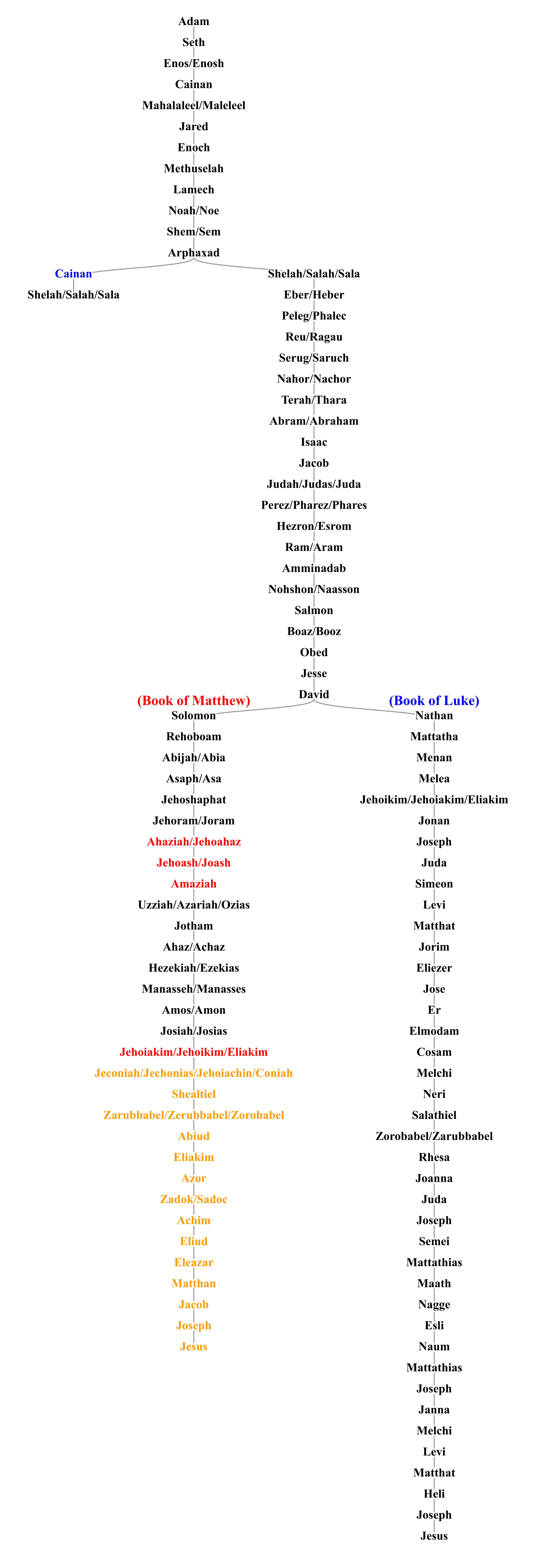 Color coding: Orange: Jeconiah cursed lineage, Blue: Person missing from Luke's account, Red: Person missing from Matthew.The claim that one of the genealogies is for Mary is mistaken. Mary's parents Joachim and Anne are listed in the Protoevangelium of James.Numbers 1:2-4 and throughout the rest of the book and Bible utilize patriarchal lineage.Joseph wasn't biologically related to Jesus. It would only be a paper relationship and not a bloodline relationship.Since Joseph wasn't the father, Jesus satisfies the misbegotten/illegitimate birth conditions of Deuteronomy 23:2.Inheritance laws didn't not apply equally to adopted children, and was only recently legally recognized.It wasn't until the Mishnaic/Talmudic period near the second century that a person was considered Jewish through the matrilineal line. This is still observed in conservative and Orthodox communities.
 - Jesus death & burial.
- The day Jesus was crucified:
- Matthew: The day after preparation.
- Mark, Luke & John: The day of preparation.
- The hour Jesus was crucified:
- Who carried Jesus' cross:
- Matthew, Mark & Luke: Simon of Cyrene.
- John: Jesus carried his own cross.
- Mocking criminals:
- Matthew & Mark: The thieves mocked Jesus.
- Luke: One of the thieves mocked Jesus, but the other repented.
- Last words:
- Matthew & Mark: Jesus cried out before dying.
- Luke: "Father, into thy hands I commend my spirit." before dying.
- John: "It is finished." before dying.
- The Darkness:
- Passover happens during a full moon. Only a lunar eclipse is possible during a full moon because the shadow of the Earth is cast onto it, making them visible at night. For darkness to happen during the day a solar eclipse during the "new moon" phase is required and that isn't possible during Passover.
- Jesus allegedly started his ministry during the 15TH year of Tiberius Caesar's (42BCE-37CE) reign which started in 14CE. Meaning Jesus started his ministry in 29CE. A solar eclipse was visible in Jerusalem in November of that year but it only lasted 1m59s.
- A total solar eclipse did take place on Sunday March 19TH 33CE but it wasn't visible in Jerusalem and it wasn't during passover.
- A lunar eclipse occurred on April 3RD 33CE which people point to as the darkness during the crucifixion. However, it wasn't during the day and it was not a total lunar eclipse. It was only a partial lunar eclipse, but it lasted nearly 3 hours.
- Who was at the Tomb:
- Matthew: An earthquake happened, an angel came down and rolled the stone away, then sat on it, while Mary Magdalene and the other Mary were there.
- Mark: Mary Magdalene, Mary the mother of James, and Salome saw that the stone was already rolled away.
- Luke: The stone was already rolled away but it was Mary Magdalene, Joanna, Mary the mother of James, and other women that were there.
- John: The stone was already rolled away and it was only Mary Magdalene who was there.
- Contents of the Tomb:
- Matthew: The angel tells both women to look and see that Jesus was not in the tomb, it doesn't say if they looked, just that the women departed.
- Mark: A young man was in the tomb.
- Luke: Two men in shining garments were in the tomb.
- John: Mary ran to tell Peter and an anonymous disciple that Jesus was taken. The anonymous disciple looked first, but both he and Peter only saw linens in the tomb, and then they went home. When Mary looks into the tomb, she sees two angels, and then she sees Jesus but doesn't recognize him.
- The day Jesus was crucified:
- Death of Judas:
- Matthew 27:3-5 says Judas hung himself after throwing the money down in the temple.
- Acts 1:16-19 says he bought a field with the money and his guts exploded.
- The number of Apostles after the crucifiction; Judas betrayed Jesus and was no longer one of the twelve:
Joseph of Arimathea
- Arimathea doesn't exist. There is no external evidence for the existence of Arimathea.
- Apologists claim it was Ramathaim from 1 Samuel 1:1. But they would be using the Greek Septuagint, instead of Hebrew. However, it's still not a proper reference because the Septuagint says "Armathaim Sipha", if that was the reference they didn't copy it correctly, even though we know the they referenced the Septuagint.
- Ramla was identified as Arimathea, but it was founded in the 8TH century.
- This character is not mentioned anywhere else. He's a wealthy man who makes a sudden appearance to serve a distinct purpose.
- Joseph bar Matthias is a far more likely candidate. Yosef bar Matthias has a phonetic similarity to Yosef Arimathea. This is also the patronymic name for Flavius Josephus who was also a wealthy man who helped some acquaintances after their crucifixion.
Solitary claims
- Only John claims that Jesus was pierced by a spear and the others being crucified had their bones broken.
- Only Mark claims Jesus says "Eloi, Eloi, lema sabachthani?" which is Aramaic. The problem is, the Aramaic speaking crowd of Jewish people incorrectly think he's talking about Elijha. This might make sense to a Greek storyteller but if the audience was Aramaic they wouldn't have misunderstood what was said.
- Only Matthew claims the tomb was guarded, and it was guarded a day later.
Later additions
- Mark 16:9-20 isn't present until the 4TH century. Most apologists will say the idea was present even though it's not in the text. Eusebius of Caesarea (an admitted liar) even noted that accurate copies of Mark ended earlier.
- John 7:53-8:11 wasn't added to John until around the 5TH century. The Didascalia Apostolorum a.k.a. the Teachings of the Apostles it contains the Pericope Adulterae (Jesus and the woman taken in adultery) but the Didascalia Apostolorum was written between the 3RD and 4TH century.
- 1 John 5:7-8 the Johannine comma is not found in any Greek manuscript until the 14TH century.
- Matthew 17:21 was added around the 4TH-5TH century.
- Matthew 18:11 isn't seen until after the 5TH century.
Third person omniscient
External records
- There are no arrest or execution records for Jesus.
- Josephus would not have suggested that Jesus was more than a man. It's a known interpolation by Eusebius.
- Tacitus never mentioned the name Jesus, at best the title of Christ is mentioned, without a real name. It also gets Pilate's position wrong, a title he uses 77 times in the works we have of his.
- Suetonius has a similar issue; he mentions a group who caused violence at the instigation of a person who was alive at the time, which would have been after the supposed lifetime of Jesus.
- The Pilate cycles contain known fakes written much later than the lifetime of Jesus. Several of the stories contain unrealistic claims.
Apocrypha
- A significant number of gospels, epistles, apocalypses, and acts were produced.
- Many of these works were cited by early church fathers and circulated within early Christianity until the 5TH century.
- Some of the works contain fantastic feats and events. Such as the Infancy Gospel of Thomas where Jesus brings clay sparrows to life, and kills children who cross him. In one instance he blinds the parents of the child that he killed with a curse. Jesus also cures his stepbrother James (son of Joseph) from a snake bite, this instance would present problem; the book of John states that his brothers didn't believe in him.
Anachronisms
Failed Prophecies
Main article
- Genesis 3:15 Seed of a woman (virgin birth) Luke 1:35, Matthew 1:18-20
- Genesis 3:15 He will bruise Satan's head Hebrews 2:14, 1 John 3:8
- Genesis 5:24 The bodily ascension to heaven illustrated Mark 6:19
- Genesis 9:26-27 The God of Shem will be the Son of Shem Luke 3:36
- Genesis 12:3 As Abraham's seed, will bless all nations Acts 3:25-26
- Genesis 12:7 The The Promise made made to Abraham's Seed Galatians 3:16
- Genesis 14:18 A priest after Melchizedek Hebrews 6:20
- Genesis 14:18 A King also Hebrews 7:2
- Genesis 14:18 The Last Supper foreshadowed Matthew 26:26-29
- Genesis 17:19 The Seed of Isaac Romans. 9:7
- Genesis 21:12 Seed of Isaac Romans 9:7, Hebrews 11:18
- Genesis 22:8 The Lamb of God promised John 1:29
- Genesis 22:18 As Isaac's seed, will bless all nations Galatians 3:16
- Genesis 26:2-5 The Seed of Isaac promised as the Redeemer Hebrews 11:18
- Genesis 49:10 The time of His coming Luke 2:1-7; Galatians 4:4
- Genesis 49:10 The Seed of Judah Luke 3:33
- Genesis 49:10 Called Shiloh or One Sent John 17:3
- Genesis 49:10 To come before Judah lost identity John 11:47-52
- Genesis 49:10 To Him shall the obedience of the people be John 10:16
- Exodus 3:13,14 The Great "I Am" John 4:26
- Exodus 12:5 A Lamb without blemish 1 Pet. 1:19
- Exodus 12:13 The blood of the Lamb (or goat) saves Romans wrath Romans. 5:8
- Exodus 12:21-27 Jesus is our Passover 1 Corinthians 5:7
- Exodus 12:46 Not a bone of the Lamb to be broken John 19:31-36
- Exodus 13:2 Blessing to first born son Luke 2:23
- Exodus 15:2 His exaltation predicted as Yeshua Acts 7:55,56
- Exodus 15:11 His Character-Holiness Luke 1:35; Acts 4:27
- Exodus 17:6 The Spiritual Rock of Israel 1 Corinthians 10:4
- Exodus 33:19 His Character-Merciful Luke 1:72
- Leviticus 14:11 The leper cleansed-Sign to priesthood Luke 5:12-14; Acts 6:7
- Leviticus16:15-17 Prefigures Jesus 's once-for-all death Hebrews 9:7-14
- Leviticus 16:27 Suffering outside the Camp Matthew 27:33; Hebrews 13:11, 12
- Leviticus 17:11 The Blood-the life of the flesh Matthew 26:28; Mark 10:45
- Leviticus 17:11 It is the blood that makes atonement 1 John 3:14-18
- Leviticus 23:36-37 The Drink-offering: "If any man thirst." John 19:31-36
- Numbers 9:12 Not a bone of Him broken John 19:31-36
- Numbers 21:9 The serpent on a pole-Jesus lifted up John 3:14-18
- Numbers 24:8 Flight to Egypt Matthew 2:14
- Numbers 24:17 Time: "I shall see him, but not now." Galatians 4:4
- Numbers 24:17-19 A star out of Jacob Matthew 2:2, Luke 1:33,78, Revelation 22:16
- Deuteronomy 18:15 "This is of a truth that prophet." John 6:14
- Deuteronomy 18:15-16 "Had ye believed Moses, ye would believe me." John 5:45-47
- Deuteronomy 18:18 Sent by the Father to speak His word John 8:28, 29
- Deuteronomy 18:19 Whoever will not hear must bear his sin John 12:15
- Deuteronomy 21:13-23 As a prophet John 6:14; 7:40, Acts 3:22,23
- Deuteronomy 21:23 Cursed is he that hangs on a tree Galatians 3:10-13
- Ruth 4:4-9 Christ, our kinsman, has redeemed us Ephesians 1:3-7
- 1 Samuel 2:10 Shall be an anointed King to the Lord Matthew 28:18; John 12:15
- 2 Samuel 7:12 David's Seed Matthew 1:1
- 2 Samuel 7:14a The Son of God Luke 1:32
- 2 Samuel 7:16 David's house established forever Luke 3:31; Rev. 22:16
- 2 Samuel 23:2-4 would be the “Rock” 1 Corinthians 10:4
- 2 Samuel 23:2-4 would be as the “light of the morning” Revelation 22:16
- 2 Kings 2:11 The bodily ascension to heaven illustrated Luke 24:51
- 1 Chronicles 17:11 David's Seed Matthew 1:1; 9:27
- 1 Chronicles 17:12, 13a To reign on David's throne forever Luke 1:32, 33
- 1 Chronicles 17:13a "I will be His Father, He my Son." Hebrews 1:5
- Job 19:23-27 The Resurrection predicted John 5:24-29
- Psalms 2:1-3 The enmity of kings foreordained Acts 4:25-28
- Psalms 2:2 To own the title, Anointed (Christ) Acts 2:36
- Psalms 2:6 His Character-Holiness John 8:46; Rev. 3:7
- Psalms 2:6 To own the title King Matthew 2:2
- Psalms 2:7 Declared the Beloved Son Matthew 3:17
- Psalms 2:7, 8 The Crucifixion and Resurrection intimated Acts 13:29-33
- Psalms 2:12 Life comes through faith in Him John 20:31
- Psalms 8:2 The mouths of babes perfect His praise Matthew 21:16
- Psalms 8:5, 6 His humiliation and exaltation Luke 24:50-53; 1 Corinthians 15:27
- Psalms 16:10 Was not to see corruption Acts 2:31
- Psalms 16:9-11 Was to arise from the dead John 20:9
- Psalms 17:15 The resurrection predicted Luke 24:6
- Psalms 22:1 Forsaken because of sins of others 2 Corinthians 5:21
- Psalms 22:1 Words spoken from Calvary, "My God " Mark 15:34
- Psalms 22:2 Darkness upon Calvary Matthew 27:45
- Psalms 22:7 They shoot out the lip and shake the head Matthew 27:39
- Psalms 22:8 " He trusted in God, let Him deliver Him " Matthew 27:43
- Psalms 22:9 Born the Savior Luke 2:7
- Psalms 22:14 Died of a broken (ruptured) heart John 19:34
- Psalms 22:14,15 Suffered agony on Calvary Mark 15:34-37
- Psalms 22:15 He thirsted John 19:28
- Psalms 22:16 They pierced His hands and His feet John 19:34,37;20:27
- Psalms 22:17,18 Stripped Him before the stares of men Luke 23:34,35
- Psalms 22:18 They parted His garments John 19:23,24
- Psalms 22:20,21 He committed Himself to God Luke23:46
- Psalms 22:20,21 Satanic power bruising the Redeemer's heel Hebrews 2:14
- Psalms 22:22 His Resurrection declared John 20:17
- Psalms 22:27 He shall be the governor of the nations Col 1:16
- Psalms 22:31 "It is finished" John 19:30
- Psalms 23:1 "I am the Good Shepherd" John 10:11
- Psalms 24:3 His exaltation predicted Acts 1:11; Phil. 2:9
- Psalms 27:12 Accused by false witnesses Matthew 26:60,61, Mark 14:57,58
- Psalms 30:3 His resurrection predicted Acts 2:32
- Psalms 31:5 "Into thy hands I commit my spirit" Luke 23:46
- Psalms 31:11 His acquaintances fled from Him Mark 14:50
- Psalms 31:13 They took counsel to put Him to death John 11:53
- Psalms 31:14,15 " He trusted in God, let Him deliver him" Matthew 27:43
- Psalms 34:20 Not a bone of Him broken John 19:31-36
- Psalms 35:11 False witnesses rose up against Him Matthew 26:59
- Psalms 35:19 He was hated without a cause John 15:25
- Psalms 38:11 His friends stood afar off Luke 23:49
- Psalms 40:2-5 The joy of His resurrection predicted John 20:20
- Psalms 40:6-8 His delight-the will of the Father John 4:34
- Psalms 40:9 He was to preach the Righteousness in Israel Matthew 4:17
- Psalms 40:14 Confronted by adversaries in the Garden John
- Psalms 41:9 Betrayed by a familiar friend John 13:18
- Psalms 45:2 Words of Grace come from His lips Luke 4:22
- Psalms 45:6 To own the title, God or Elohim Hebrews 1:8
- Psalms 45:7 A special anointing by the Holy Spirit Matthew3:16; Hebrews 1:9
- Psalms 45:7,8 Called the Christ (Messiah or Anointed) Luke 2:11
- Psalms 49-15 His Resurrection Acts 2:27; 13:35, Mark 16:6
- Psalms 55:12-14 Betrayed by a friend, not an enemy John 13:18
- Psalms 55:15 Unrepentant death of the Betrayer Matthew 27:3-5; Acts 1:16-19
- Psalms 68:18 To give gifts to men Ephesians 4:7-16
- Psalms 68:18 Ascended into Heaven Luke 24:51
- Psalms 69:4 Hated without a cause John 15:25
- Psalms 69:8 A stranger to own brethren Luke 8:20,21
- Psalms 69:9 Zealous for the Lord's House John 2:17
- Psalms 69:14-20 Messiah's anguish of soul before crucifixion Matthew 26:36-45
- Psalms 69:20 "My soul is exceeding sorrowful." Matthew 26:38
- Psalms 69:21 Given vinegar in thirst Matthew 27:34
- Psalms 69:26 The Savior given and smitten by God John 17:4; 18:11
- Psalms 72:10,11 Great persons were to visit Him Matthew 2:1-11
- Psalms 72:16 The corn of wheat to fall into the Ground John 12:24
- Psalms 72:17 His name, Yinon, will produce offspring John 1:12,13
- Psalms 72:17 All nations shall be blessed by Him Acts 2:11,12,41
- Psalms 78:1.2 He would teach in parables Matthew 13:34-35
- Psalms 78:2b To speak the Wisdom of God with authority Matthew 7:29
- Psalms 88:8 They stood afar off and watched Luke 23:49
- Psalms 89:26 Messiah will call God His Father Matthew 11:27
- Psalms 89:27 Emmanuel to be higher than earthly kings Luke 1:32,33
- Psalms 89:35-37 David's Seed, throne, kingdom endure forever Luke 1:32,33
- Psalms 89:36-37 His character-Faithfulness Rev. 1:5
- Psalms 90:2 He is from everlasting (Micah 5:2) John 1:1
- Psalms 91:11,12 Identified as Messianic; used to tempt Christ Luke 4:10,11
- Psalms 97:9 His exaltation predicted Acts 1:11;Ephesians 1:20
- Psalms 100:5 His character-Goodness Matthew 19:16,17
- Psalms 102:1-11 The Suffering and Reproach of Calvary John 21:16-30
- Psalms 102:16 Son of Man comes in Glory Luke 21:24 Revelation 12:5-10
- Psalms 102:25-27 Messiah is the Preexistent Son Hebrews 1:10-12
- Psalms 109:4 Prays for His enemies Luke 23:34
- Psalms 109:7,8 Another to succeed Judas Acts 1:16-20
- Psalms 109:25 Ridiculed Matthew 27:39
- Psalms 110:1 Son of David Matthew 22:43
- Psalms 110:1 To ascend to the right-hand of the Father Mark 16:19
- Psalms 110:1 David's son called Lord Matthew 22:44,45
- Psalms 110:4 A priest after Melchizedek's order Hebrews 6:20
- Psalms 112:4 His character-Compassionate, Gracious, et al Matthew 9:36
- Psalms 118:17,18 Messiah's Resurrection assured Luke 24:5-7;1 Corinthians 15:20
- Psalms 118:22,23 The rejected stone is Head of the corner Matthew 21:42,43
- Psalms 118:26a The Blessed One presented to Israel Matthew 21:9
- Psalms 118:26b To come while Temple standing Matthew 21:12-15
- Psalms 132:11 The Seed of David (the fruit of His Body) Luke 1:32
- Psalms 138:1-6 The supremacy of David's Seed amazes kings Matthew 2:2-6
- Psalms 147:3,6 The earthly ministry of Christ described Luke 4:18
- Psalms 1:23 He will send the Spirit of God John 16:7
- Proverbs 8:22-23 The Messiah would be from everlasting John 17:5
- Proverbs 30:4 Declared to be the Son of God John 3:13, Romans 1:2-4, 10:6-9, 2 Peter 1:17
- Song of Solomon 5:16 The altogether lovely One John 1:17
- Isaiah 2:2-4 Repentance for the nations Luke 24:47
- Isaiah 4:2 Messiah reigning
- Isaiah 5:1-6 Son of God's vineyard: a parable of judgment
- Isaiah 6:1 When Isaiah saw His glory John 12:40-41
- Isaiah 6:9-10 Parables fall on deaf ears Matthew 13:13-15
- Isaiah 6:9-12 Blinded to Christ and deaf to His words Acts 28:23-29
- Isaiah 7:14 To be born of a virgin Luke 1:35
- Isaiah 7:14 To be Emmanuel-God with us Matthew 1:18-23
- Isaiah 8:8 Called Emmanuel Matthew 28:20
- Isaiah 8:14 A stone of stumbling, a Rock of offense 1 Pet. 2:8
- Isaiah 9:1,2 His ministry to begin in Galilee Matthew 4:12-17
- Isaiah 9:6 A child born-Humanity Luke 1:31
- Isaiah 9:6 A Son given-Deity Luke 1:32; John 1:14; 1 Tim. 3:16
- Isaiah 9:6 Declared to be the Son of God with power Romans. 1:3,4
- Isaiah 9:6 The Wonderful One, Peleh Luke 4:22
- Isaiah 9:6 The Counselor, Yaatz Matthew 13:54
- Isaiah 9:6 The Mighty God, El Gibor Matthew 11:20
- Isaiah 9:6 The Everlasting Father, Avi Adth John 8:58
- Isaiah 9:6 The Prince of Peace, Sar Shalom John . 16:33
- Isaiah 9:7 To establish an everlasting kingdom Luke 1:32-33
- Isaiah 9:7 His Character-Just John 5:30
- Isaiah 9:7 No end to his Government, Throne, and Peace Luke 1:32-33
- Isaiah 11:1 Called a Nazarene-the Branch, Netzer Matthew 2:23
- Isaiah 11:1 A rod out of Jesse-Son of Jesse Luke 3:23,32
- Isaiah 11:2 The anointed One by the Spirit Matthew 3:16,17
- Isaiah 11:2 His Character-Wisdom, Understanding, et al John 4:4-26
- Isaiah 11:4 His Character-Truth John 14:6
- Isaiah 11:10 The Gentiles seek Him John 12:18-21
- Isaiah 12:2 Called Jesus-Yeshua (salvation) Matthew 1:21
- Isaiah 16:4,5 Reigning in mercy Luke 1:31-33
- Isaiah 22:21-25 Peg in a sure place Revelation 3:7
- Isaiah 25:8 The Resurrection predicted I Corinthians 15:54
- Isaiah 26:19 His power of Resurrection predicted John 11:43,44
- Isaiah 28:16 The Messiah is the precious corner stone Acts 4:11,12
- Isaiah 29:13 He indicated hypocritical obedience to His Word Matthew 15:7-9
- Isaiah 29:14 The wise are confounded by the Word I Corinthians 1:18-31
- Isaiah 32:2 A Refuge-A man shall be a hiding place Matthew 23:37
- Isaiah 33:22 Son of the Highest Luke 1:32; 1 Timothy 1:17 6:15
- Isaiah 35:4 He will come and save you Matthew 1:21
- Isaiah 35:5 To have a ministry of miracles Matthew 11:4-6
- Isaiah 40:3,4 Preceded by forerunner John 1:23
- Isaiah 40:9 "Behold your God." John 1:36;19:14
- Isaiah 40:11 A shepherd-compassionate life-giver John 10:10-18
- Isaiah 42:1-4 The Servant-as a faithful, patient redeemer Matthew12:18-21
- Isaiah 42:2 Meek and lowly Matthew 11:28-30
- Isaiah 42:3 He brings hope for the hopeless John 4
- Isaiah 42:4 The nations shall wait on His teachings John 12:20-26
- Isaiah 42:6 The Light (salvation) of the Gentiles Luke 2:32
- Isaiah 42:1,6 His is a Worldwide compassion Matthew 28:19,20
- Isaiah 42:7 Blind eyes opened John 9:25-38
- Isaiah 42:13-25 Messiah's actions at His second coming Revelation
- Isaiah 43:11 He is the only Savior Acts 4:12
- Isaiah 44:3 He will send the Spirit of God John 16:7,13
- Isaiah 45:23 He will be the Judge John 5:22; Romans. 14:11
- Isaiah 48:12 The First and the Last John 1:30; Rev. 1:8,17
- Isaiah 48:17 He came as a Teacher John 3:2
- Isaiah 49:1 Called from the womb-His humanity Matthew 1:18
- Isaiah 49:5 A Servant from the womb Luke 1:31;Phil. 2:7
- Isaiah 49:6 He is Salvation for Israel Luke 2:29-32
- Isaiah 49:6 He is the Light of the Gentiles Acts 13:47
- Isaiah 49:6 He is Salvation unto the ends of the earth Acts 15:7-18
- Isaiah 49:7 He is despised of the Nation John 8:48-49
- Isaiah 50:3 Heaven is clothed in black at His humiliation Luke 23:44,45
- Isaiah 50:4 He is a learned counselor for the weary Matthew 11:28,29
- Isaiah 50:5 The Servant bound willingly to obedience Matthew 26:39
- Isaiah 50:6a "I gave my back to the smiters." Matthew 27:26
- Isaiah 50:6b He was smitten on the cheeks Matthew 26:67
- Isaiah 50:6c He was spat upon Matthew 27:30
- Isaiah 52:4-5 Suffered vicariously Mark 15:3,4,27,28; Luke 23:1-25,32-34
- Isaiah 52:7 To publish good tidings of peace Luke 4:14,15
- Isaiah 52:13 The Servant exalted Acts 1:8-11; Ephesians 1:19-22
- Isaiah 52:13 Behold, My Servant Matthew 17:5; Phil. 2:5-8
- Isaiah 52:14 The Servant shockingly abused Luke 18:31-34; Matthew 26:67,68
- Isaiah 52:15 Nations startled by message of the Servant Romans. 15:18-21
- Isaiah 52:15 His blood shed to make atonement for all Rev. 1:5
- Isaiah 53:1 His people would not believe Him John 12:37-38
- Isaiah 53:2a He would grow up in a poor family Luke 2:7
- Isaiah 53:2b Appearance of an ordinary man Phil. 2:7-8
- Isaiah 53:3a Despised Luke 4:28-29
- Isaiah 53:3b Rejected Matthew 27:21-23
- Isaiah 53:3c Great sorrow and grief Luke 19:41-42
- Isaiah 53:3d Men hide from being associated with Him Mark 14:50-52
- Isaiah 53:4a He would have a healing ministry Luke 6:17-19
- Isaiah 53:4b He would bear the sins of the world 1 Pet. 2:24
- Isaiah 53:4c Thought to be cursed by God Matthew 27:41-43
- Isaiah 53:5a Bears penalty for mankind's transgressions Luke 23:33
- Isaiah 53:5b His sacrifice would provide peace between man and God Col. 1:20
- Isaiah 53:5c His back would be whipped Matthew 27:26
- Isaiah 53:6a He would be the sin-bearer for all mankind Galatians 1:4
- Isaiah 53:6b God's will that He bear sin for all mankind 1 John 4:10
- Isaiah 53:7a Oppressed and afflicted Matthew 27:27-31
- Isaiah 53:7b Silent before his accusers Matthew 27:12-14
- Isaiah 53:7c Sacrificial lamb John 1:29
- Isaiah 53:8a Confined and persecuted Matthew 26:47-27:31
- Isaiah 53:8b He would be judged John 18:13-22
- Isaiah 53:8c Killed Matthew 27:35
- Isaiah 53:8d Dies for the sins of the world 1 John 2:2
- Isaiah 53:9a Buried in a rich man's grave Matthew 27:57
- Isaiah 53:9b Innocent and had done no violence Mark 15:3
- Isaiah 53:9c No deceit in his mouth John 18:38
- Isaiah 53:10a God's will that He die for mankind John 18:11
- Isaiah 53:10b An offering for sin Matthew 20:28
- Isaiah 53:10c Resurrected and live forever Mark 16:16
- Isaiah 53:10d He would prosper John 17:1-5
- Isaiah 53:11a God fully satisfied with His suffering John 12:27
- Isaiah 53:11b God's servant Romans. 5:18-19
- Isaiah 53:11c He would justify man before God Romans. 5:8-9
- Isaiah 53:11d The sin-bearer for all mankind Hebrews 9:28
- Isaiah 53:12a Exalted by God because of his sacrifice Matthew 28:18
- Isaiah 53:12b He would give up his life to save mankind Luke 23:46
- Isaiah 5:12c Grouped with criminals Luke 23:32
- Isaiah 53:12d Sin-bearer for all mankind 2 Corinthians 5:21
- Isaiah 53:12e Intercede to God in behalf of mankind Luke 23:34
- Isaiah 55:1 Every one come who is thirsty New Testament
- Isaiah 55:3 Resurrected by God Acts 13:34
- Isaiah 55:4 A witness John 18:37
- Isaiah 55:5 Foreign nations come to God Acts
- Isaiah 59:15-16a He would come to provide salvation John 6:40
- Isaiah 59:15-16b Intercessor between man and God Matthew 10:32
- Isaiah 59:20 He would come to Zion as their Redeemer Luke 2:38
- Isaiah 60:1-3 Nations walk in the light Luke 2:32
- Isaiah 61:1-2a The Spirit of God upon him Matthew 3:16-17
- Isaiah 61:1-2b The Messiah would preach the good news Luke 4:17-21
- Isaiah 61:1-2c Provide freedom from the bondage of sin and death John 8:31-32
- Isaiah 61:1-2 Proclaim a period of grace John 5:24
- Isaiah 62:1-2 Called by an new name Luke 2:32, Revelation 3:12
- Isaiah 62:11 Thy King Cometh, Entered Jerusalem on Colt Matthew 21:7
- Isaiah 63:1-3 A vesture dipped in blood Revelation 19:13
- Isaiah 63:8,9 Afflicted with the afflicted Matthew 25:34-40
- Isaiah 65:9 The elect shall inherit Romans 11 5-7, Hebrews 7:14, Revelation 5:5
- Isaiah 65:17-25 New heaven/New Earth 2 Peter 3:13, Revelation 21:1
- Isaiah 66:18-19 All nations come to God New Testament
- Jeremiah23:5-6a Descendant of David Luke 3:23-31
- Jeremiah 23:5-6b The Messiah would be God John 13:13
- Jeremiah 23:5-6c The Messiah would be both God and Man 1 Tim. 3:16
- Jeremiah 30:9 Born a King John 18:37, Revelation 1:5
- Jeremiah 31:15 Massacre of infants Matthew 2:16-18
- Jeremiah 31:22 Born of a virgin Matthew 1:18-20
- Jeremiah 31:31 The Messiah would be the new covenant Matthew 26:28
- Jeremiah 33:14-15 Descendant of David Luke 3:23-31
- Ezekiel17:22-24 Descendant of David Luke 3:23-31
- Ezekiel 21:26,27 The humble exalted Luke 1:52
- Ezekiel34:23-24 Descendant of David Matthew 1:1
- Daniel 2:34-35 Stone cut without hands Acts 4:10-12
- Daniel 2:44,45 His Kingdom Triumphant Luke 1:33, 1 Corinthians 15:24, Revelation 11:15
- Dan. 7:13-14a He would ascend into heaven Acts 1:9-11
- Dan. 7:13-14b Highly exalted Ephesians 1:20-22
- Dan. 7:13-14c His dominion would be everlasting Luke 1:31-33
- Daniel 7:27 Kingdom for the Saints Luke 1:33, 1 Corinthians 15:24, Revelation 11:15
- Dan. 9:24a To make an end to sins Galatians 1:3-5
- Dan. 9:24b He would be holy Luke 1:35
- Dan. 9:25 Announced to his people 483 years, to the exact day, after the decree to rebuild the city of Jerusalem John 12:12-13
- Dan. 9:26a Killed Matthew 27:35
- Dan. 9:26b Die for the sins of the world Hebrews 2:9
- Dan. 9:26c Killed before the destruction of the temple Matthew 27:50-51
- Dan. 10:5-6 Messiah in a glorified state Rev. 1:13-16
- Hosea 3:5 Israel restored John 18:37, Romans 11:25-27
- Hosea 11:1, Numbers 24:8 Flight to Egypt Matthew 2:14
- Hosea 13:14 He would defeat death 1 Corinthians 15:55-57
- Joel 2:28-32 Promise of the Spirit Acts 2:17-21, Romans 10:13
- Joel 2:32 Offer salvation to all mankind Romans. 10:12-13
- Micah 2:12-13 Israel Regathered John 10:14,26
- Micah 4:1-8 The Kingdom established - place of Birth Bethlehem Luke 1:33, Matthew 2:1, Luke 2:4,10,11
- Micah 5:2a Born in Bethlehem Matthew 2:1-2
- Micah 5:2b God's servant John 15:10
- Micah 5:2c from everlasting John 8:58
- Haggai 2:6-9 He would visit the second Temple Luke 2:27-32
- Haggai 2:23 Descendant of Zerubbabel Luke 3:23-27
- Joel 2:28-32 Promise of the Spirit Acts 2:17-21, Romans 10:13
- Amos 8:9 The Sun Darkened Matthew 24:29, Acts 2:20, Revelation 6:12
- Amos 9:11-12 Restoration of tabernacle Acts 14:16-18
- Habakkuk 2:14 Earth filled with knowledge of the glory of the Lord Romans 11:26, Revelation 21:23-26
- Zechariah 2:10-13 The Lamb on the Throne Revelation 5:13, 6:9, 21:24
- Zechariah 3:8 God's servant John 17:4
- Zechariah 6:12-13 Priest and King Hebrews 8:1
- Zechariah 9:9a Greeted with rejoicing in Jerusalem Matthew 21:8-10
- Zechariah 9:9b Beheld as King John 12:12-13
- Zechariah 9:9c The Messiah would be just John 5:30
- Zechariah 9:9d The Messiah would bring salvation Luke 19:10
- Zechariah 9:9e The Messiah would be humble Matthew 11:29
- Zechariah 9:9f Presented to Jerusalem riding on a donkey Matthew 21:6-9
- Zechariah 10:4 The cornerstone Ephesians 2:20
- Zechariah 11:4-6a At His coming, Israel to have unfit leaders Matthew 23:1-4
- Zechariah 11:4-6b Rejection causes God to remove His protection Luke 19:41-44
- Zechariah 11:4-6c Rejected in favor of another king John 19:13-15
- Zechariah 11:7 Ministry to "poor," the believing remnant Matthew 9:35-36
- Zechariah 11:8a Unbelief forces Messiah to reject them Matthew 23:33
- Zechariah 11:8b Despised Matthew 27:20
- Zechariah 11:9 Stops ministering to the those who rejected Him Matthew 13:10-11
- Zechariah 11:10-11a Rejection causes God to remove protection Luke 19:41-44
- Zechariah 11:10-11b The Messiah would be God John 14:7
- Zechariah 11:12-13a Betrayed for thirty pieces of silver Matthew 26:14-15
- Zechariah 11:12-13b Rejected Matthew 26:14-15
- Zechariah 11:12-13c Thirty pieces of silver thrown into the house of the Lord Matthew 27:3-5
- Zechariah 11:12-13d The Messiah would be God John 12:45
- Zechariah 12:10a The Messiah's body would be pierced John 19:34-37
List of prophecies ignored in Ezekiel
Anachronisms
Definition
Details from the wrong time period in the story.
Example: "The Dark Knight was incredible, no cap. Gyatt!" said George Washington as he took a massive hit from his vape while yeeting a cherry.
Rabbis before the destruction of the second temple
- Yohanan Ben Zakkai was the first to receive the title of Rabbi some time after 70CE.
- Pharisees transitioned to Rabbis and Sadducees essentially dissolved after the temple's destruction.
- Mentions of Rabbi: John 1:38, 1:49, 3:2, 3:26, 6:25
- Matthew 21 takes place in Jerusalem. Matthew 23 uses Pharisees and Rabbi in the same chapter, incorrectly assuming they co-existed before 70CE.
- In contemporary literature many sages were quoted without the prefix of rabbi. Jose ben Joezer, Simon Ben Shetah, Shmmai, Hillel, Shammai, Nahum, etc.
- The Hebrew word Rabbi is used in the Greek, when other words for Teacher existed.
- Josephus writes extensively about Jewish history near the end of the 1ST century, but he never uses the term Rabbi because he left for Rome around 71CE and the term Rabbi didn't exist at that time.
Other anachronisms
- According to "Did a Rolling Stone Close Jesus' Tomb?" by Amos Kloner at the Biblical Archaeology Society only 4 round tombs have been dated to the second temple period. They know who owned them. Joseph of Arimathaea wasn't one of them. Tombs with smaller round stones were popularized during the Byzantine era. Sadly the article is behind a paywall. There's a way to find it that won't put you wayback.
- Burial in simple linens was not a standard Jewish custom until it was started by Gamaliel II in 118CE; he wanted to ease the burden of funeral expenses. A few exceptions have been discovered. One contained the remains of a wealthy individual who was buried in simple linen, this could be explained by the fact that he had two infectious ailments, he also didn't go through the second burial phase and his tomb was sealed shut (Not with a round stone). The examples we have do not consist of a single piece of linen like the Shroud of Turin.
- Denarii in Mark 12. Donald Ariel in "A Survey of Coin Finds in Jerusalem" concludes that significant numbers of denarii are found in Jerusalem only after 69CE. The Tyrian shekel was the dominant currency in the area in the 30s.
- Mark 13: The Abomination of Desolation/desolating sacrilege. Some translations add "of which Daniel the prophet has spoken." continues with "then those in Judea must flee to the mountains." Some believe this to be a reference to the destruction of the Temple. Though, it can also be a reference to the statue of Hadrian, the Temple to Jupiter, and the total expulsion of the Jewish people from Jerusalem.
- The pool of Bethesda in John chapter 5. Healing pools were a Greco-Roman practice distinct from the mikva'ot purification ritutals of Judaism. The language of John uses present tense, suggesting they are present at the time of writing. The problem is that the Romans razed Jerusalem after the Jewish-Roman war only leaving three towers and the western wall, but the Bethesda pools were discovered in 1888CE mostly intact. Emperor Hadrian had transformed the pools into a grand Asclepion after 129CE for healing purposes and included the five porticos mentioned in John 5. John 5 is describing something that didn't exist at the time (allegedly ~90CE), weren't utilized for the purpose he states, and contained features that would have been destroyed in the Jewish-Roman war, but remain intact because they weren't present until much later.
- Mark 10:12 women initiating divorce wasn't an option at that time period.
- Temple veil ripped. However, Titus bragged as he confessed that he "took a sword and slashed the curtain" in 70CE. Roman witnesses saw and heard Titus bragging about it while he had the veil in a procession that was marched throughout the streets of Rome. An imperial arch was built (the Arch of Titus) with detailed reliefs. These reliefs illustrated General Titus sacking the Jerusalem temple.
- Later writers identify Hermas from Romans 16:14 as the author of Shepherd of Hermas and brother of Pope Pius I who died in 154CE (Sources: Muratorian fragment, Liberian catalogue, and the poem of Pseudo-Tertullian against Marcion). So either there was a huge age gap or Romans was written in the second century.
Ignatius of Antioch
??CE-2ND century
- His death is contested. Eusebius lists it as 108CE.
- Richard Pervo dates his death to 140CE. He argues "Eusebius may have had an ideological interest in dating church leaders as early as possible, and asserting a continuous succession between the original apostles of Jesus and the leaders of the church in his day." His reason for the later date is because Ignatius quoted a work of the Gnostic Ptolemy, who became active only in the 130s.
- Ignatius could be Peregrinus Proteus as written about by Lucian of Samosata. Who died during the Olympic games of 165CE.
- The oldest surviving manuscripts contain 6 or 7 "original" epistles are from the 11TH century and it contains several of the pseudepigraphical letters.
- John Calvin of the Calvinism movement (1509CE-1564CE) called the epistles "rubbish published under Ignatius' name."
- William Dool Killen (1806CE-1902CE) published an essay in 1886 doubting the authenticity of the epistles attributed to Ignatius, labeling them as "entirely spurious."
- Otto Zwierlein (1939CE-Present) supports the thesis of a forgery written around 170CE.
- Ignatius pushed for a "monarchical episcopate" which was the standard by the time of Irenaeus of Lyons (c. 180CE).
- Irenaeus (125CE-202CE) quotes a passage almost verbatim from the Epistle of Ignatius to the Romans but he doesn't cite Ignatius, which differs from his habit of giving proper attestation.
- In the single surviving work of Polycarp. Chapter 9 treats Ignatius as dead. However, Chapter 13 treats him as alive.
- Eusebius (an admitted liar) is the earliest source for the martyrdom taking place during the reign of Trajan.
- Jerome (~342-345CE-420CE) is the first to mention lions.
- John Chrysostom (347CE-407CE) is the first to say it took place at the Colosseum.
- These details were not mentioned by Philo of Cilicia or Rheus Agathopus, who are claimed to be eyewitnesses and together, composed the Martyrium Ignatii. However, their authorship is in doubt and scholars who believe it is authentic often believe that it has been largely interpolated.
- Dr. M. David Litwa provides evidence and arguments for dating Ignatius nearer to the mid-2ND century in his YouTube video: Ignatius of Antioch: Questioning the Traditional Date
Strange route to prison
- He was taken from Antioch, in the province of Syria, to Asia Minor.
- He was then taken to Smyrna, via a route that bypassed the cities of Magnesia, Tralles, and Ephesus, but passed through Philadelphia.
- He was brought to Troas, where he boarded a ship bound for Neapolis in Macedonia.
- He passed through the city of Philippi.
- He was taken to Rome.
Ancient Antioch was near the Mediterranean Sea. The cheapest, fastest, and most direct route would have been by sea to Rome.
While being transferred, the soldiers allowed the chained Ignatius to meet with entire congregations of Christians. Numerous visitors and messengers were allowed to meet with him individually. Using these messengers, Ignatius sent six letters to nearby churches, and one to Polycarp, the bishop of Smyrna.
Not only are the route and treatment odd, Stevan Davies points out "If Ignatius was in some way a donation by the Imperial Governor of Syria to the games at Rome, a single prisoner seems a rather miserly gift."
Similarities between
Ignatius and Peregrinus Proteus
- Fascinated with martyrdom.
- Christian background.
- Gathered followers.
- Utilized similar titles for their followers.
- Imprisonment by Romans.
- While imprisoned; Christians from all over Asia Minor came to visit them and brought them gifts.
- While imprisoned; They sent letters as "Testamonies" to several Greek cities shortly before their deaths.
Didache
2ND-3RD century
- It is anonymous.
- It was not accepted into canon.
- It's a composite letter, not backed by hard evidence.
- It contains ethics, rituals, Church organization, and practices.
- The name comes from the first line of the Didache: The teaching of the Lord to the Gentiles (or Nations) by the twelve apostles.
- It is also known as Judicium Petri (Judgement of Peter) and Duae Viae (The Two Ways), and Teachings of the Apostles.
- Irenaeus is linked to it through unacknowledged thematic similarities such as: idioms, eucharistic theology, church order, and imagery that mirrors "The Two Ways" (true and false Christian discipleship). It is possible that these originated with Irenaeus before the Didache was written.
- One of the earliest quotes from Didache might be by Clement of Alexandria in his work The Stromata Book 1 Chapter 20, sometime in the early 3RD century. However, he doesn't name the book and it may have been a saying from another work that happened to make it into the Didache.
- It appears dependent on Matthew, but lacks Pauline influence. If traditional dating is used, it would need to be written after Matthew (75-80CE). If it came from the apostles, we encounter an issue: tradition says (Note: no evidence) a majority of the apostles died between 60-80CE. If Paul was as influential as we're led to believe, wrote as early as claimed, and was famously labeled as the "apostle to the gentiles", it's lacking any authoritative input from him.
- It echoes verses in 1 Timothy, Luke, and Matthew: "The laborer deserves to be paid."
- Scholars compare the contents of Titus that outline the qualifications for church leaders to Chapter 15 of the Didache. Titus refers to the contradictory genealogies in Luke and Matthew. If the Didache relies on these works, it would need to have been created post 144CE since Luke is completely dependent upon Marcion's Evangelion. 1 Timothy must be post Marcion because it explicitly warns against Antithesis and Gnosticism.
- It was lost for centuries. Two copies were found, the first in 1873 within the Codex Hierosolymitanus (1056CE) and a Latin version containing the first 5 chapters was discovered in 1900CE.
- Eusebius listed it among the rejected writings.
- Eusebius is the first to reference it directly by title: Teachings of the Apostles.
- Athanasius of Alexandria (296CE-373CE) calls it useful but not canonical.
Justin Martyr
~90/100CE-165CE
- Justin Martyr operated in Rome but there is no record of him conversing with or mentioning any Popes or Bishops of the Church. He does mention a president carrying out the ritual of the Eucharist. This may suggest a less centralised structure at the time.
- Justin Martyr noted that the Christians are Chrestians.
- Justin Martyr was the first to equate the apostle John with the author of Revelation. Eusebius refutes this hypothesis, stating it was a different John.
- Justin Martyr wrote about the customs of the eucharist. He states that worshipers of Mithras commanded the same thing.
Dialog with Trypho Chapter 8 (155CE-160CE)
Trypho: I approve of your other remarks, and admire the eagerness with which you study divine things; but it were better for you still to abide in the philosophy of Plato, or of some other man, cultivating endurance, self-control, and moderation, rather than be deceived by false words, and follow the opinions of men of no reputation. For if you remain in that mode of philosophy, and live blamelessly, a hope of a better destiny were left to you; but when you have forsaken God, and reposed confidence in man, what safety still awaits you? If, then, you are willing to listen to me (for I have already considered you a friend), first be circumcised, then observe what ordinances have been enacted with respect to the Sabbath, and the feasts, and the new moons of God; and, in a word, do all things which have been written in the law: and then perhaps you shall obtain mercy from God. But Christ — if He has indeed been born, and exists anywhere — is unknown, and does not even know Himself, and has no power until Elias come to anoint Him, and make Him manifest to all. And you, having accepted a groundless report, invent a Christ for yourselves, and for his sake are inconsiderately perishing.
Mara Bar Serapion
1ST-3RD century
- While it mentions Socrates and Pythagoras, Jesus isn't mentioned and it was most likely referring to Simon Bar Kokhba.
- Simon Bar Kokhba was betrayed by his own people.
- Simon Bar Kokhba was called the promised King Messiah by Rabbi Akiva, a contemporary.
- Simon Bar Kokhba was a Prince and that title was reflected on his coins.
- Simon Bar Kokhba established a covenant, commanded obedience, and created new laws.
- The dispersion of the Jewish people was a result of the failed revolt. Which aligns with the mention that it was "just after that their kingdom was abolished."
- If it's supposed to be about Jesus, the details are incorrect:
- No mention of the Romans' involvement.
- No time, place, individual name, or how they were driven from their Kingdom.
- If Mara Bar Serapion intended it to be a reference to the second temple's destruction, Jesus' alleged death was 4 decades earlier and unrelated.
Mara Bar Serapion. Letter to his son. 73CE-3RD century
What else can we say, when the wise are forcibly dragged off by tyrants, their wisdom is captured by insults, and their minds are oppressed and without defense? What advantage did the Athenians gain from murdering Socrates? Famine and plague came upon them as a punishment for their crime. What advantage did the men of Samos gain from burning Pythagoras? In a moment their land was covered with sand. What advantage did the Jews gain from executing their wise king? It was just after that their kingdom was abolished. God justly avenged these three wise men: the Athenians died of hunger; the Samians were overwhelmed by the sea and the Jews, desolate and driven from their own kingdom, live in complete dispersion. But Socrates is not dead, because of Plato; neither is Pythagoras, because of the statue of Juno; nor is the wise king, because of the "new law" he laid down.
Lucian of Samosata
125CE-180CE
- Provides the first external critique of Christianity.
- There are similarities between Peregrinus Proteus and Ignatius.
- The Passing of Peregrinus never once mentions Jesus, instead it says "the man who was crucified in Palestine because he introduced this new cult into the world."
- It also calls Christians "poor wretches" and says "So if any charlatan and trickster, able to profit by occasions, comes among them, he quickly acquires sudden wealth by imposing upon simple folk."
- TLDR; It tells of a man who interpreted and wrote some of the books for the Christians. They held him in high regard and financed him. When he was imprisoned the Christians sent people to sleep with him. He ultimately loses favor by eating something he wasn't allowed to.
The Passing of Peregrinus
11. "It was then that he learned the wondrous lore of the Christians, by associating with their priests and scribes in Palestine. And—how else could it be?—in a trice he made them all look like children, for he was prophet, cult-leader, head of the synagogue, and everything, all by himself. He inter preted and explained some of their books and even composed many, and they revered him as a god, made use of him as a lawgiver, and set him down as a protector, next after that other, to be sure, whom11 they still worship, the man who was crucified in Palestine because he introduced this new cult into the world.
12. "Then at length Proteus was apprehended for this and thrown into prison, which itself gave him no little reputation as an asset for his future career and the charlatanism and notoriety-seeking that he was enamoured of. Well, when he had been imprisoned, the Christians, regarding the incident as a calamity, left nothing undone in the effort to rescue him Then, as this was impossible, every other form of attention was shown him, not in any casual way but with assiduity, and from the very break of day aged widows and orphan children could be seen waiting near the prison, while their officials even slept inside with him after bribing the guards. Then elaborate meals were brought in, and sacred books of theirs were read aloud, and excellent Peregrinus—for he still went by that name—was called by them 'the new Socrates.'
13. "Indeed, people came even from the cities in Asia, sent by the Christians at their common expense, to succour and defend and encourage the hero. They show incredible speed whenever any such public action is taken; for in no time they lavish their all. So it was then in the case of Peregrinus; much money came to him from them by reason of his imprisonment, and he procured not a little revenue from it. The poor wretches have convinced themselves, first and foremost, that they are going to be immortal and live for all time, in consequence of which they despise death and even willingly give themselves into custody; most of them. Furthermore, their first lawgiver12 persuaded them that they are all brothers of one another after they have transgressed once, for all by denying the Greek gods and by worshipping that crucified sophist himself and living under his laws. Therefore they despise all things indiscriminately and consider them common property, receiving such doctrines traditionally without any definite evidence. So if any charlatan and trickster, able to profit by occasions, comes among them, he quickly acquires sudden wealth by imposing upon simple folk.
14. "However, Peregrinus was freed by the then governor of Syria, a man who was fond of philosophy.13 Aware of his recklessness and that he would gladly die in order that he might leave behind him a reputation for it, he freed him, not consider ing him worthy even of the usual chastisement.14 Upon returning to his home, he found that the matter of his father's murder was still at fever heat and that there were many who were for pressing the charge. against him. Most of his possessions had been carried off during his absence, and only his farms remained, amounting to fifteen talents; for the entire property which the old man left had been worth perhaps thirty talents, not five thousand as that utterly ridiculous Theagenes asserted. Even the entire city of Parium,15 taking along with it the five that are its neighbours, would not fetch that much, including the men, the cattle, and all the rest of their belongings.
15. "However, the charge and complaint was still aglow, and it was probable that before long somebody would appear. against him; above all, the people themselves were enraged, mourning over a good old man (as he was called by those who had seen him) so impiously slain. But observe what a plan our clever Proteus discovered to cope with all this, and, how he escaped the danger. Coming before the assembly of the Parians—he wore his hair long by now, dressed in a dirty mantle, had a wallet slung at 'his side, the staff was in his hand, and in general he was very histrionic in his get-up—manifesting himself to them in this guise, he said that he relinquished to the state all the property which had been left him by his father of blessed memory. When the people, poor folk agape for largesses, heard that, they lifted their voices forthwith: 'The one and only philosopher! The one and only patriot! The one and only rival of Diogenes and Crates!' His enemies were muzzled, and anyone who tried to mention the murder was at once pelted with stones.
16. "He left home, then, for the second time, to roam about, possessing an ample source of funds in the Christians, through whose ministrations he lived in unalloyed prosperity. For a time he battened himself thus; but then, after he had transgressed in some way even against them—he was seen, I think, eating some of the food that is forbidden them,16 they no longer accepted him, and so, being at a loss, he thought he must sing a palinode and demand his possessions back from his city. Submitting a petition, he expected to recover them by order of the Emperor. Then, as the city sent representatives to oppose the claim, he achieved nothing, but was directed to abide by what he had once for all determined, under no compulsion from anyone.
Clement of Rome
2ND century
- The text is anonymous.
- 1 Clement is dated to 96CE because it says: "By reason of the sudden and repeated calamities and reverses which are befalling us"
- It's assumed that it happened during Domitian's reign but the only evidence is an account of two individuals (Flavius Clemens and Domitilla) who were executed for "atheism" a term sometimes associated with Christians.
- The Catacombs of Domitilla are also associated to Christian persecution but they were constructed after Domitian during the 2ND and 3RD centuries.
- The connection to Christian persecution claim are three individuals who were not contemporaries:
- Tertullian (155CE-220CE)
- Cassius Dio (165CE-??)
- Eusebius (??-339CE)
- Pliny the Younger was a practicing lawyer while Prefect of the Military (96CE) during reign of Domitian but in Pliny's letter to Trajan he mentions never being present for the trial of a Christian.
- Eusebius says that Dionysius of Corinth (??CE-??CE) attributed 1 Clement to Clement of Rome.
- Eusebius also claimed that Clement died in the third year of the reign of Trajan (99/100CE)
- That is the only evidence we have for the existence of Dionysius of Corinth.
- It briefly mentions the martyrdom of Peter and Paul. It doesn't mention the method of execution for either of them.
- Dr. M. David Litwa provides more information on 1 Clement and why it should be dated to the mid 2ND century. He also provides a follow-up video covering 2 Clement.
The Shepherd of Hermas
- The Muratorian fragment 170CE, Liberian catalogue, and the poem of Pseudo-Tertullian against Marcion identify Hermas as the brother of Pope Pius I (??-154CE).
- In Shepherd of Hermas, Clement's job was to communicate with other churches.
Liberian catalogue
- Lists Clement as Pope in 67CE.
- It is thought to be dependent on the lost work Chronica by Bishop Hippolytus of Rome (??-235CE).
- Edited by Furius Dionysius Philocalus the official engraver of the Pope in 354CE.
- The Hippolytean source is inaccurate about Pope Pius; the Muratorian fragment 170CE states they lived "very recently in our own times."
Celsus
Wrote around 170CE-180CE
- Celsus had a very unflattering view of Christianity.
- He was not a contemporary and was born long after Jesus.
- He said that Jews claim Jesus was the son of a Roman soldier and that he performed miracles by sorcery.
- He also wrote "Jesus himself does not deny that these works at least are not at all divine, but are the acts of wicked men"
Origen quoting Celsus in Contra Celsus Book 1 Chapter 32
"when she was pregnant she was turned out of doors by the carpenter to whom she had been betrothed, as having been guilty of adultery, and that she bore a child to a certain soldier named Panthera;"
Origen quoting Celcus in Contra Celsus Book 2 Chapter 49
O light and truth! he distinctly declares, with his own voice, as ye yourselves have recorded, that there will come to you even others, employing miracles of a similar kind, who are wicked men, and sorcerers; and Satan. So that Jesus himself does not deny that these works at least are not at all divine, but are the acts of wicked men; and being compelled by the force of truth, he at the same time not only laid open the doings of others, but convicted himself of the same acts. Is it not, then, a miserable inference, to conclude from the same works that the one is God and the other sorcerers? Why ought the others, because of these acts, to be accounted wicked rather than this man, seeing they have him as their witness against himself? For he has himself acknowledged that these are not the works of a divine nature, but the inventions of certain deceivers, and of thoroughly wicked men.
Irenaeus of Lyons
125CE-202CE
- Unlike many of his peers, he was brought up in a Christian household. Instead of converting as an adult.
- He is considered one of the most influential church fathers.
- He is the first person to claim Polycarp (69CE-155CE) "heard" the disciple John. A detail never recorded by Polycarp, anyone who wrote to Polycarp, nor is John referenced in Polycarp's eulogy.
- Some scholars claim Ignatius knew John because he supposedly knew Polycarp. Even though the letters of Ignatius are widely considered spurious or pseudepigraphical. The only surviving letter of Polycarp mentions Ignatius but the letter is considered interpolated.
- He was the first to claim Papias of Hierapolis (60CE-130CE) was a "hearer" of John.
- Irenaeus composed Against Heresies around 180CE. Where he refutes various Gnostic ideologies such as those Valentinian Gnostics, he also argues for monotheism, and against Marcion's theology.
- Until the Nag Hammadi was discovered in 1945CE, Against Heresies was the best-surviving description of Gnosticism.
- Irenaeus was the first to name the gospels and asserted Matthew, Mark, Luke, and John are canonical.
- Itrenaus was the first to claim Pope Linus was appointed by Paul and Perer in Against Heresies 3.3.2-3. There is very little information on Linus.
- Against Heresies 3.11.7 acknowledges that many heterodox Christians use only one gospel while 3.11.9 acknowledges that some use more than four.
- Irenaeus argues against the Gnostics by using scripture to add several years after his baptism by referencing 3 visits to Jerusalem.
- The first is when Jesus makes wine out of water, he goes up to the Paschal feast-day, after which he withdraws and is found in Samaria.
- The second is when Jesus goes up to Jerusalem for Passover and cures the paralytic, after which he withdraws over the sea of Tiberias.
- The third mention is when he travels to Jerusalem, eats the Passover, and suffers on the following day.
- Irenaeus quotes scripture (John 8:57), to suggest that Jesus ministers while in his 40s and died in his 50s.
Quintus Septimius Florens Tertullianus
155CE-220CE
- Tertullian is often mentioned as a source by Christians, but he wasn't contemporary since he was born 120 years after the supposed death of Jesus.
- It's believed that he converted to Christianity around 197CE and is considered an early church father.
- He wrote apologetics for Christianity and against Judaism and paganism.
- He was also the first writer in Latin to use the term Trinity.
- He is considered the father of Latin Christianity.
- He wrote 5 books specifically Against Marcion.
- Against Marcion contains a reference to a general date range that Marcion composed his gospel between Tiberius and Antoninus Pius who reigned 138CE-161CE. Estimates place it around 130s-140s CE.
- Against Marcion book 4 Chapter 4 points out that Marcion argues that Luke was interpolated by defenders of Judaism.
- In Against Marcion book 5 Chapter 1 Tertullian puts into question Paul's origins according to Marcion. Tertullian points out Paul isn't in the gospel or any list of apostles. Instead, Tertullian believes Paul's story begins in the Old Testament from the line of Benjamin.
- Tertullian believes Acts is evidence of the origins of Paul that Marction doesn't have/believe, making Paul "his" (Tertullian).
- Tertullian was born in 155CE and Marction died around 160CE when Tertullian was around five years old. Tertullian wrote Against Marcion around 207CE, almost 50 years after the passing of Marcion. He's composing objections directly to Marcion but would know that he will not get a reply or counterargument.
- Tertullian also wrote that the Chrestians are Christians.
P52
200CE
- About the size of a credit card
- The date of the fragment has been updated to closer to 200CE by the John Rylands Library.
- The fragment contains 7 lines from John 18:31-33.
- The first editor dated the fragment to the first half of the second century (between 100CE-150CE). The date was estimated palaeographically, by comparing the handwriting with other manuscripts.
Visit the John Rylands Library.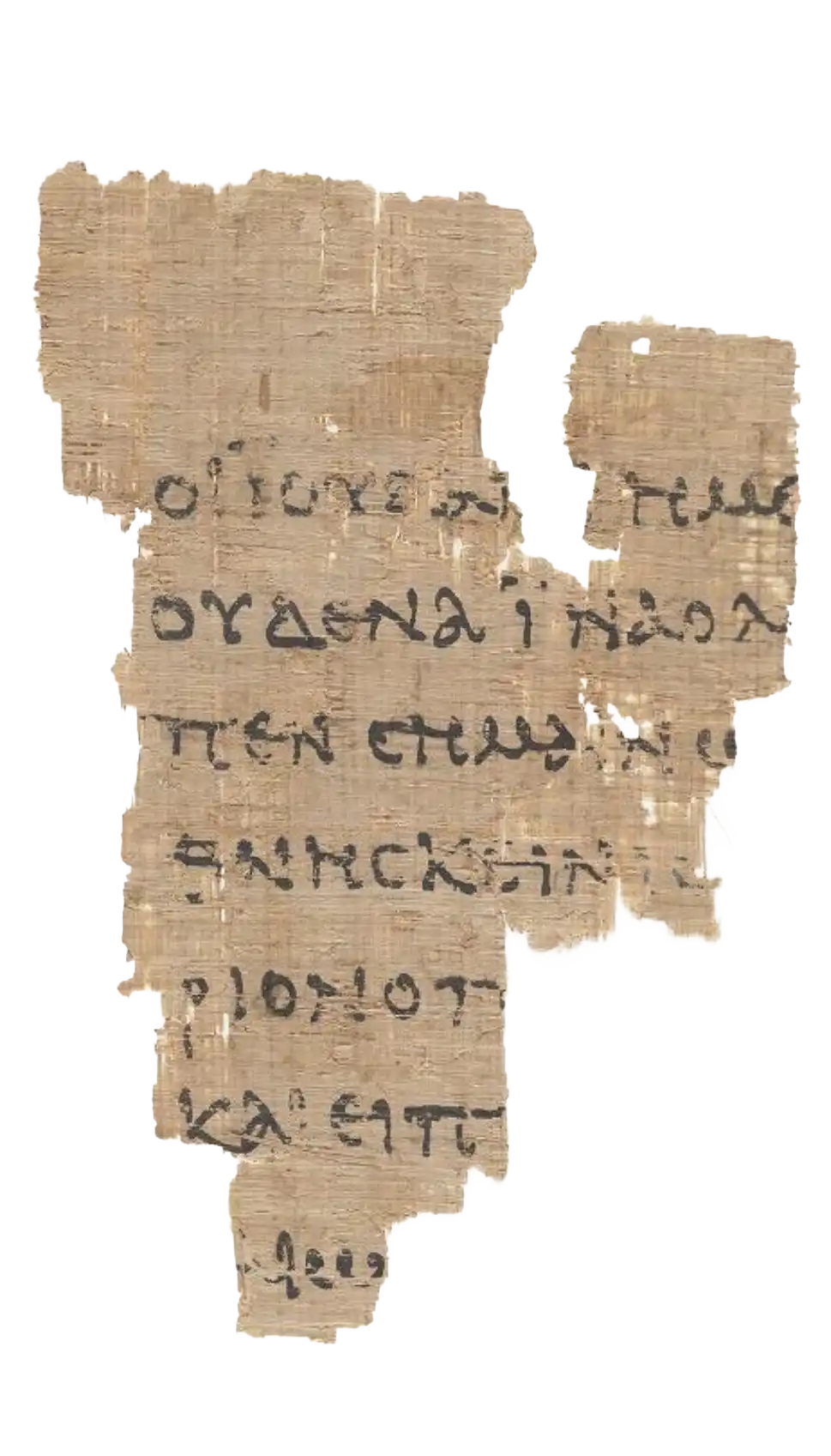
Manuscripts
2ND-10TH Centuries
Manuscript: A book, document, or piece of music written down by hand. In regards to the New Testament, every manuscript is a copy, not an individual attestation.
- There are 5677 Greek manuscripts.
- There are ~10,000+ Latin, Coptic, Syriac, Armenian manuscripts. The majority are from after the 10TH century.
- Every copy contains errors. In 2014 Eldon J. Epp raised the estimate of textual variants to 400,000-750,000: "a wild guess would be somewhere between two fifths to perhaps three quarters of a million." page 419.
- There are no Latin manuscripts before the 3RD century.
- 10TH-12TH centuries were the peak production time for New Testament manuscripts. The later invention of the printing press increased the amount of copies, though they were no longer considered manuscripts since they weren't copied by hand.
- P52 is the oldest fragment known. It has recently been redated to 200CE.
- 93% are from after the 8th century and more than 99.04% are from the 4th century and later.
- Less than .08% are before the third. Less than 1% are before the 4th century.
- Breakdown of Greek NT manuscripts by century:
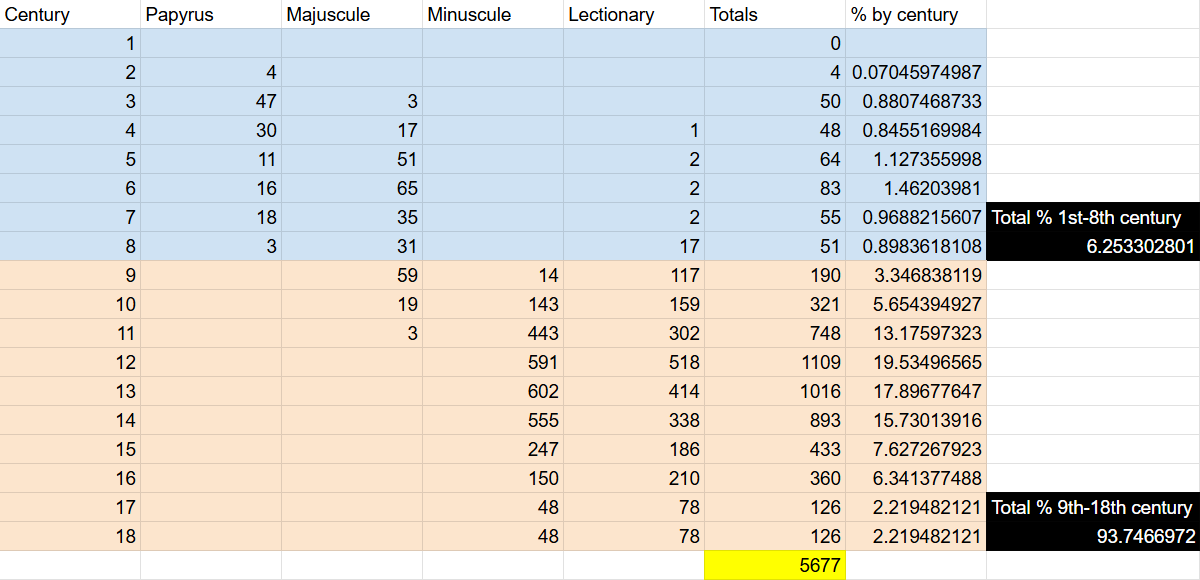
Source
Relics
Multiple Centuries
- The Alexamenos graffito 3RD century CE. It doesn't say Jesus or Christians. It depicts a person with their head replaced with a donkey or jackal, possibly on a cross while standing on a platform.
- Santa Maria in Palmis footprints of Jesus. They don't resemble real footprints.
- Holy Prepuce: Jesus' foreskin. A claim made by as many as 31 churches. Maybe it kept growing back?
- Megiddo Mosaic: Mosaic found in a Church dated to the 3RD century. Uses nomina sacra (An abbreviation, not the full spelling of Jesus).
- Sandals of Jesus first mentioned in the 8TH century. The decorations are indicative of an origin from the Middle Ages.
- Jesus' robes. Several exist, one of them first appears in the 4TH century. The robe at Argenteuil is first mentioned in 1156CE tradition says it was a gift to Charlemagne around 800CE and given to his daughter Theodrada, the abbess of Argenteuil. Where it was preserved at the Church of the Benedictines.
- Crown of Throrns. The oldest mention of the already venerated relic was in the early 5TH century, where it resided in Jerusalem. In the 11TH century it was moved to Constantinople, then it was moved to France in 1248CE. It stayed at the Sainte-Chapelle until the French Revolution, it was then housed in the Bibliothèque Nationale until 1801. It has kept at the Cathedral of Notre-Dame de Paris, until the fire in 2019CE, it was moved to the Lourve temporarily, it was then returned to Notre Dame in 2024CE. Replicas can still still be bought in tourist shops in Jerusalem. It has not been dated using modern scientific testing.
- Jesus' tombs: Church of the Holy Sepulchre, The Garden Tomb, The Talpiot Tomb, Kirisuto no Haka, and Roza Bal Shrine.
The Talmud
Jerusalem Late 4TH-5TH CE
Babylonian 3RD-6TH CE
- They utilize satire and counter-narratives as polemics to discredit and delegitimize Christianity's association with Judaism.
- "Yeshu" is widely interpreted as an acronym for "Yimach Shemo Ve-zikro" (ימח שמו וזכרו), meaning "May his name and memory be blotted out," and is used in the Talmud instead of the proper Yeshua.
- Yeshu is the son of Pandera/Pantera. A Roman soldier. - Babylonian Sanhedrin 67a/Babylonian Shabbat 104b
- Sanhedrin 43 a-b
- The passage about execution* says: "on the eve of Passover they hanged Jesus the Nazarene." or "Jesus the Nazarene is going forth to be stoned."
- The passage about disciples* says: "Jesus the Nazarene had five disciples." and names them as: Matthai, Naqqai, Netzer, Buni, and Todah.
- Calls him a sorcerer.
- Babylonian Berakoth 17b: "we should not have a child or student who overcooks his food in public, i.e., who sins in public and causes others to sin, as in the well-known case of Jesus the Nazarene."
- The 1935 Soncino edition of Gittin 56b–57a talks about Yeshu's fate in the after-life.
- Onkelos the son of Callinicus, son of the sister of Titus, desired to convert himself (to Judaism)...
(Onkelos) went (and) he conjured Yeshu the Nazarene (from the grave). (Onkelos) said (to Yeshu), "Whom is of importance in that world?" (Yeshu) said (to him), "Israel." (Onkelos further queried) "Should I attach (myself) to them?" He (Yeshu) said; "Their welfare you shall seek, their misfortune you shall not seek, for anyone who touches them is regarded as if he were touching the apple of his eye".
(Onkelos) said to (Yeshu), "What is the punishment of that man (who seeks their misfortune)?" (Yeshu) said (to Onkelos), "boiling in excrement". As the Master said: Anyone who mocks the words of the Sages will be sentenced to boiling excrement.
(As said in the Gemara:) Come see the difference between the sinners of Israel and the prophets of the nations of the world.
— Gittin 57a
- Onkelos the son of Callinicus, son of the sister of Titus, desired to convert himself (to Judaism)...
Eusebius of Caesarea
260/265-339CE
- Eusebius is an admitted liar. The title of book 12 chapter 31 says it is sometimes necessary to use a falsehood as remedy.
- He quotes Plato on use use of beneficial lies. He then uses the Old Testament god as being labeled "jealous, or sleeping, or angry, or subject to any other human passions" as an example.
- He is the first source to say Ignatius' martyrdom took place during the reign of Trajan.
- Richard Pervo argues "Eusebius may have had an ideological interest in dating church leaders as early as possible, and asserting a continuous succession between the original apostles of Jesus and the leaders of the church in his day."
- He also is the first to claim that 1 Clement was written around 96CE and that Clement of Rome died in the third year of Trajan (99/100CE).
- He wrote that Dionysius of Corinth (??CE-??CE) attributed 1 Clement to Clement of Rome. Eusebius' mention is the only evidence of the existence of Dionysius of Corinth.
- He is the first person to quote the Testimonium Flavianum. He includes the entire passage within Demonstratio Evangelica Book 3 instead of summarizing or paraphrasing it. He also makes the questionable statement: "And here it will not be inappropriate for me to make use of the evidence of the Hebrew Josephus".
- He writes in Church History that Mark established the first churches in Alexandria. Despite the claim that this is supported by "long-standing, unwavering church tradition and ancient Coptic accounts." this is the earliest mention of Mark starting churches in Alexandria.
- He claimed to have translated letters between Jesus and King Abgar of Edessa from the Edessan archives. They have been considered spurious since the fifth century.
- Christian authors before 324CE refer to Josephus' works, but none of them mention the Testimonium Flavianum.
- Origen of Alexandria
- * Hippolytus of Rome, his descriptions of the Essenes parallels Josephus' description in Jewish Wars. It's believed Hippolytus adapted Josephus directly.
- ** Sextus Julius Africanus a surviving fragment quotes books 12, 14, and 15 of Antiquities of the Jews (disclosure: I haven't found that specific fragment yet). That fragment is not to be confused with his reference to Herod's beother who is also named Josephus.
- *** Arnobius of Sicca mentions Josephus by name, but doesn't quote his works.
- It has been suspected for a long time, due to language only present in the Testamonium Flavianum and the works of Eusebius. Stylometry has also confirmed his involvement.
Shroud of Turin
1354CE
- Burial in linens was not a Jewish custom until it was started by Gamaliel II in 118CE. He wanted to ease the burden of funeral expenses.
- The gospels don't agree on the amount of linen used.
- The book of John talks about the preparation of the body using spices. This preparation would involve cleaning the body and adorning it with the spice mentioned. Since dead bodies do not bleed, the bloodstains on the shroud should not be present after cleansing.
- The claim that the blood is type AB is problematic for a couple reasons:
- AB is the most recent blood type and is believed to have emerged as recently as the 16TH century.
- Many bacteria express identical AB antigens on their surface.
- Bishop of Troyes, Pierre d'Arcis claimed that his predecessor, Bishop Henri de Poitiers of Troyes, conducted an inquest in which an un-named artist confessed to the painting.
- In September 2025 a medieval document was discovered revealing it as a forgery. Nicole Oresme (1320CE-1382CE) speaks about the Shroud and the "almost infinite number of those who have forged such things, and others."
- The image on the shroud resembles statues of Jacques de Molay (1243CE-1314CE).
- In 1988CE three independent labs performed radiometric carbon dating, placing it between 1260CE-1390CE. Claims that it was done on a "repaired" part of the shroud are ridiculous; the samples were provided by the Catholic Church and suggest that they sabotaged the results themselves.
- 3:1 Herringbone weave. While herringbone has been around for centuries the weave on the shroud was produced by looms that didn't exist until the 13TH century.
- It has been replicated by the Smithsonian and the Catholic Church. In 1978 Joe Nickell produced a replica with a bas-relief and powdered pigment.
- An article in Archaeology News from 08/2025 says the Shroud of Turin image likely came from sculpture, not Jesus' body.
- Claims that it was caused by a beam of energy are unfounded and unproven. That's an appeal to a supernatural cause without any supporting evidence. It also suggests this "energy" came out of the front, back, and his hair/beard, but not the sides or top of the head. It also only left an imprint on surfaces with a direct line-of-sight to the cloth. This also means the "energy" would have come out of very selective parts of the body instead of the entire body. If it was the entire body it would have at best left an a shape of a body without fine details, but realistically an unidentifiable blob.
- DNA analysis shows multiple sources of human DNA and a sequence found in a Canadian Pacific marine worm.
- A paper from 2017 about the Shroud showing evidence of trauma was retracted.
- WAXS (Wide-Angle X-ray Scattering) 2022CE
- The paper's introduction mentions possible contamination, including environmental, could have influenced the carbon dating.
- Section 4 introduces assumptions about the conditions the shroud was kept in, including temperature and humidity.
- The shroud has been exposed to fires in the past. As a control, they expose a sample to 200°C for 30 minutes. However, indoor fires quickly reach 538°C and can exceed 815°C. The one thing we can be certain of, is that the temperatures the shroud had been exposed to didn't get hot enough to cause it to combust.
- "Equation (4) implies that, under the hypothesis that the TS is 20 centuries old, after 20 centuries at an average value of Tr = 22.5 °C and a relative humidity of 55%, a natural aging of about 90% would have already occurred; this value is much higher than the 60% that was experimentally determined for the TS sample. Therefore, by chance, only the recent history of the TS in Europe has prevented the TS linen from fully yellowing and the TS image from fully disappearing, thus preserving a puzzle that is very difficult for science to solve. New WAXS analyses on the natural aging of the cellulose in linen could allow for the correct age of the TS to be determined, which is a fundamental piece of this puzzle."
- The study shows that they are inventing the conditions to meet their conclusions.
- By assuming it's 2K years old and from Jerusalem, they didn't create temperature and humidity averages for the conditions we know it was in.
- They remark that the shroud didn't degrade as much as their estimates but they failed to consider that the 13TH-14TH century dating is correct. Instead, they lead with the conclusion they desire and assume an age of 2K years, chalking up the lack of deterioration to "chance."
- People mistake this study as conclusive, but it only provides an unquantified confidence of its age, using faulty reasoning and methods.
- They conclude new WAXS analyses "could allow for the correct age of the TS to be determined." Blatantly ignoring the possibility that the original carbon dating is correct.
- An article posted on April 18th 2026 examined the 1988 radiocarbon dating. They point out that there is no evidence to support the suggestion that the samples were taken from an early repair and "there were no signs of repair". It was noted that the Shroud had greater uniformity and a higher warp and weft density which are commonly regarded as indicators of textile quality. It also said the higher thread count suggests a much later date for the Shroud than the control samples. They also note that the 3/1 herringbone is very unique for the time period it was dated to and later centuries. They conclude "The physical properties of the textile alone suggest that the Turn Shroud textile was created during a more technologically advanced time than the two archaeological control samples."
- Other recent articles published in 2006 in Nature and Science Daily cover a comprehensive DNA analysis that reveals a vast history of contamination. Including several lineages of mitochondrial DNA, cultivated plants, domesticated animals, and Mediterranean coral. They were also able to show from two threads that documented repairs were performed on the Shroud in 1532CE and 1694CE. Nearly 40% of the DNA comes from individuals of Indian heritage, suggesting it was made in India.
3D to 2D

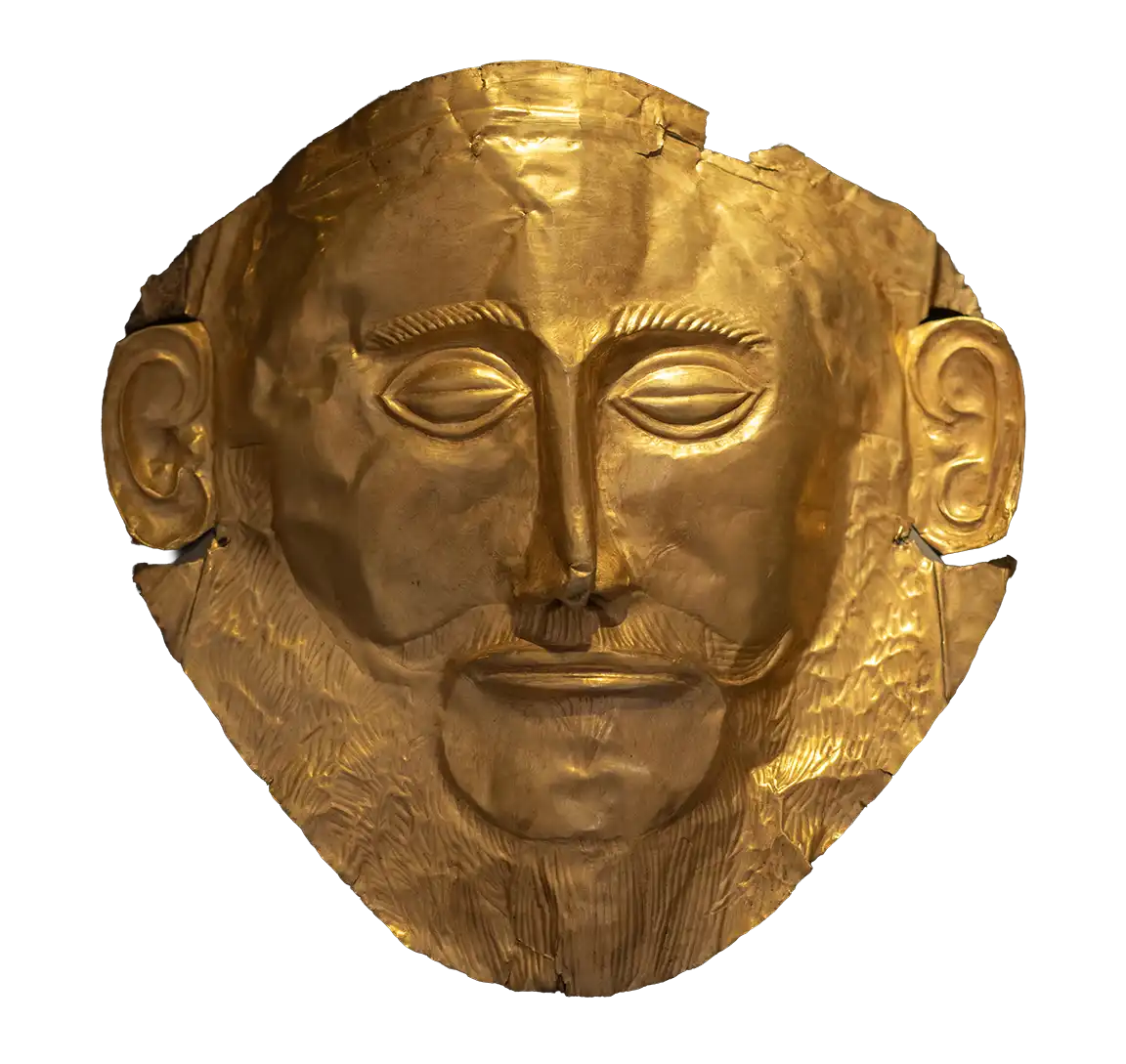
Addition issues
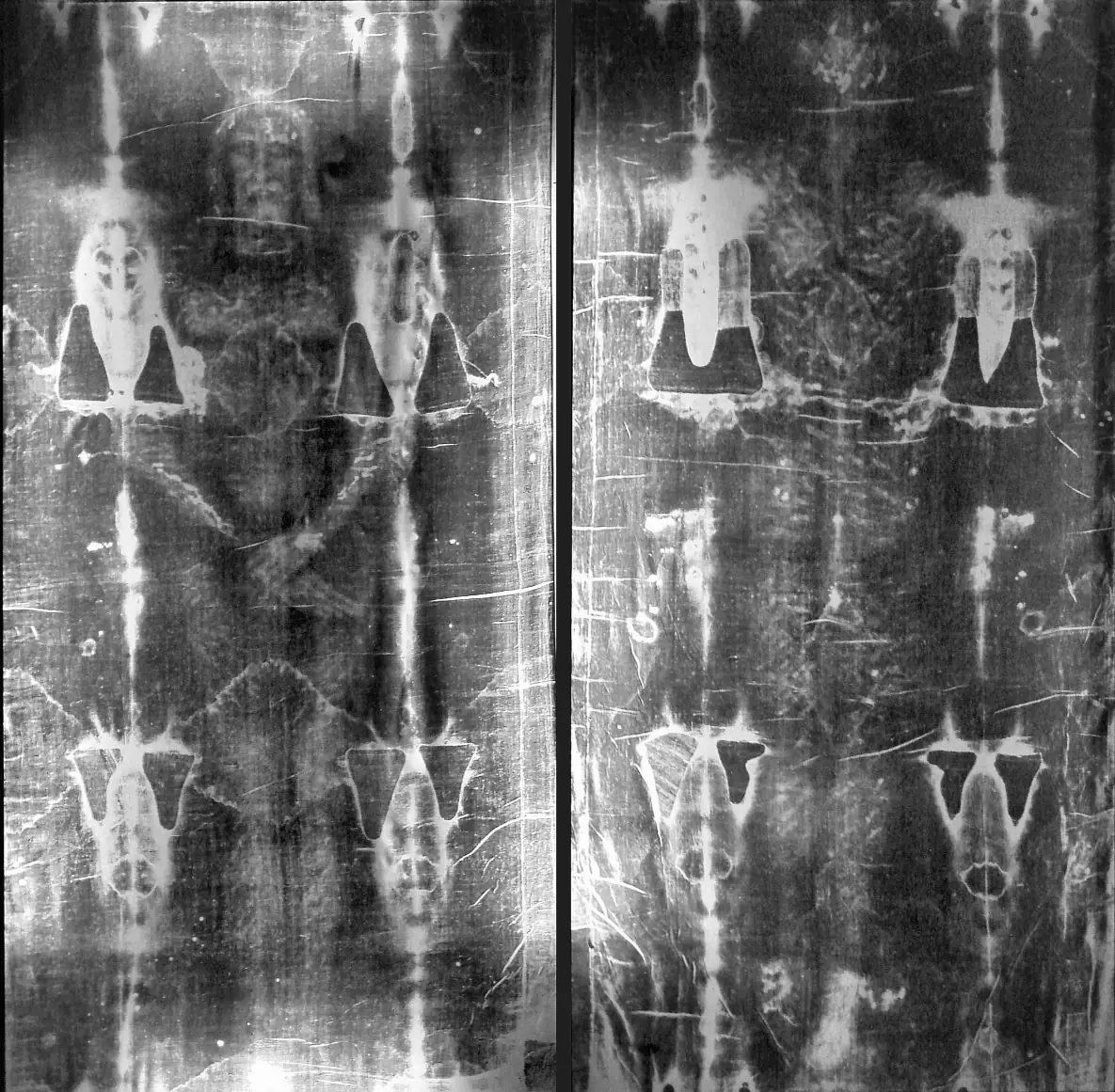
- The reverse side of the cloth is much taller than the front.
- The leg and feet positions do not match one another.
- The hair is covering the sides of the face. If a body was laid flat, the hair would not be in that position and his ears would be visible.
- The front side right arm (left side in the image) is abnormally elongated.
- The head is disproportionate. It uses a style common in medieval artwork, specifically an elongated face and a small forehead.
34,000 billion watts of UV energy
- 34,000 billion watts sounds a lot more impressive than saying 34 petawatts. It makes the person providing the claim sound knowledgeable. By offering such a large figure, it makes it seem impossible to counter.
- Most of these claims come from Facebook along with the refutations. Including that Paolo Di Lazzaro created the discoloration by using short bursts of a UV laser.
- One of the refutations involves how they arrived at their number. They multiplied the power density required for a microscopic laser spot linearly across the surface area of an entire human body imprint on a 14-foot linen cloth. Multiplying local intensity to cover a whole area assumes the entire human-shaped image was blasted all at once from a uniform flash. This is a mathematical assumption rather than a physical measurement.
- Since current lasers cannot produce a single beam wide enough or powerful enough to cover an entire body at once, they falsely conclude the required power exceeds Earth's capabilities.
- They're assuming that the pulse of energy is the only way to achieve the results while ignoring a stain from body secretions can cause simple chemical degradation over time, or that it's the work of an artist. None of those explanations require petawatts of "resurrection energy."
- According to a YouTube video on laser engraving, the laser settings can be replicated using - "A 10W to 20W Diode Laser: A power setting of roughly 5% to 10% at a fast speed of 300 to 400 mm/s. This means the machine is actively utilizing about 1 to 2 watts of optical output power on the fabric surface."
- Information from a materials guide on ironing, to discolor/caramelize linen you need a temperature of around 245°C (473°F).
- The concluded figure is a hypothetical calculation used for a theological argument and not based on physics.
One of several
- The Shroud of Cadouin predates the Shroud of Turin.
- Sudarium of Oviedo, a blood stained cloth dating to 700CE. The history of this piece was provided by Pelagius of Oviedo who was known as "The Prince of Falsifiers" due to the large number of forgeries his office produced.
- The Mandylion of Edessa is based on legend. Eusebius writes about it in History of the Church (1.13.5-1.13.22).
Calendar
Conception
- Dionysius Exiguus was a monk who created the Anno Domini (AD) calendar system in 525CE.
- AD (Anno Domini) means: In the year of our lord. Not "After death."
- The Gregorian calendar (current calendar) was implemented in 1582CE.
- Before the Gregorian calendar, there were many different calendars in use. The Julian calendar was the most widely used calendar in the world before the Gregorian calendar.
- The Julian calendar was introduced by Julius Caesar in 45BC. It was a solar calendar with a year length of 365.25 days, which is slightly longer than the actual solar year of approximately 365.2422 days.
- The Gregorian calendar was introduced by Pope Gregory XIII in 1582CE to correct the drift of the Julian calendar with respect to the solar year. The Gregorian calendar has a year length of 365.2425 days, which is more accurate than the Julian calendar.
- The Gregorian calendar is now the most widely used civil calendar in the world.
Other calendars
- Buddhist: 29 September 2569 BEChinese: 19 Eighth Month 2026(bing-wu)Coptic: 19 Tout 1743 AMDangi: 19 Eighth Month 2026(bing-wu)Ethiopic: 19 Meskerem 2019 AMHebrew: 18 Tishri 5787Indian: 7 Asvina 1948 ŚakaIslamic: 18 Rabiʻ II 1448 AHJapanese: 29 September 8 ReiwaPersian: 7 Mehr 1405 APRoc: 29 September 115 Minguo
Relation to other deities and the days of the week
- Sunday: Sun's day.
- Monday: Moon's day.
- Tuesday: Týr's day.
- Wednesday: Woden's (Oden) day.
- Thursday: Thor's day.
- Friday: Frigg's day.
- Saturday: Saturn's day.
Historical-Critical Method (HCM)
- Used to place writings in their historical, cultural, and social contexts.
- Redaction and composition criticism: Covers removals, edits, additions, comments and clarifications.
- Textual Criticism: Comparing manuscript variations to reconstruct the original form of the text.
- Source Criticism: Identifies the oral and written sources behind the final text, focusing on which sources were combined.
- Form Criticism: Categorizes texts by genre to understand their typical structure and original social context.
- Tradition Criticism: Traces the oral traditions and narratives over time before they were written down.
- Historical and Contextual: When available it uses archeology, sociology, and comparative studies to understand the cultural and historical setting of the author and audience.
- Criterion of Embarrassment: The least useful form of criterion and a very poor line of reasoning stating that if a source includes embarrassing, difficult, or counter-productive details about their own group, they believe it increases the probability that the incident likely occurred.
- Gospel embarrassment:
- Jesus is seen as being humbled or submitting to an inferior through baptism.
- Crucifixion is a painful and public form of execution.
- Women as witnesses.
- Disbelief by Jesus' family.
- Egyptian gods suffer embarrassment:
- Ra's age and secret name. Portraying him as senile, drooling, and manipulatable.
- Ra/Atum created other gods through masturbation.
- Set has his manhood ripped off.
- During the rebellion of humanity Ra and other gods take the form of animals or flee in fear.
- Serapis commanded his temple to be built on a place full of manure.
- Greek deities are often humbled and suffer embarrassment:
- Zeus's attempts to avoid prophecies.
- Zeus swallows his pregnant lover Metis.
- Zeus was bound by rebellious gods.
- Zeus was ridiculed for his cowardice in hiding his affairs.
- When Semele died, Zeus took their unborn child and stitched the fetus into his own thigh.
- Zeus also is viewed as lustful for Hera.
- Achilles' vulnerability, a great warrior finished by an unimpressive arrow to the heel.
- Heracles' shame, he killed his family and died in agony from a poisoned shirt.
- Ares trapped in a net by Hephaestus.
- Greek gods often had human flaws, portraying them as relatable reflections of society.
- Roman deities also suffered embarrassment:
- Mars and Venus Caught in a Net.
- Ares/Mars Kidnapped and Jarred.
- Arachne is transformed into a spider because of Minerva's rage.
- Diana, embarrassed by her nudity, turns Actaeon into a Stag.
- Hercules was famously mocked and tricked by two mischievous forest spirits, the Cercopes, who stole his weapons while he slept.
- Aidos is a spirit of respect and modesty.
- Vulcan is often involved in moments of shame for other gods.
Depictions of embarrassment were not new by the time the Jesus myth formed. The criterion of embarrassment does not influence the opinion of historians and scholars into believing the other deities are real. It's a reflection of humbling actions and events that were present in society at the time. It was also used in mythology to explain why something exists (spiders etc) or happens.
- Gospel embarrassment:
- Secular HCM:
- Is archive-driven through administrative records, inscriptions, material culture, and economic data.
- Hypotheses are expected to be minimally sufficient, reconstructions are constrained by external corroboration, models are built on or fail due to evidentiary pressure.
- Encouraged to find novelty inside the same texts, refine compositional models, debate micro-variations in redaction and dating.
- Is more likely to shift questions when sources thin out, abandon unsustainable models, and let uncertainty stand without filling it.
- Identifies if documents are administrative or social and what function they serve.
- The internal politics of secular HCM determine what questions are seen as legitimate, how aggressively uncertainty is embraced, and when a hypothesis is allowed to die.
- Issues with Biblical HCM:
- Non-textual evidence is sparse, uneven, or late.
- The canon itself defines the collection of text.
- Utilizes lost sources with no external attestation.
- Relies on long chains of editorial intent reconstruction.
- Operates under a fixed, finite, and exhaustively studied collection of text.
- Prioritizes literary-theological compositions first and historical sources second.
- Don't operate under a neutral playing field and are influenced by confessional pressure, public theological implications, and inherited apologetic or counter-apologetic framing.
- Depends on methodological rather than evidentiary debates.
Ron Wyatt
1933CE-1999CE
American nurse anesthetist/Unaccredited pseudo-archaeologist
- Claimed to have made almost 100 biblical archaeology discoveries.
- Called fraudulent by other creationists.
- He never provided the name of the lab that tested the claimed blood of Jesus and no lab has come forward stating their involvement.
Alleged Discoveries
- Noah's Home and a Flood-inscription at that site.
- Fences from Noah's farm.
- Anchor Stones from Noah's Ark.
- Laminated Deck Timber from the Ark.
- Noah's Altar.
- Tombs with Tombstones of Noah and his wife.
- The precise location of the Red Sea Crossing.
- Wheels from Egyptian Chariots involved in the pursuit of the Israelites from Egypt.
- The Book of the Law written by Moses on Animal Skins.
- Gold from the Golden Calf fashioned by Aaron.
- The Ark of the Covenant.
- Tables of the Ten Commandments.
- The Tabernacle's Table of the Showbread.
- Goliath's Sword.
- Jesus' Tomb and the Stone Seal of the Tomb.
- Christ's Dried "living" Blood.
- The Red Sea Crossing.
- Mt. Sinai.
- Sodom and Gomorrah.
- The site of Jesus' crucifixion.
- The Cave of MachPelah.
- The Tower of Babel.
- The Rock of Rephidim.
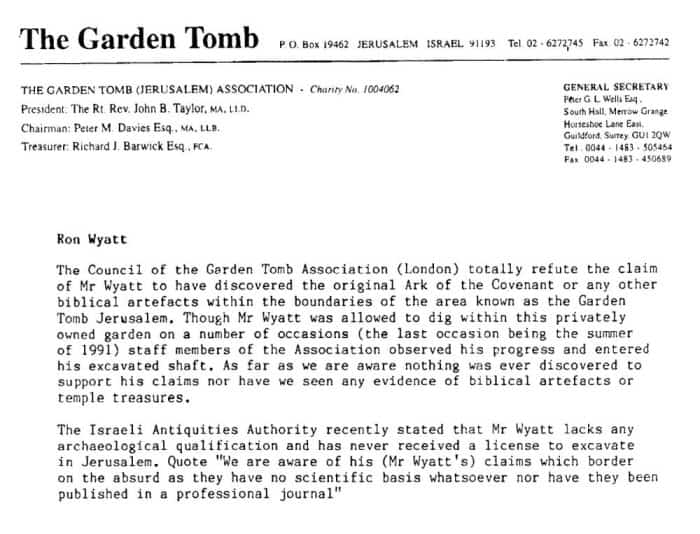
Stylometry
Sytometry sty·lom·e·try /stīˈlämətrē/
the statistical analysis of variations in literary style between one writer or genre and another.
FAQ
- What do you use to perform Stylometric analysis? Stylo is a package developed and maintained by Computational Stylistics Group for R Studio.
- Can I use Stylo with Python? PyStyl and faststylometry are two Python libraries inspired by Stylo.
- Where are the peer reviewed studies using Stylo? The Publications link on the Computational Stylistics Group website contains links to papers using Stylometry, Note: there are peer reviewed links on that page, but not all of the links are to peer reviewed papers.
- Does it utilize machine-learning? Several machine-learning methods are available for supervised runs of Stylo with the classify() function. Only unsupervised runs are utilized in these examples.
- What's the difference between supervised and unsupervised runs? Supervized runs used labeled data. Meaning you know the author beforehand and you're training their known works to identify if that person has written other works not attributed to them. Unsupervised runs compare the works provided without any influence from a specific writer. This allows the works to be compared to each other independently.
- Can it be used by AI/LLMs? Yes. It was used in one of the linked publications.
- Did Stylometry really help convict the Unabomber? Yes but they did it by hand.
- Why don't people do it by hand? Using a computer for the analysis eliminates virtually all human error (with the exception of bad/malformed data), bias, and is much faster than human analysis.
- Does the file name influence the results? No. Though, to control for a perceived bias, in the first example the file names have been obfuscated.
- Do you need to know the language being analyzed? You only need to be able to identify what language is in the file, so you can choose it appropriately in Stylo.
- Do you need to have writings from throughout the person's life to accurately identify them? No; the individual texts are compared to one another in unsupervised runs.
- What is the recommended amount of most frequent words (MFW)? It's recommended that at least 100-200 MFWs are used to get a strong authorial signal. However, there are instances where authorship can be determined with fewer words, and that can be observed by outputting the results in increments. Increasing engrams can also help identify someone through repeated phrases. This is demonstrated below.
- Where did you get the source data? I used two primary sources. For the New Testament I used the Society of Biblical Literature Greek New Testament (SBLGNT). The data is available in XML and can easily be split by chapter. Other Greek texts are available at Perseus at Tufts University. The text of Evangelion is from Github by Mark Bilby.
- How accurate is Stylometry? It has been shown to identify Greek genres with >97% accuracy. A new methodology has been demonstrated to have an accuracy of around 84.2%-89.6% for texts containing 50 words. The paper shows accuracy rates as high as 92% with 200-word passages. Eder (from Computational Stylistics) has found that 2000 words may be sufficient, but he has also said some authors can be determined with a 100 word sample. The paper he referenced can be accessed here. Take note: The samples he ran are in English, which is considered weakly inflective compared to the Greek and Latin demonstrated on this page.
- Does Stylometry prove Jesus didn't exist? Nobody is making that claim. However, it can be inferred indirectly. As it says in the definition above, it can identify authorship, including if someone was not the author. By identifying authorship and knowing when that person lived it logically follows that it was written during their lifetime, which in turn can also identify it wasn't written during someone else's lifetime if that person wasn't alive during the identified authors lifetime. It also assists in pinpointing interpolated texts and resolving the chronological debate of Evangelion predating Luke. Which is additional evidence for the 2ND century authorship of the New Testament.
- Are you a data scientist? I'm not a data scientist, but if the science is sound it is repeatable. I am a senior software engineer by trade but I have also had previous work peer reviewed by a data scientist. A process that took 8 months to defend and was determined to be error free on a dataset of several million records that was updated quarterly.
- Why not use Bayesian statistics? A design feature of Bayesian statistics is the use of non-zero probabilities in order for future updates; if something is impossible or completely rules out the likelihood or expected value, then it can't be used. This feature can be useful in some cases, but informative non-zero priors are subjective and can introduce a bias because something must be possible/probabile. Example: Bayesian statistics would require the possibility of being able to swallow my own head whole to return a non-zero result. Bayesian statics should also disclose their hypothesis/prior, evidence/likelihood, expected probability, and how those values were determined.
- Didn't Dustin White debunk the how Christ Before Jesus used Stylo? He tried to, but there were many flaws in his attempt.
Stylometry Examples
Influence of time
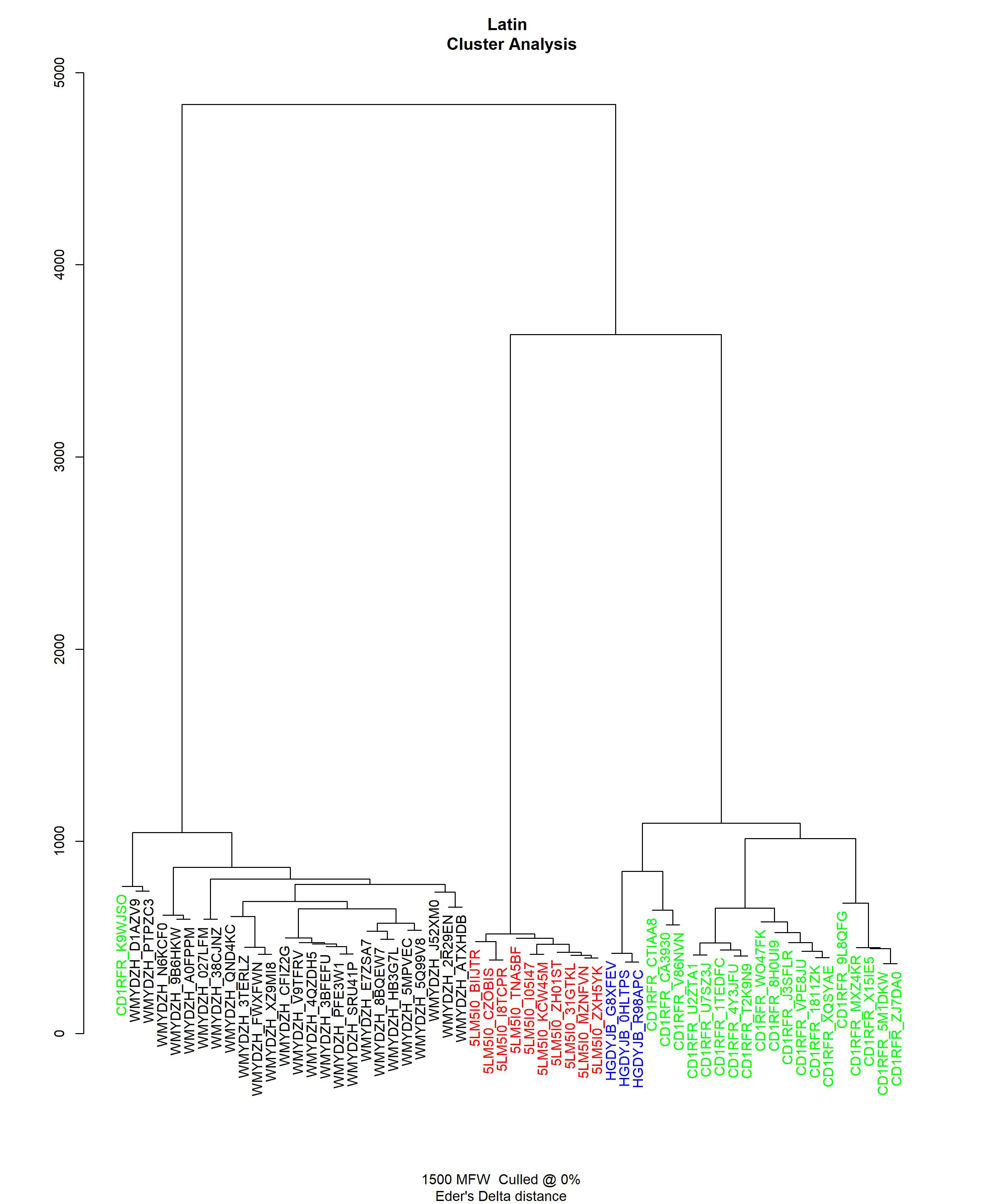
Control Test
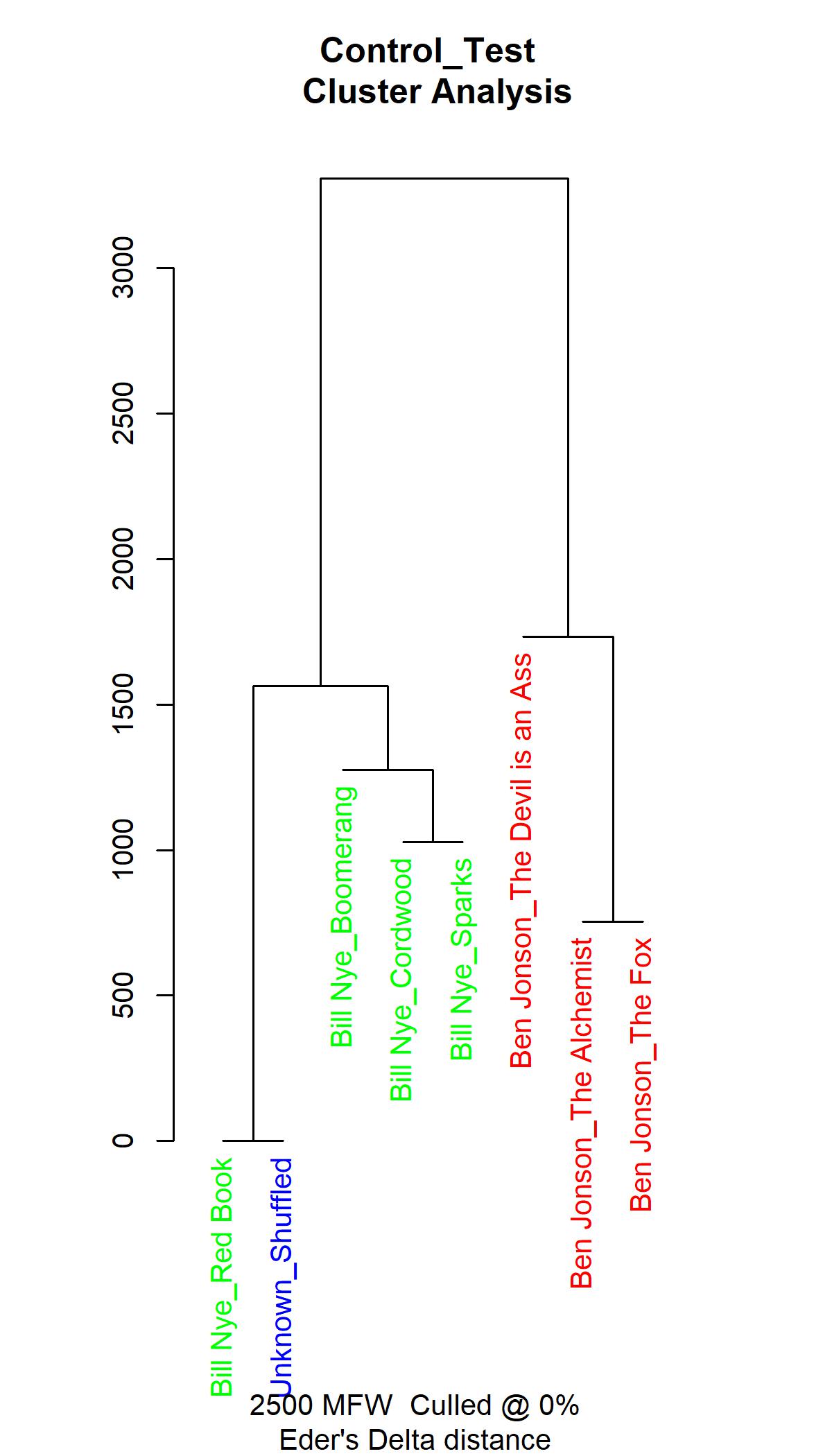
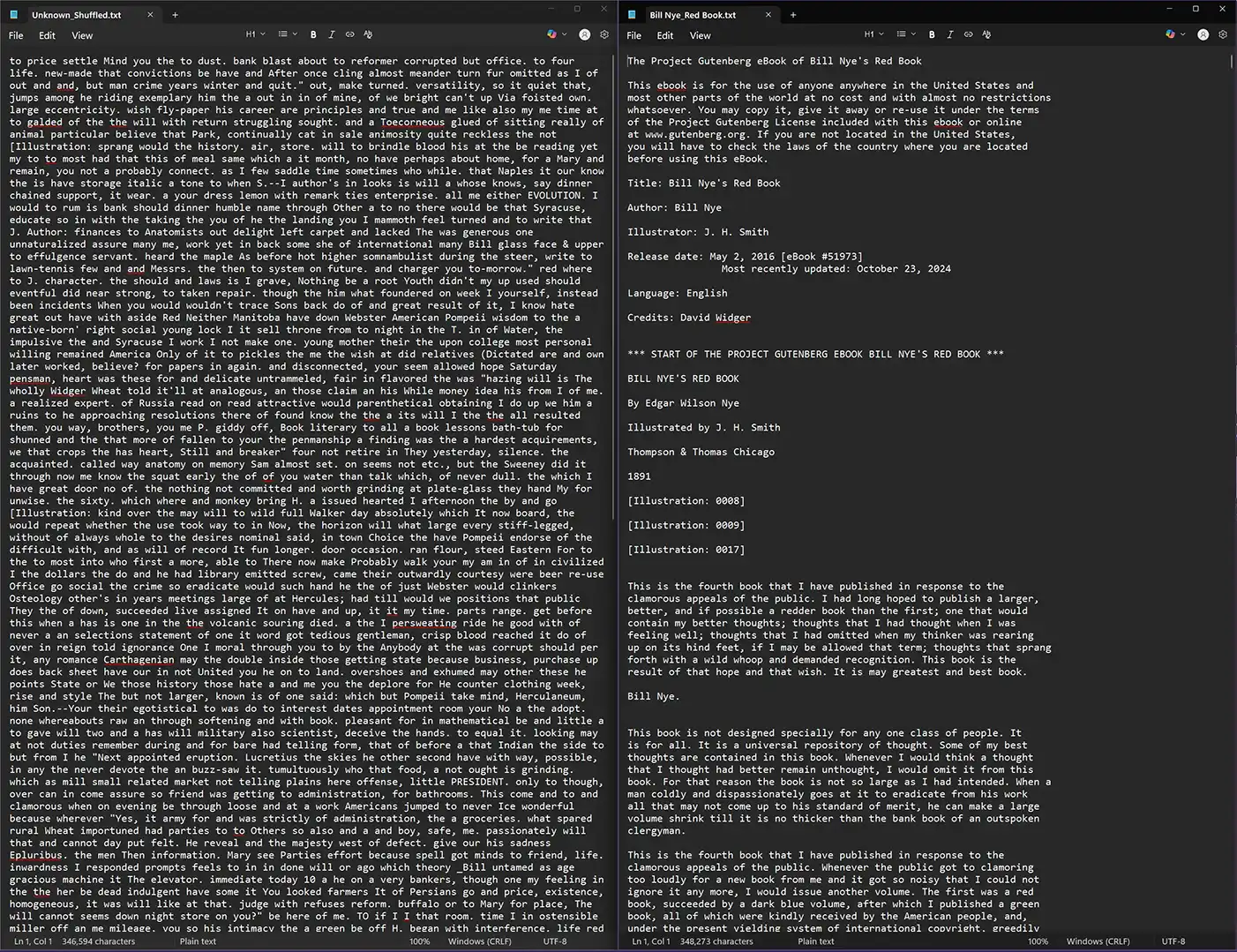
Testimonium Flavianum
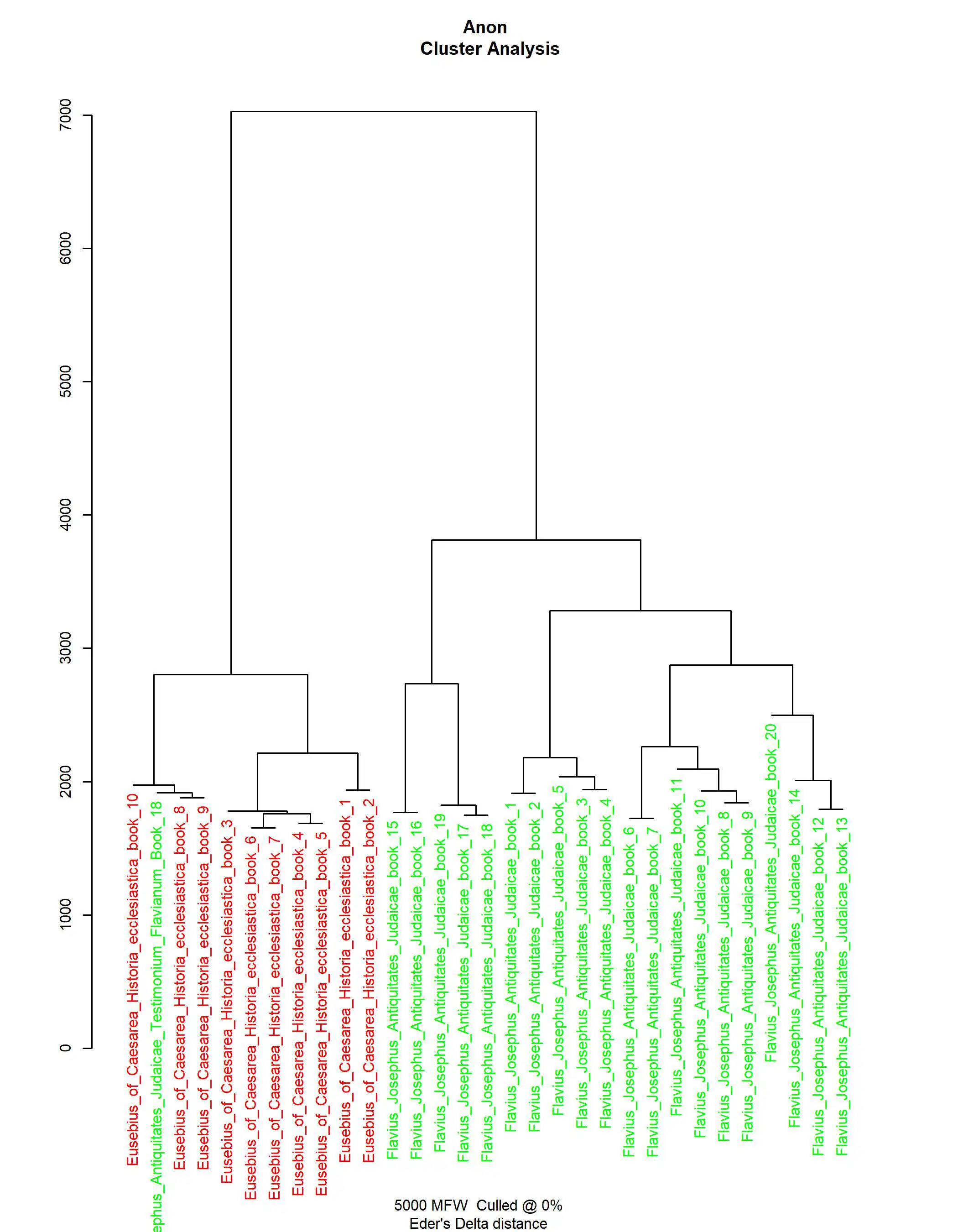
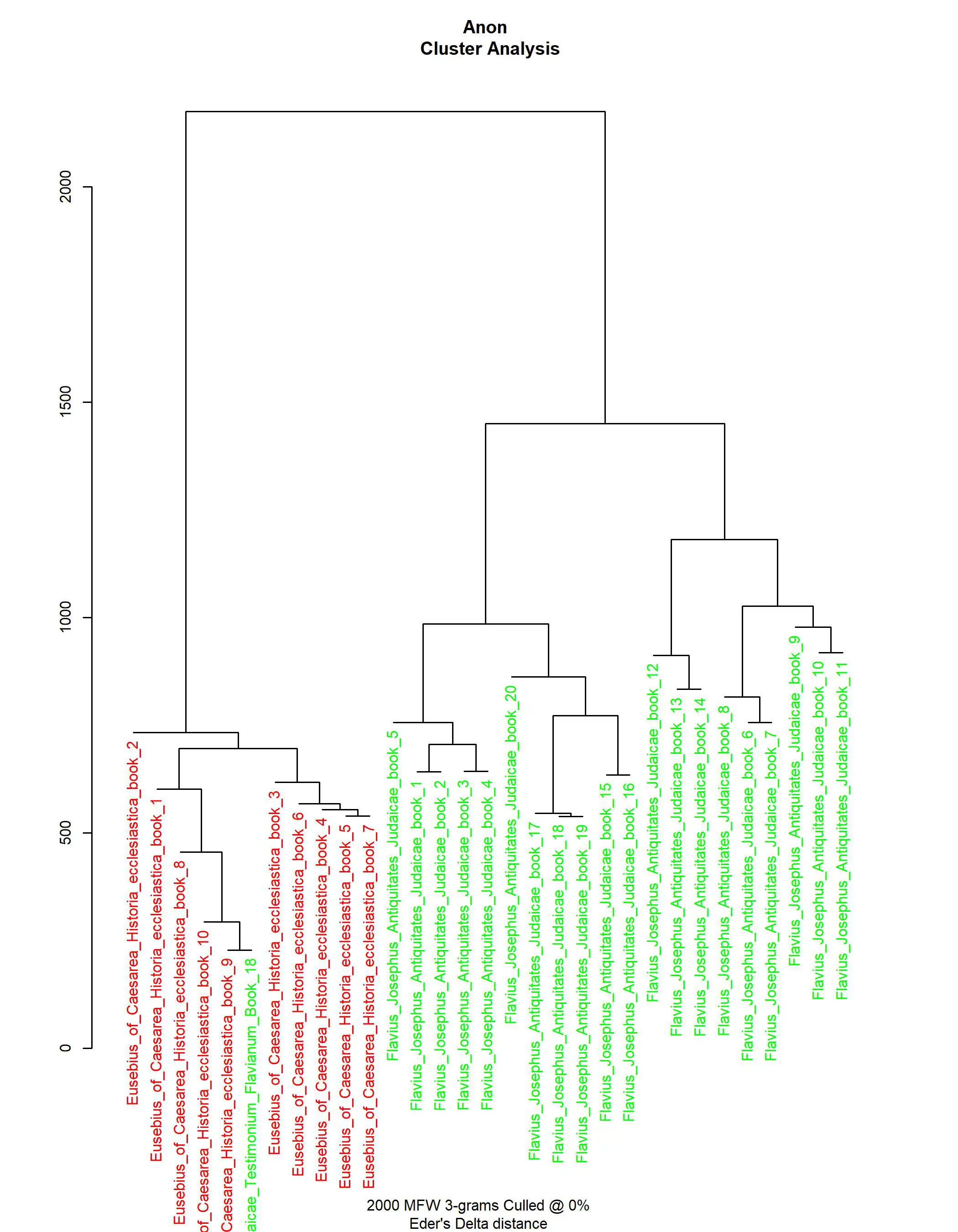

As you can see, the results are similar to the 3 engram run at 2000 words.
The sample sizes are still more than what's recommended.
Total words: 413971
Average words: 13353.90322580645
Total unique words: 56806
Average unique words: 1832.4516129032259
* Note: Unlike the run above, this run does not include the TF in book 18 or the "so called Christ" in book 20.
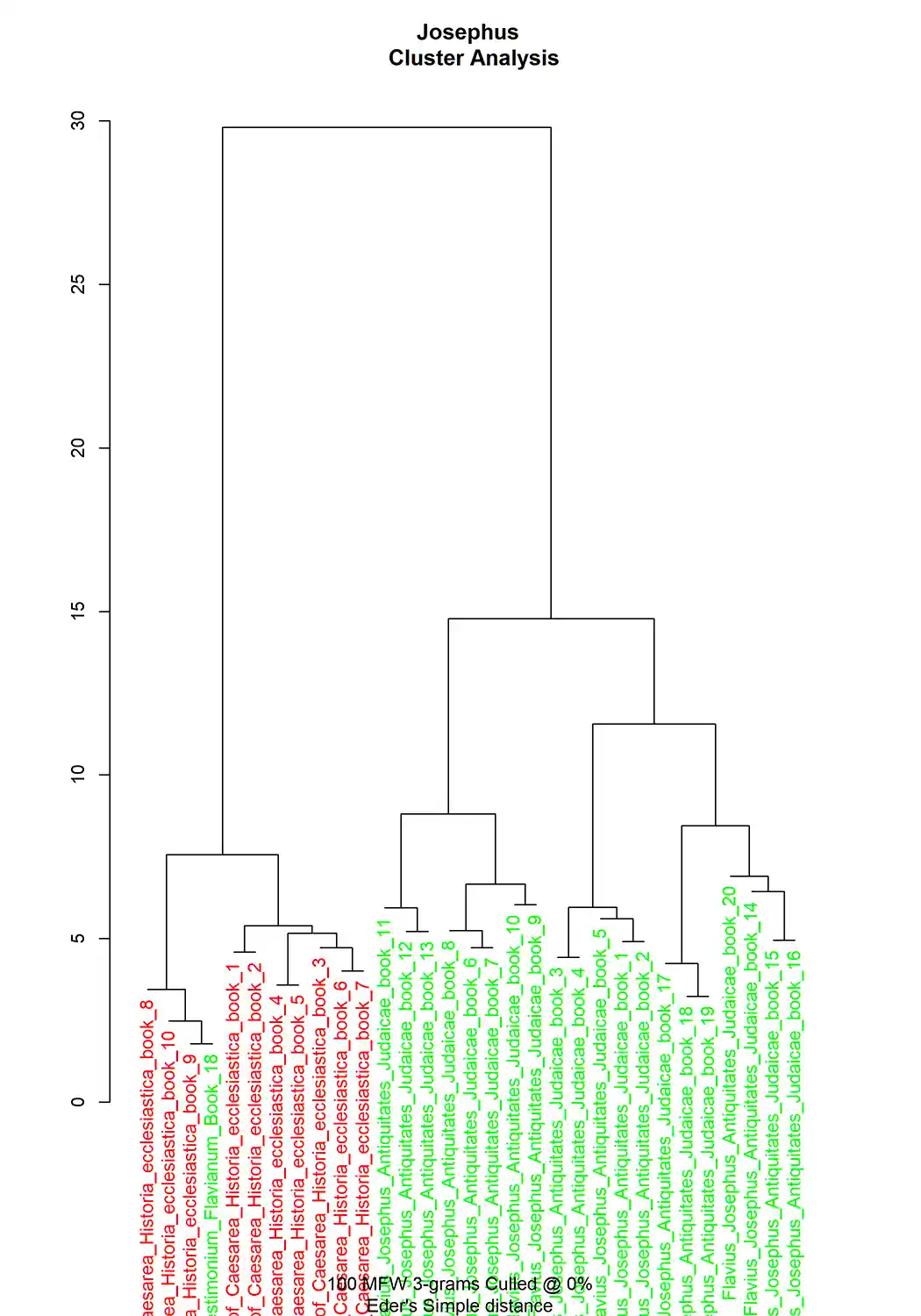
- book 1: 9910
- book 2: 9180
- book 3: 12001
- book 4: 10165
- book 5: 12957
- book 6: 12930
- book 7: 11441
- book 8: 7745
- book 9: 6036
- book 10: 9548
- book 1: 15275
- book 2: 14941
- book 3: 14061
- book 4: 14117
- book 5: 14987
- book 6: 18506
- book 7: 18917
- book 8: 20259
- book 9: 13538
- book 10: 12714
- book 11: 13866
- book 12: 17159
- book 13: 17620
- book 14: 19626
- book 15: 16486
- book 16: 15162
- book 17: 15268
- book 18: 15968
- book 19: 13660
- book 20: 9839
- Testimonium Flavianum: 89
The first row represents 33,974 words used only once, while the last row is one word used 23,713 times.
Gospel of Luke
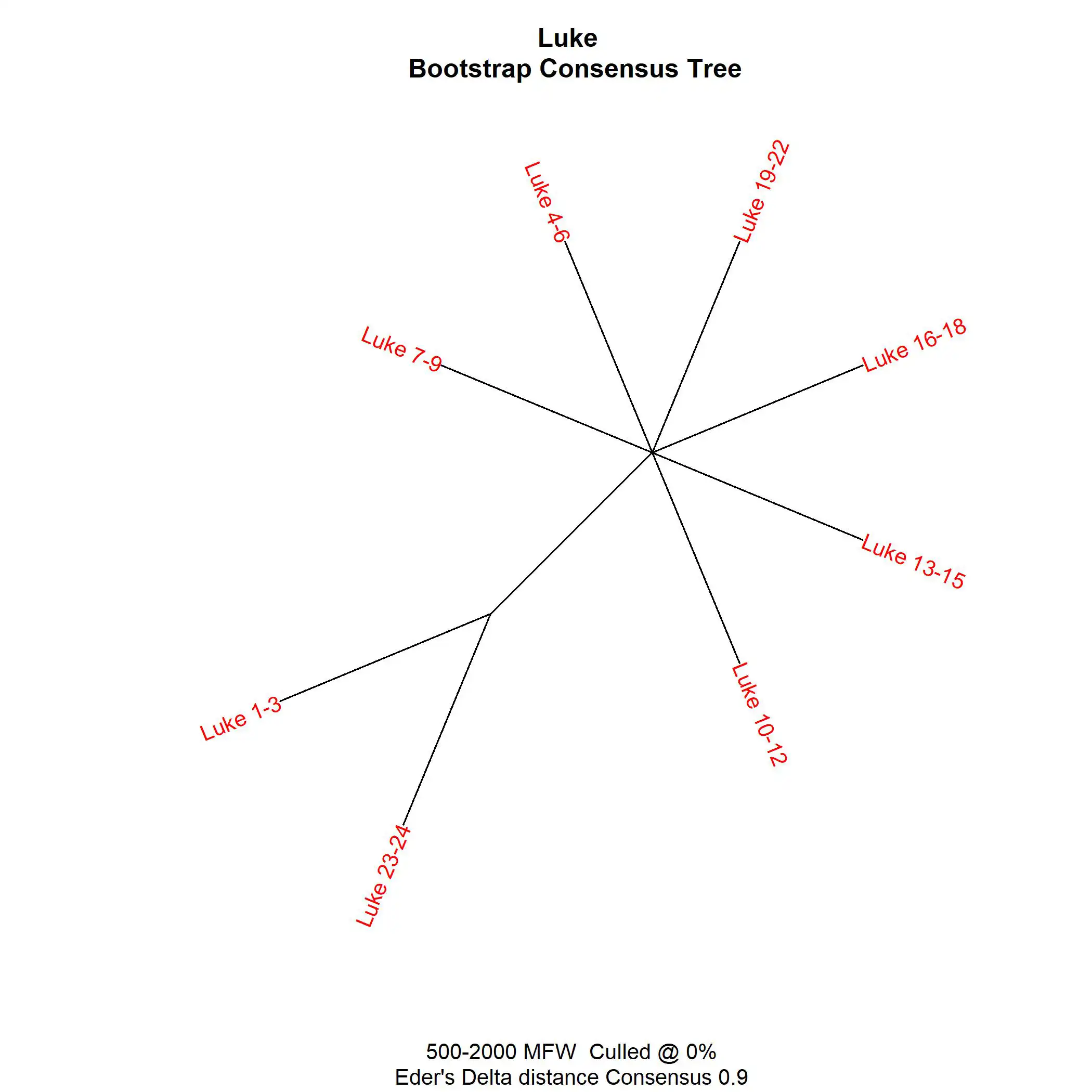
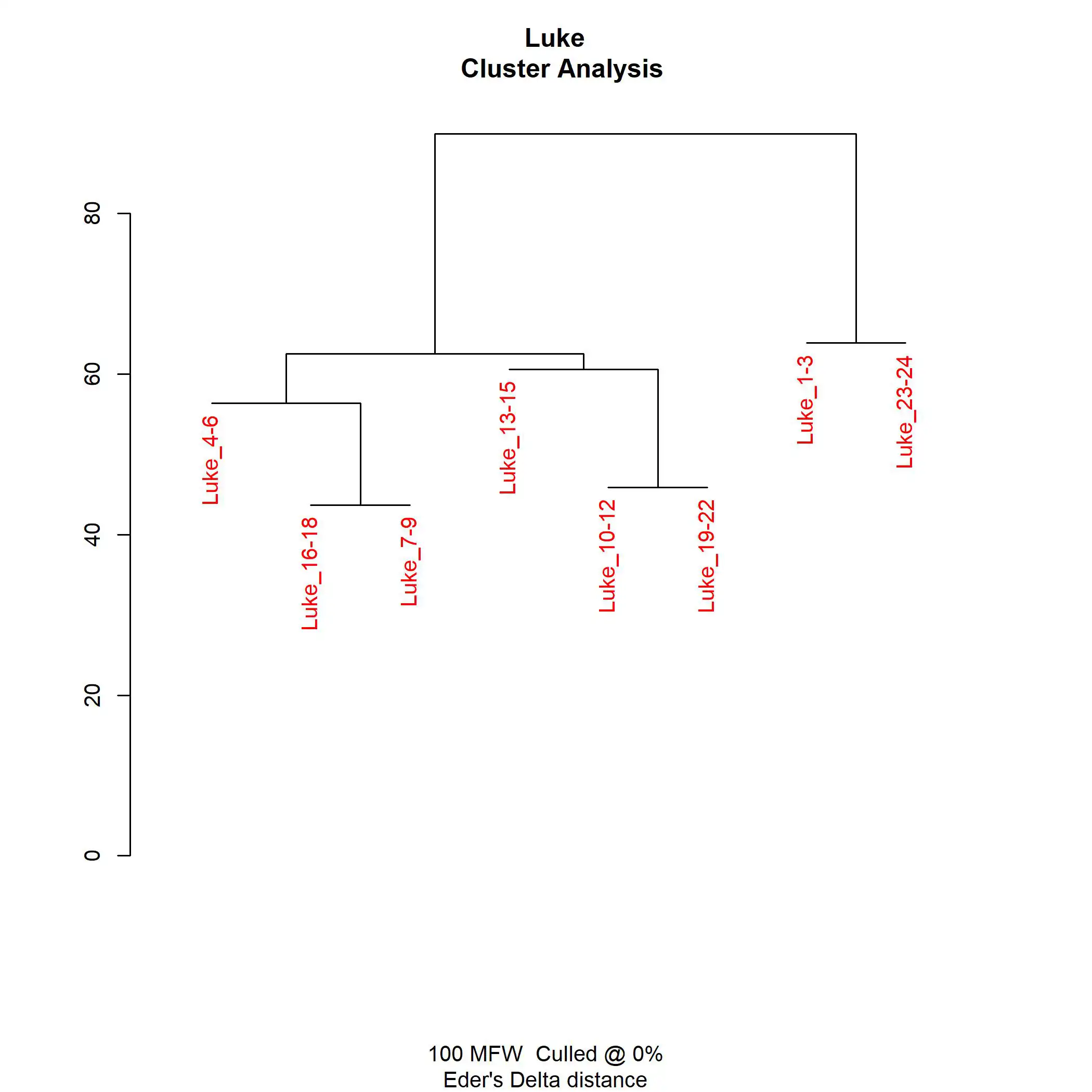
Luke compared to Acts
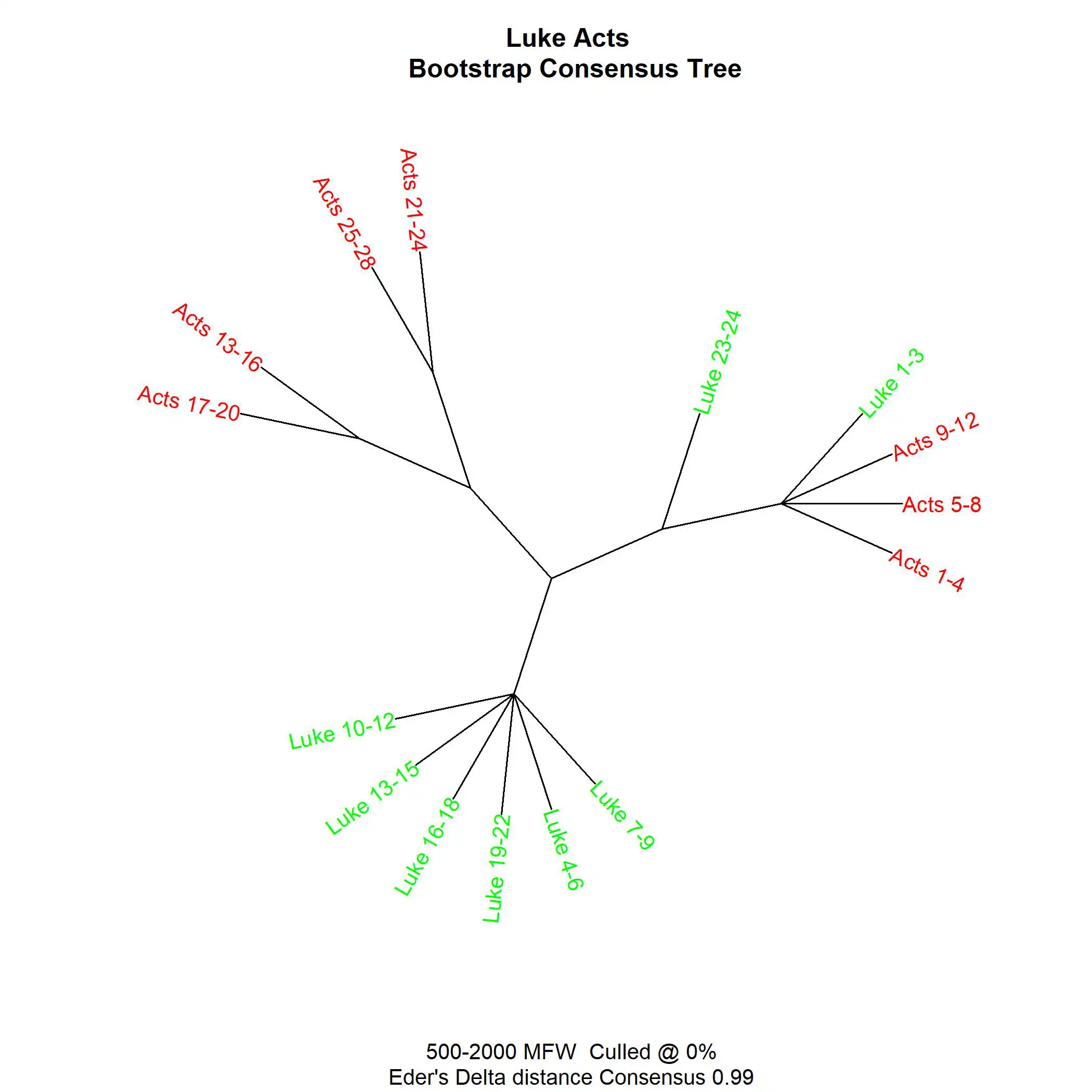
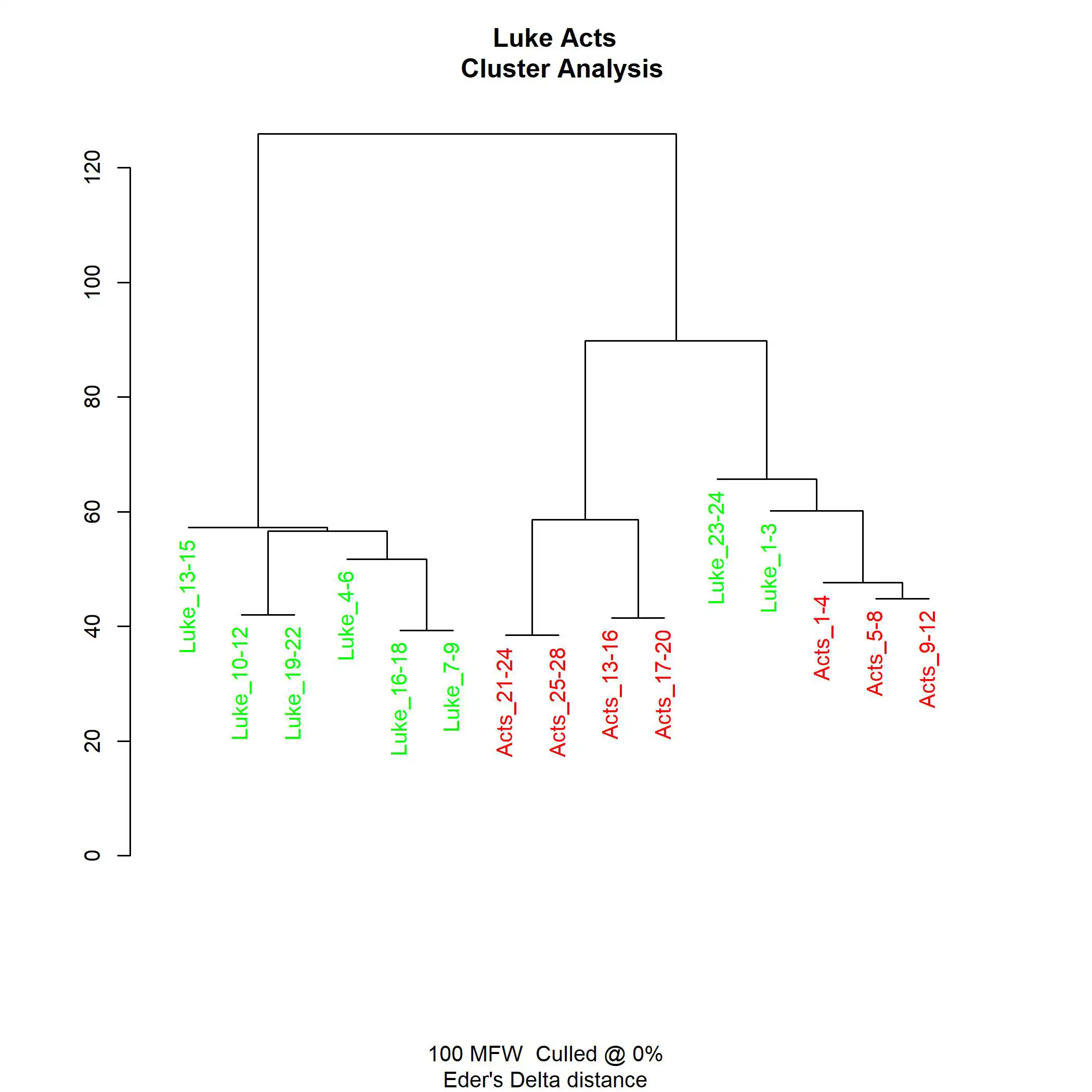
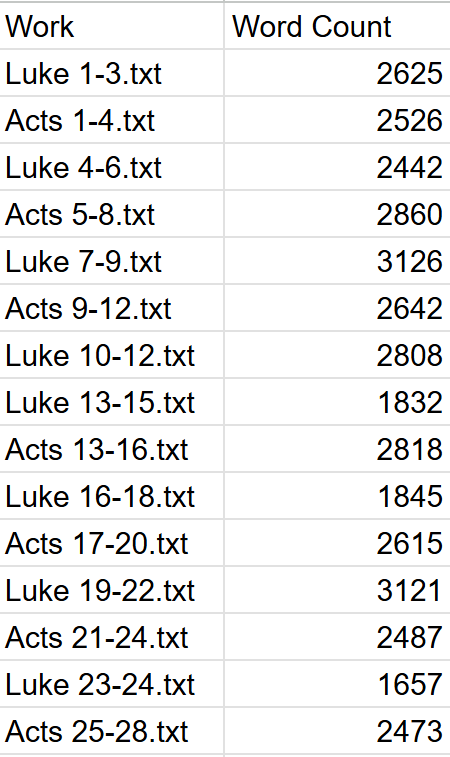
Who wrote most of Luke?
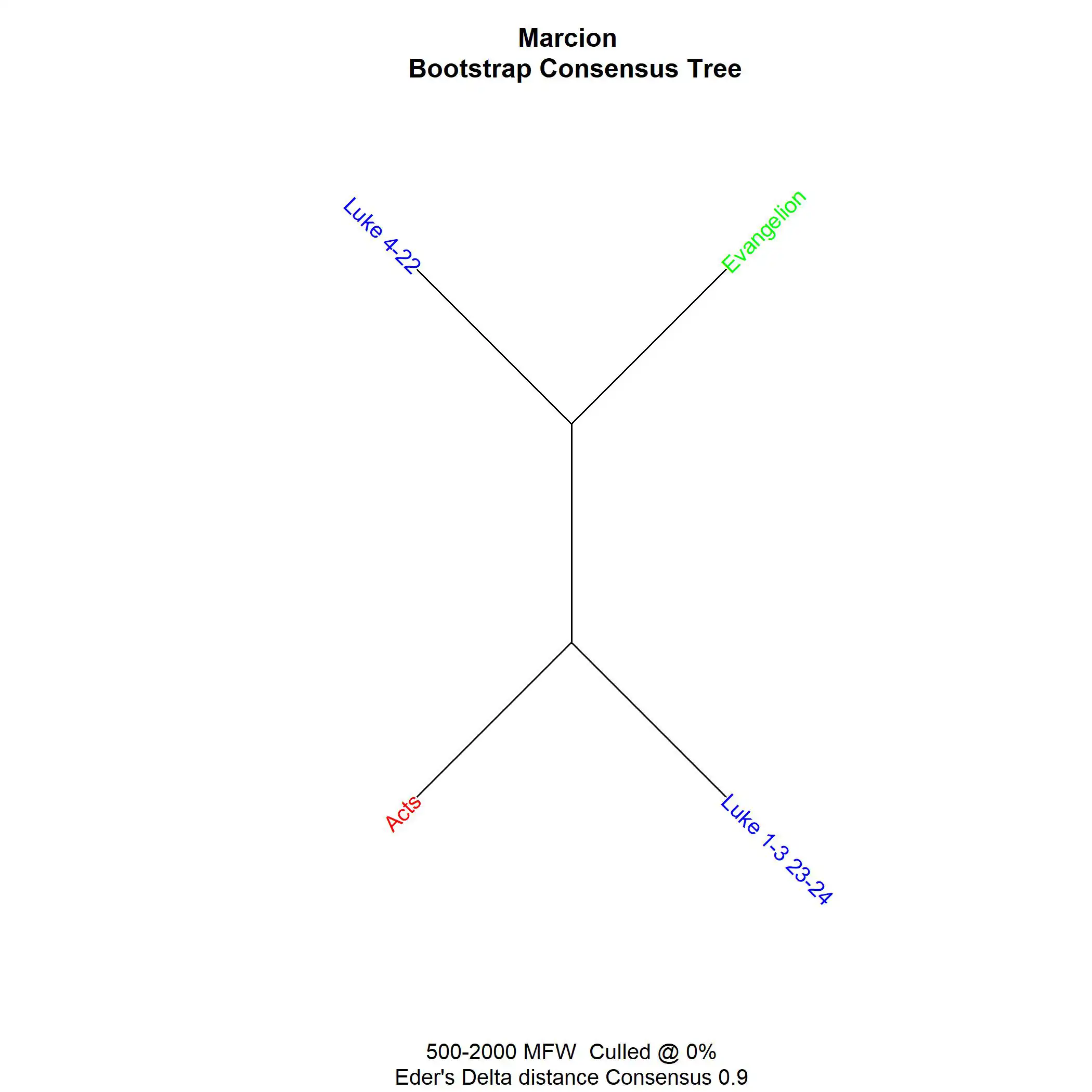
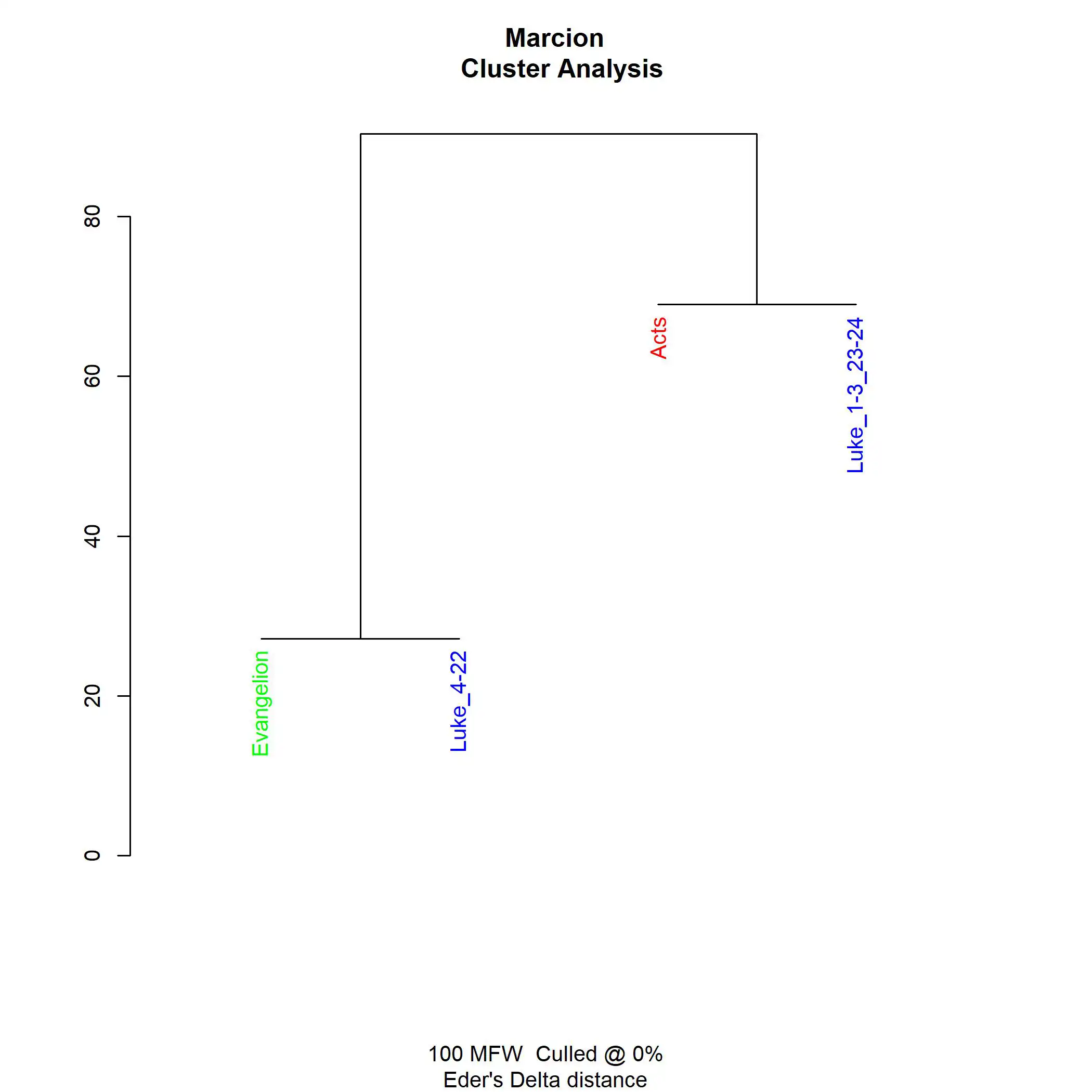
- Melito of Sardis (100CE-180CE) was a Christian convert with Jewish and Hellenistic roots. Most of his works have been lost but he was quoted by Eusebius, Clement of Alexandria, and Origen.
- Hegesippus (110CE-180CE) he arrived in Rome around 157CE-168CE and wrote around 174CE-180CE.
- Tatian the Syrian (120CE-185CE) was a convert to Christianity and was expelled sometime after 165CE for his ascetic and gnostic views.
- Polycrates of Ephesus (130CE-196CE) he came from a family in the center of Christianity. Seven of his relatives were Bishops. He states in his letter to Victor around 186CE-195CE that he has served the Lord for 65 years.
- Irenaeus of Lyon (130CE-202CE) who grew up in the Church. He wrote Against Heresies around 180CE to refute Gnosticism, promote Monotheism in books 1 and 2, counter Marcion's dual-god belief in Book 3, and names the Gospels.
- Athenagoras of Athens (133CE-190CE) was a convert to Christianity. He wrote Legatio Pro Christianis to Marcus Aurelius around 176CE-177CE. There are only two mentions of him in early Christian Literature.
- Clement of Alexandria (150CE-215CE) writes between 195CE-203CE, outside the potential range. However, he does use phrases similar to "most excellent."
"Genuine" Pauline Epistles
The Most Frequent Words (MFWs) parameter was set to 200, as the computational analysis in Stylo relies on word usage frequency. This parameter selection is informed by the observation that the majority of the files (excluding Philemon) average fewer than 200 unique words across their chapters. Targeting this average effectively eliminates rare terms that appear only once or twice with single-use vocabulary accounting for approximately 10% of total unique words, while preserving high-frequency vocabulary. This configuration yields satisfactory analytical outcomes and doubles the default baseline setting of 100 MFWs.
Here is a tab separated value (.tsv) file with all of the word counts per chapter and book. It is broken down by 20 words per row. In all of the examples 200 words (10 rows) retrieves all of the words used multiple times and words that are only used once, and in some cases all of the words in the chapter itself.
A chart for Philemon is not included since it is only one chapter.
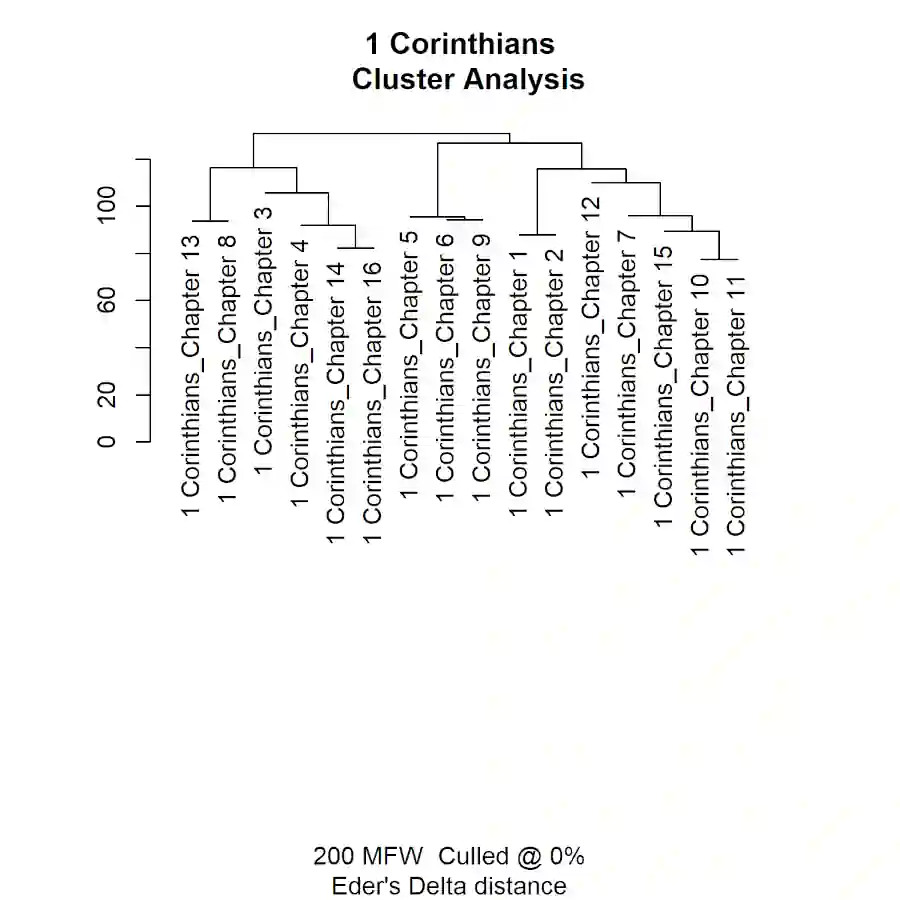
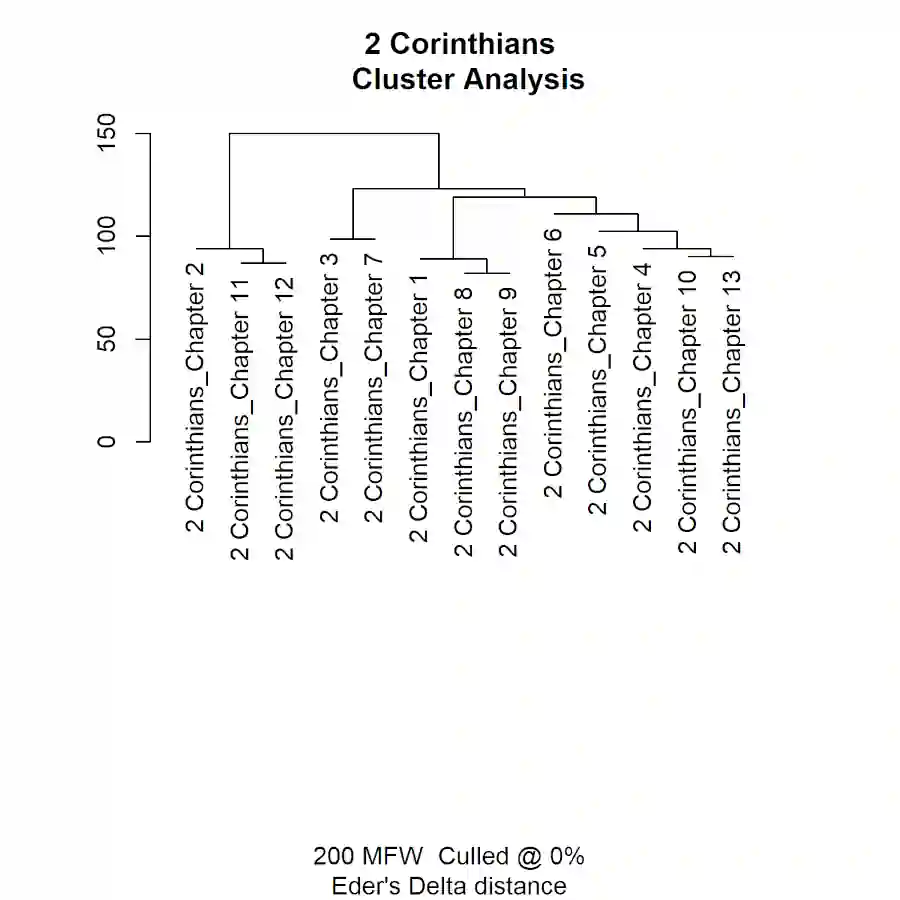
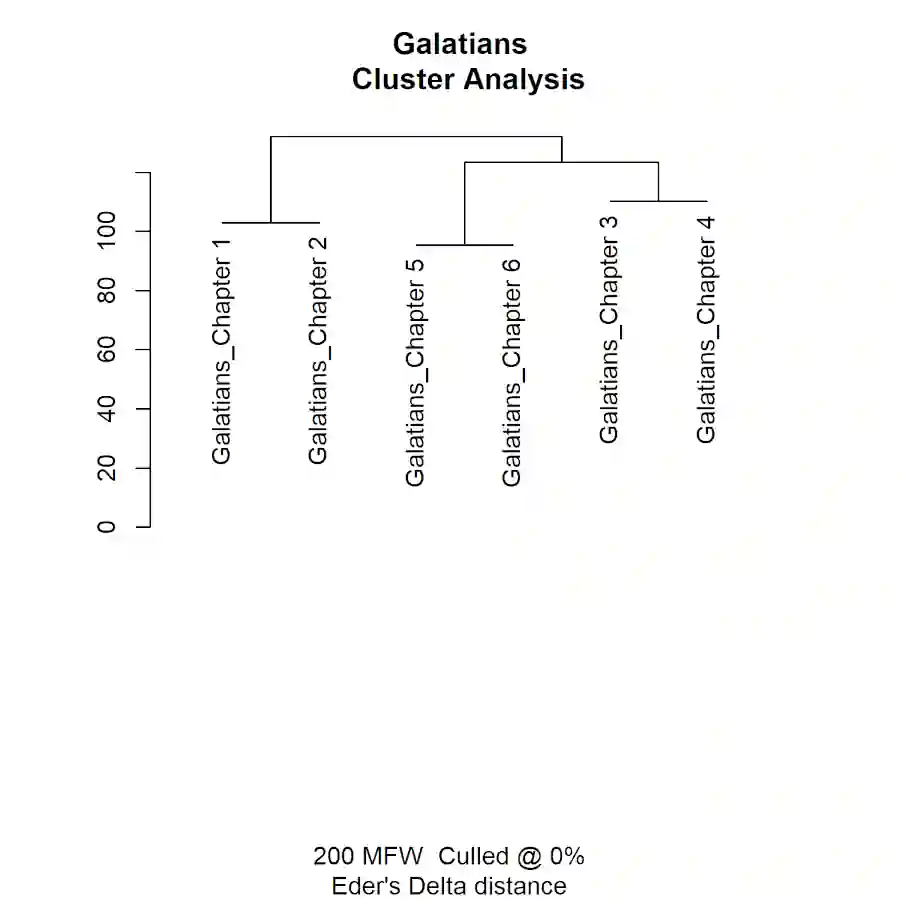
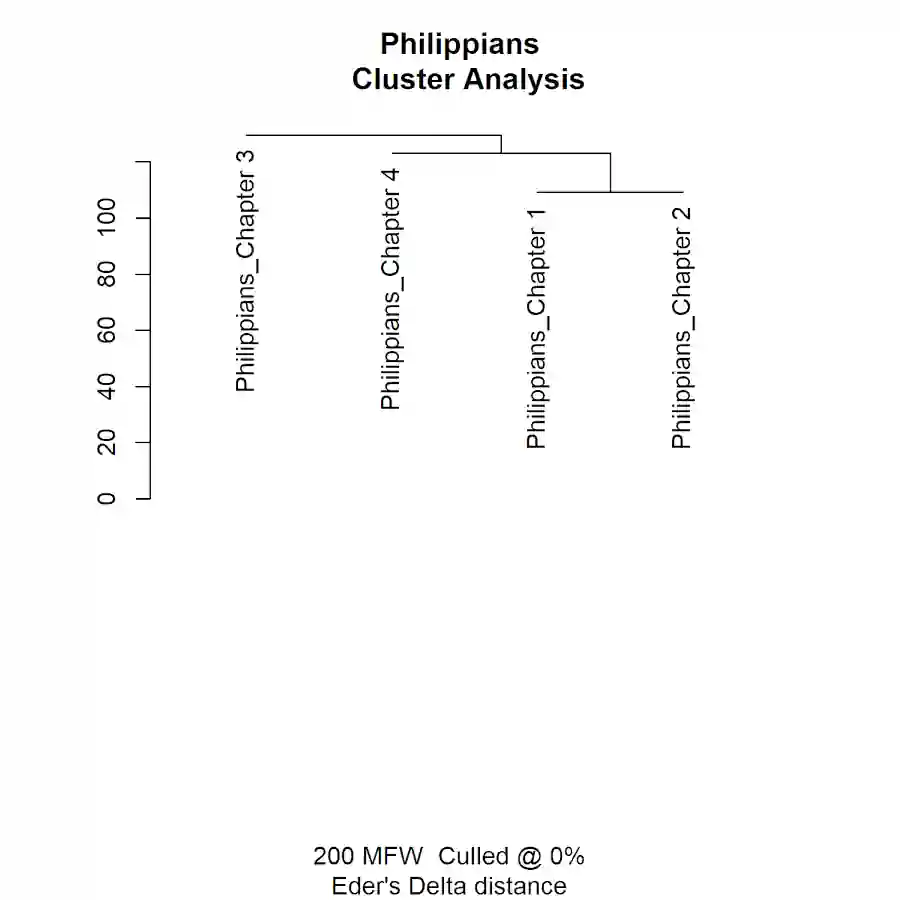
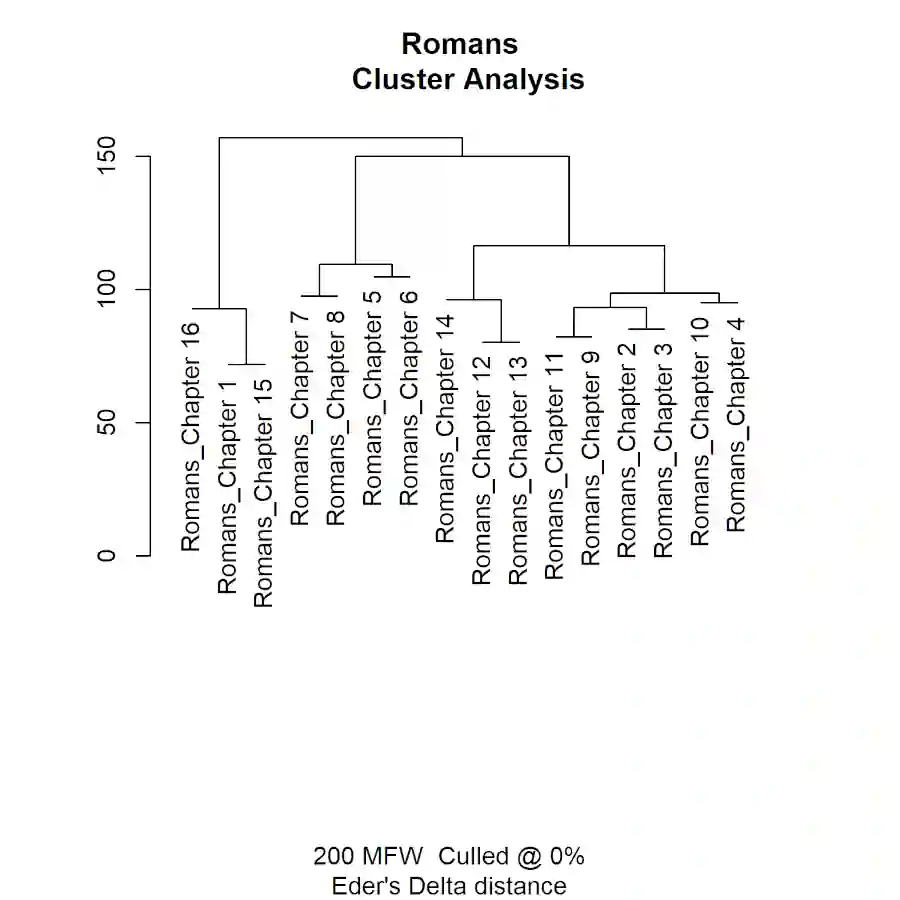
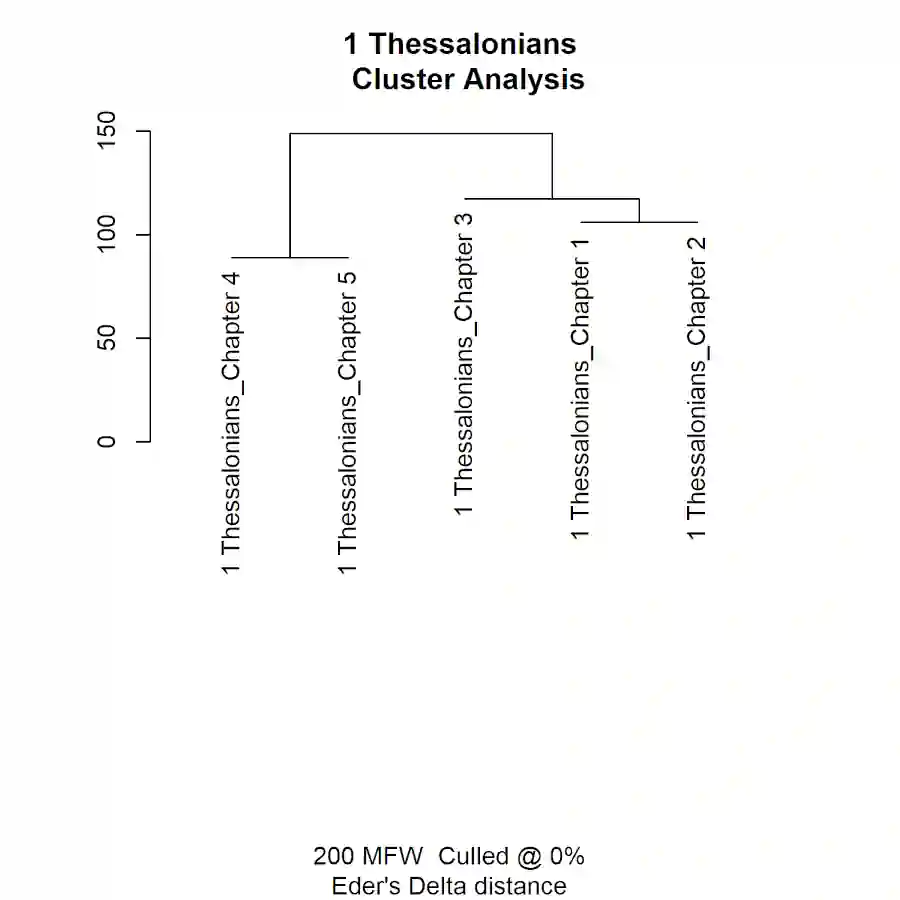
Epistle Data
| 1 Corinthians | |
|---|---|
| Chapter 1 | 500 |
| Chapter 2 | 287 |
| Chapter 3 | 340 |
| Chapter 4 | 345 |
| Chapter 5 | 221 |
| Chapter 6 | 334 |
| Chapter 7 | 688 |
| Chapter 8 | 226 |
| Chapter 9 | 449 |
| Chapter 10 | 463 |
| Chapter 11 | 529 |
| Chapter 12 | 465 |
| Chapter 13 | 197 |
| Chapter 14 | 606 |
| Chapter 15 | 843 |
| Chapter 16 | 323 |
| Total Words | 6816 |
| Avg Count | 426 |
| Total Unique | 2136 |
| Avg Unique | 133.5 |
| 2 Corinthians | |
|---|---|
| Chapter 1 | 490 |
| Chapter 2 | 285 |
| Chapter 3 | 296 |
| Chapter 4 | 320 |
| Chapter 5 | 338 |
| Chapter 6 | 266 |
| Chapter 7 | 328 |
| Chapter 8 | 410 |
| Chapter 9 | 284 |
| Chapter 10 | 311 |
| Chapter 11 | 500 |
| Chapter 12 | 412 |
| Chapter 13 | 236 |
| Total Words | 4476 |
| Avg Count | 344.3 |
| Total Unique | 1526 |
| Avg Unique | 117.38 |
| Galatians | |
|---|---|
| Chapter 1 | 364 |
| Chapter 2 | 385 |
| Chapter 3 | 455 |
| Chapter 4 | 444 |
| Chapter 5 | 313 |
| Chapter 6 | 267 |
| Total Words | 2228 |
| Avg Count | 371.33 |
| Total Unique | 920 |
| Avg Unique | 153.33 |
| Philippians | |
|---|---|
| Chapter 1 | 503 |
| Chapter 2 | 431 |
| Chapter 3 | 337 |
| Chapter 4 | 357 |
| Total Words | 1628 |
| Avg Count | 407 |
| Total Unique | 713 |
| Avg Unique | 178.25 |
| Romans | |
|---|---|
| Chapter 1 | 545 |
| Chapter 2 | 449 |
| Chapter 3 | 428 |
| Chapter 4 | 399 |
| Chapter 5 | 432 |
| Chapter 6 | 367 |
| Chapter 7 | 467 |
| Chapter 8 | 652 |
| Chapter 9 | 525 |
| Chapter 10 | 338 |
| Chapter 11 | 578 |
| Chapter 12 | 304 |
| Chapter 13 | 270 |
| Chapter 14 | 379 |
| Chapter 15 | 541 |
| Chapter 16 | 383 |
| Total Words | 7057 |
| Avg Count | 441.06 |
| Total Unique | 2146 |
| Avg Unique | 134.12 |
| 1 Thessalonians | |
|---|---|
| Chapter 1 | 213 |
| Chapter 2 | 390 |
| Chapter 3 | 247 |
| Chapter 4 | 309 |
| Chapter 5 | 317 |
| Total Words | 1476 |
| Avg Count | 295.2 |
| Total Unique | 589 |
| Avg Unique | 117.8 |
| Philemon | |
|---|---|
| Chapter 1 | 336 |
| Total Words | 336 |
| Avg Count | 336 |
| Total Unique | 204 |
| Avg Unique | 204 |
All Epistle Chapters Compared
The dendrogram encompassing all chapters of the Epistles reveals three main clusterings, with two exhibiting a higher degree of proximity to each other than to the third. Additionally, two to three sub-clusters are identifiable within these primary groups. Cross-collaboration is evident in Romans and Galatians between the top and middle clusters, whereas the initial and concluding sections of Romans appear to have been expanded by the most distant group. The top cluster accounts for the majority of 1 Corinthians, while the middle cluster is predominantly associated with 2 Corinthians. The bottom cluster of writers is exclusively responsible for, or provided the mojority via expansion to 1 Thessalonians and Philemon, as well as the larger portion of Philippians. This is consistent with Dr. BeDuhn's reconstruction containing a shorter version of Philippians that was subsequently expanded by the bottom group. It is demonstrated that they were responsible for the majority of the contents of chapters 1, 2, and addition of a 4TH chapter. The dendrogram reveals there is enough of the original text in chapter 3 that the authorship is placed into the first group. This is consistent with the pattern observed in Romans and the opening chapter of 1 Corinthians. This finding, combined with the substantial distance separating it from the other clusters, indicates that the bottom group introduced its additions and revisions subsequent to the work of the former two groups.
An examination of the consolidated dendrogram reveals that the majority of chapters maintain their structural proximity relative to the independent analyses, though certain deviations occur when the full corpus is integrated. These shifts signify a deeper lexical affinity with the later additions than the initial metrics suggest when evaluating individual epistles in isolation. Such patterns not only distinguish the presence of various contributors but also uncover a deliberate effort to harmonize these later insertions with the stylistic precursors. While these collaborative layers may remain obscured at the specific chapter level, the full comparative synthesis renders these editorial nuances distinct.
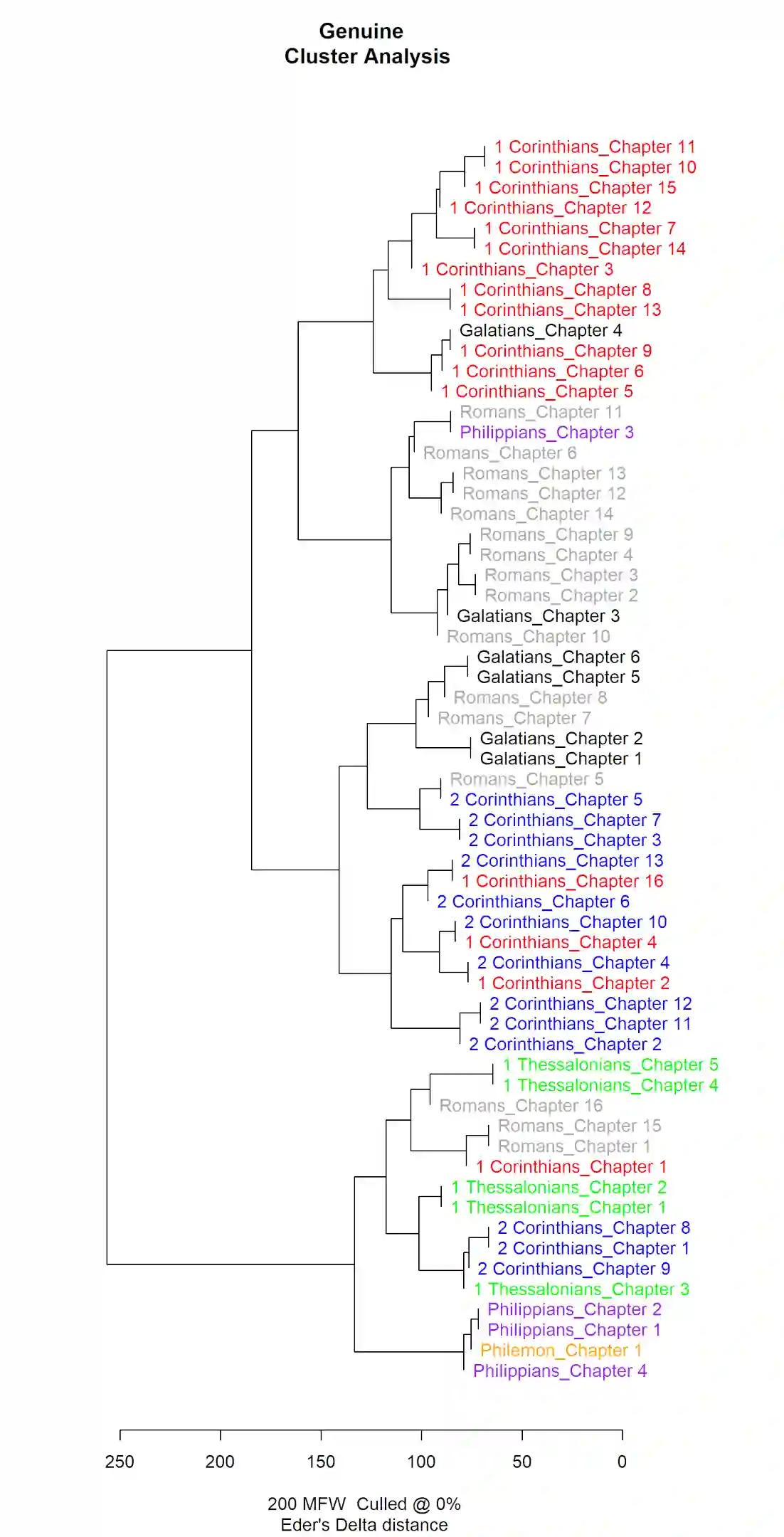
Stylo citation
a package for computational text analysis. R Journal 8(1): 107-121.
<https://journal.r-project.org/archive/2016/RJ-2016-007/index.html>